
Geographically Distributed Backups for Enhanced Data Protection

distributed_backups_SiteGround

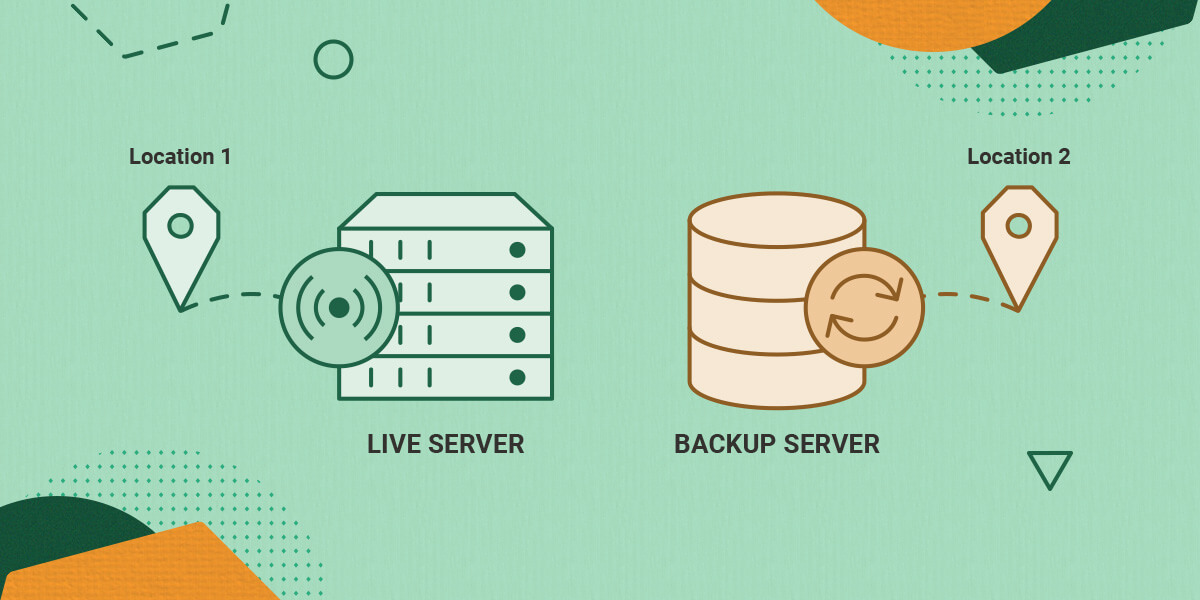
We are excited to announce that as of this month, we have deployed a system for geographically distributed backups, which minimizes the risk of data loss and аllows for fast data recovery even in case of a serious incident that may affect a whole data center. 

Backups are stored in a different physical data center from the one hosting the live account

As of this month, we started backing up accounts in a data center different from the one hosting the live account as follows: 

  • Iowa, US servers are backed up on machines in Virginia, US
  • Virginia, US servers are backed up on machines in Ohio, US
  • California, US servers are backed up on machines in Oregon, US
  • Texas, US servers are backed up on machines in Southern Carolina, US
  • London, UK servers are backed up in Eemshaven, NL
  • Frankfurt, DE servers are backed up in Eemshaven, NL
  • Madrid, ES servers are backed up in Eemshaven, NL
  • Eemshaven, NL servers are backed up in Frankfurt, DE 
  • Sydney, AU servers are backed up in Singapore, SG
  • Paris, FR servers are backed up in Madrid, ES

This service is not available for accounts hosted in Singapore for now. These accounts are backed up on different servers within the Singapore facility.

Enhanced data protection

Data storage and safety is a key component of our service and there are multiple risk factors and threats that we keep in mind when coming up with data security solutions. The most common ones are human errors, hardware failure, and hacks. For those occasions, we rely on our daily backups stored on different servers independently from the live account. But then, there are the less likely, yet more damaging risks such as fire, power outage, or a natural disaster that may shut down a whole data center facility. Hosting the backups in a different location means we improve the chances of saving your data and putting it back online even in case of such a serious incident.

Faster service restore

Now imagine your website goes offline due to a massive power outage and the ETA is unknown, which most often means hours of downtime. Or, a hurricane completely destroyed the facility and all servers are lost beyond recovery. That was a very real threat we experienced with Katrina hurricane back in 2005 and is a growing risk in some areas given the climate change and the growing number of natural disasters all over the world. Or, maybe a fire burns the datacenter and a lot, if not all, servers are hurt. That one happened quite recently to a third-party data center in France.

Thanks to our new system, we now have you covered since we have your data safely backed up not more than 24 hours ago in a different data center. In case of an incident, we would be able to put your website back online in the new location that is fully operational.

Thus the distributed backups not only save your data but allow us to restore service in the new DC much faster than any optimistic ETA would forecast for restoring in the original DC.

The distributed backup strategy has been something we have considered for a long time. However, it became practically possible once we started to use the Google Cloud infrastructure. The use of one and the same provider for all our geographical locations, with a super fast interrelatedness between its different data centers and a wide network of facilities around the world, allowed us to distribute data across regions, countries, and continents in a way that was not possible before.

We have to recognize the fact that before switching to Google Cloud infrastructure that strategy for distributed backups was not possible in such a sophisticated way. Google Cloud has given us easy access to all their worldwide facilities, including networking capacity and that generated various new possibilities to distribute data across regions, countries, and continents.

Same level of data privacy

Our Privacy Policy and DPA continue to apply in light of our new geographically distributed backups. Our clients’ data will be protected in the same way as before, as promised, and under our DPA.

While we are hopeful that no natural forces will affect any data centers, our team prefers to be prepared for the worst and provide our clients with reassurance for their websites.

[subscribe_cta]

Green Web Hosting And SiteGround’s Commitment To Sustainability

Data centers play a big role in the Internet industry: they store, process and deliver all the websites’ information on their non-stop running servers. They are usually part of massive facilities which need a controlled and artificially-cooled environment to run properly. That requires a huge amount of energy, indeed, according to recent studies, global data centers are estimated to consume 1% of global electricity use, issuing high quantities of CO2.

As an international hosting provider that manages more than 2 Million domains and 5PB of data, we are fully aware of this impact on the environment and it is in our hands to actively mitigate it by committing to provide green web hosting services as much as possible. From designing our hosting operations and services with the highest efficiency in mind, to implementing several policies that support an environmentally-friendly mindset, we take it seriously because we truly care.

Since today is Earth Day and we want to celebrate that day with joy and gratitude, it seemed relevant to give you some background on what it means to be a green web hosting provider, what to keep in mind when choosing one, and what actions SiteGround is taking towards sustainability.

What is green web hosting and how hosting providers can mitigate their environmental impact?

Green web hosting means that the hosting provider is committed to contribute towards the health of the environment and proactively takes eco-friendly actions that involve either carbon offsetting or renewable energy usage in order to reduce or mitigate the environmental impact of their servers’ energy consumption.

There are two main actions a hosting provider can take on the way to offering green hosting service:

  1. Use renewable energy to power up their data centers and facilities. This means that the electricity they use comes from natural resources that are replenished naturally, such as sunlight, wind, rain, tides and geothermal heat.
  2. Buy carbon credits. With this option, the company can buy a permit to emit one ton of carbon dioxide per credit or its equivalent of any other greenhouse gas with the aim to offset their carbon footprint.

As the internet industry evolves, so does the amount of energy and resources needed to process all the operations that the content storage and traffic implies. Choosing a hosting provider which is actively running actions towards better efficiency of their data centers and fostering initiatives to reduce their business environmental footprint is becoming ever so important, as it all makes a great impact on climate change, in addition to having several advantages for you. Three of the main ones are:

  • Carbon footprint reduction of your e-business and online operations, since green hosting providers usually opt for renewable energy usage or buy carbon credits.
  • Better efficiency of your website, as their efforts towards sustainability may include the adoption of latest technologies and resources optimization. 
  • Easiness to be part of the green change, as at the very moment you host your website with a hosting committed to the environment, you are already making a difference compared to others in regards to climate change.

Actions SiteGround is taking as a green web hosting provider:

Reducing our carbon footprint by partnering with commited providers

Since we are not a data center provider, and are not operating our own data center facilities, we need to rely on the green policies of our main data center partners. That’s why, a key motivating factor for our decision to move our infrastructure to Google Cloud Platform was their commitment to sustainability. Google’s data centers match 100% of the energy consumed by their global operations with renewable energy and maintain a commitment to carbon neutrality. Choosing such a leader in energy efficiency as our infrastructure partner is something that we are very proud of.

Optimizing resources by providing customers with top-notch technologies for better efficiency of your website applications

Efficiency is another key factor of green web hosting. Simply put, every website operation is managed and executed by its hosting server processor, and requires CPU, RAM, and storage resources. The heavier your website is, the longer its server processor and resources are in use, the more electricity it consumes. 

At SiteGround, we are constantly optimizing our server software to get the most out of our technology and reduce the resource usage of our clients’ websites. As a result, the better optimized our servers are, the less resources and less energy your website will use for the same volume of tasks, making our operations and clients’ websites “greener” thanks to our software performance. For example, our Ultrafast PHP can speed up website performance up to 30%, making it consume proportionally less energy. Our latest RAM optimization of our cloud MySQL setup on our servers additionally increases client websites’ resource usage efficiency. 

We also constantly look for ways to optimize our internal operations for maximum efficiency – for example, performing regular backups at certain hours when the overall server resources usage is relatively low, to avoid putting extra load on the server processors, thus balancing energy consumption. Overall, our policy to always strive to make the latest website technologies available for our clients to use not only helps you reach top website performance, but promotes energy efficiency, as well.

Reducing the environmental impact of our workplace

In early 2019 we finished the building project of the new SiteGround Headquarters building. One of our main goals was for it to be built entirely in accordance with the Leadership in Energy and Environmental Design (LEED) requirements. LEED is the most widely used green building certification in the world, globally recognized as a symbol of sustainability achievement.

SiteGround Headquarters Building is built entirely in accordance with the LEED requirements.

Encouraging a more conscious lifestyle among our team members

In addition to our efforts on a business and company level to become a green web hosting provider, we constantly try to maximize our impact by encouraging every single employee of SiteGround to lead a more conscious lifestyle. We are running several internal initiatives to help us do that:

  • Company E-cars, e-bikes and free e-charging stations at the disposal of our employees during work hours or for running small errands. Following this benefit, we saw more colleagues opting for electric cars in their own households and others seriously considering it!;
Company E-cars are at the disposal of our employees during work hours.
  • No plastic water bottles, containers, or water coolers in the office: we installed water filter dispensers across all our offices to replace plastic use due to daily water consumption;
  • Using custom green-friendly tissue for our company gifts: For all SiteGround-branded gifts and packages that we send to employees and partners, we use a custom-design eco-packaging by Noissue’s Eco-Packaging Alliance. For every order made they plant a new tree, contributing to global reforestation and carbon neutrality;
  • Our last (for now) team building event in 2019 was dedicated entirely to the Zero-waste idea, which was reflected not only in all team workshops and activities, but across the whole event organisation, banning single-use plastics, separating and recycling all our waste from the event, etc.

Having in mind all of the above, we are fully aware that sustainability is a process – it starts with an intention and only goes on and improves with time. We will continue looking into adding even more meaningful actions to continue delivering green web hosting features. But the future depends on all of us. We all need to realize that our personal choices have public consequences, and be more conscious about what we can do in order to sustain our business or way of life, but in a way that is also considerate for the environment.

In addition to us sharing our efforts towards sustainability, we’d love to hear from you! Share in the comments below what you are individually doing to achieve a greener way of living, working, and doing business. It is always comforting to know every single step that is done at every level, as when put all together, they will sum up to turn into a big leap towards mitigating environmental issues.

[subscribe_cta]

Optimizing the RAM Utilization by the MySQL on the Cloud

Over the last 6 months, it has been all about speed at SiteGround. We have boosted the performance of the websites hosted with SiteGround up to 5 times by launching the new Ultrafast PHP and MySQL setups and enabling the dynamic cache (full page caching) for all sites. As a next major step in this process, we have turned our attention to our cloud servers and are glad to announce that we rolled out a new dynamic RAM-allocation algorithm that further improves the resource utilization of the MySQL and makes the database-intensive websites hosted on our higher cloud plans run faster. 

What is the problem with MySQL?

MySQL could be a real troublemaker. When left untamed, it devours resources and keeps asking for more. If it doesn’t get what it wants, it starts slowing processes one after the other and turns into a bottleneck for database-driven apps like WordPress. So the MySQL settings are the key to resolving many of the site slow issues reported, but many webmasters have difficulties tracing the origins of the slow performance. It is not just a question of adding more RAM. This RAM should be smartly utilized in a way that allows MySQL to run as fast as possible, but still to be restrained from eating up all the available resources.  

We have been helping clients with evaluating what is an optimal allocation of RAM to the MySQL given the specific services running on the website and the available specs and manually resolving those case by case, but, now we have come up with a way to automate that and diminish the amount of work and expertise required by our clients in the process.

What have we done?

We have implemented a dynamic configuration that depends on the amount of memory your Cloud account has. This means that MySQL settings will be adjusted depending on the available resources. We will not only start new Cloud instances with predefined configurations, but in case of an Automatic Scale event (or upgrade), the server config will adjust itself for optimal resource utilization without manual intervention.  That means that database queries will be processed faster and the I/O usage will be lower. Last, but not least, the additional RAM you add will now be utilized more efficiently, and even fast-growing sites will have to add less of it less often and thus save on their hosting expenses.  

Who Gets It?

The new system is already deployed on all Cloud servers! You don’t need to enable it or otherwise configure it. Just watch out for performance improvements and do let us know your feedback. The more database-intensive your site is (such are, for example, membership sites, online stores, forums, etc.), the bigger the improvement from the change will be!

[subscribe_cta]

All SiteGround Accounts are Now Using Site Tools

Mission Accomplished! The last one of our cPanel servers was switched to Site Tools yesterday. We are so excited to see this long and complex migration come to an end as now each and everyone of our customers is safely brought to the new era of SiteGround development. A year and a half ago we started the transition from a 15-year old server setup, dominated by third-party software that was inevitably putting reins on many of our boldest dreams, to the new state-of-the-art hosting management platform, driven by our own unique server software. Since we launched our first server on the new platform in 2019, we were finally able to unleash the full potential of our imagination and we have already created a lot of speed, security and usability improvements that would have never been possible with the old platform. And, we know that the best is yet to come!

The idea and vision for our new cutting-edge platform was born about 4 years ago and soon after, we dived into building SiteGround’s Site Tools and new Client Area. We started onboarding new clients to it in the summer of 2019, but switching all our existing clients was a hugely complex task that took us another 1.5 years and tons of hard work. Here’s a glimpse of all the effort that went into this complex migration process to explain why this is such a milestone and a proud moment for us.

Large Number of Accounts and over 3367.46 TB of Data Migrated 

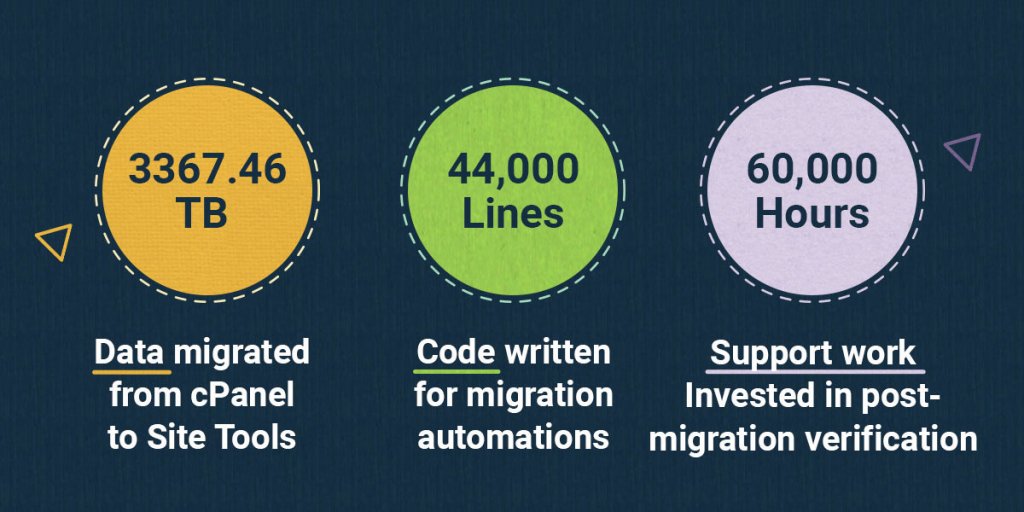
The huge amount of live hosting accounts and website data that had to be transferred from servers with cPanel to servers with Site Tools setup was a fundamental part of the challenge. Performing such a massive operation successfully required a meticulous organization of manpower and resources. During the past 1.5 years our management team spent countless hours coordinating teams and shuffling resources to ensure that we are migrating away from cPanel in the fastest and safest way possible for our clients. To sum it all up, we transferred a total of 15 774 servers with 3367.46 TB of data on them in the period from September 2019 to April 2021, and that is a huge deal! 

A Multitude of Use Cases and 44,000 Lines of Code Written for Migration Automations

Besides the large volume of data, the second biggest challenge was the multitude of edge cases that had to be reviewed and addressed with a solid technical solution – multiple applications set to use absolute paths in their configuration; websites with either addon, parked or subdomain infinite setup option; multiple addon domains using the same database; and more! Our DevOps, Software Engineers and Technical Support teams all had to dig deeper into identifying, analyzing, and providing a solution for each of those cases. Once we identified them and crafted an efficient solution for each, we got to automate it. Our DevOps would write scripts for pre-migration checks to detect matching potential issues on a server, call special migration rules for them, and then run post-migration checks to make sure nothing was broken. If anything did go wrong, we would audit the scripts and get back to coding to improve them. In addition, in case of any issues with the automations, our Technical Support representatives would take over by running manual website checks and fix them.

We had 35 of our experts in charge of writing migration scripts, iterating, testing, and enhancing their code over and over until we made them as fast and efficient as possible. Together, these dedicated professionals lived and breathed this project every day, writing 44,000 lines of code in total to get us where we are today.

Our Best Record: 8985 Accounts Migrated in One Day 

In the beginning, we were shyly moving at a few hundred account transfers per day with a high fail rate, meaning we had to go over many of them manually and fix any issues that might have been caused by the migration. Thanks to the constant improvement of our scripts and our admins’ growing expertise, we managed to speed up the process tremendously and drop the fail rate significantly. It all led up to our record-breaking day – March 7, 2021 when we migrated 8985 accounts in a single day!

60,000 Hours Invested in Manual Post-migration Verification

Another big challenge was our determination to move all of the accounts in the shortest time possible without affecting the availability and functioning of the sites. As explained above, manual checks were an intrinsic part of the process, no matter how much the fail rate was dropping. We counted 60,000 human hours in total distributed among 160 000 accounts that were audited for post-migration issues and manually fixed after.

So many new features now available to all!

On behalf of the whole SiteGround team, make yourself at home with Site Tools! Here’s a short overview of the new features you will enjoy:

  • Easy multiple website management under one login, 
  • Seamless team work by adding website collaborators,
  • One-click transfers of ready-made sites to your clients,
  • Giving your clients  white-label access to their websites’ Site Tools, 
  • Interfaces designed in line with accessibility standards,
  • Faster MySQL setup,
  • Unique Ultrafast PHP setup,
  • Top speed technologies being implemented much faster on the Site Tools servers such as Brotli compression, support for the Webp image format, and more.

We are truly excited and proud of being able to provide so many new features and service improvements to all our customers in such a short time. Despite the adversities, we have proven once again that even the most ambitious goals and complex processes can be successfully mastered when the best team runs a tight ship, paddles in the same direction and gets the best source of motivation – the trust of all our beloved clients and the desire to deliver the best customer experience!

[subscribe_cta]

We Are Turning 17 And This Is How We Have Matured

SiteGround_17_Birthday

Turning 17 is exciting for everyone, even for a hosting provider! And today, March 22, 2021 marks our 17th Birthday! During these years we managed to keep our enthusiasm and spirits just as high as that of a high school senior, but gain even more experience. In this past year alone we matured tremendously, having been through a lot of changes and facing challenging times that made us stronger and better than ever before, especially in terms of our service and commitment to our communities and those who were in need during the COVID-19 crisis. What helps us celebrate and enjoy this anniversary is knowing that we have done a lot of good work and we want to invite you to join us on a short walk down memory lane.

Enhancing our interfaces for a smooth user experience

Looking back at our beginnings, it is quite impressive how our increasing focus on delivering a top-notch user experience has been reflected in our interfaces. Those days in which website platform, dashboard or control panel were a synonym for complicated routes to follow only suitable for the most technical ones are gone.

SiteGround User Area from 2012 to 2019

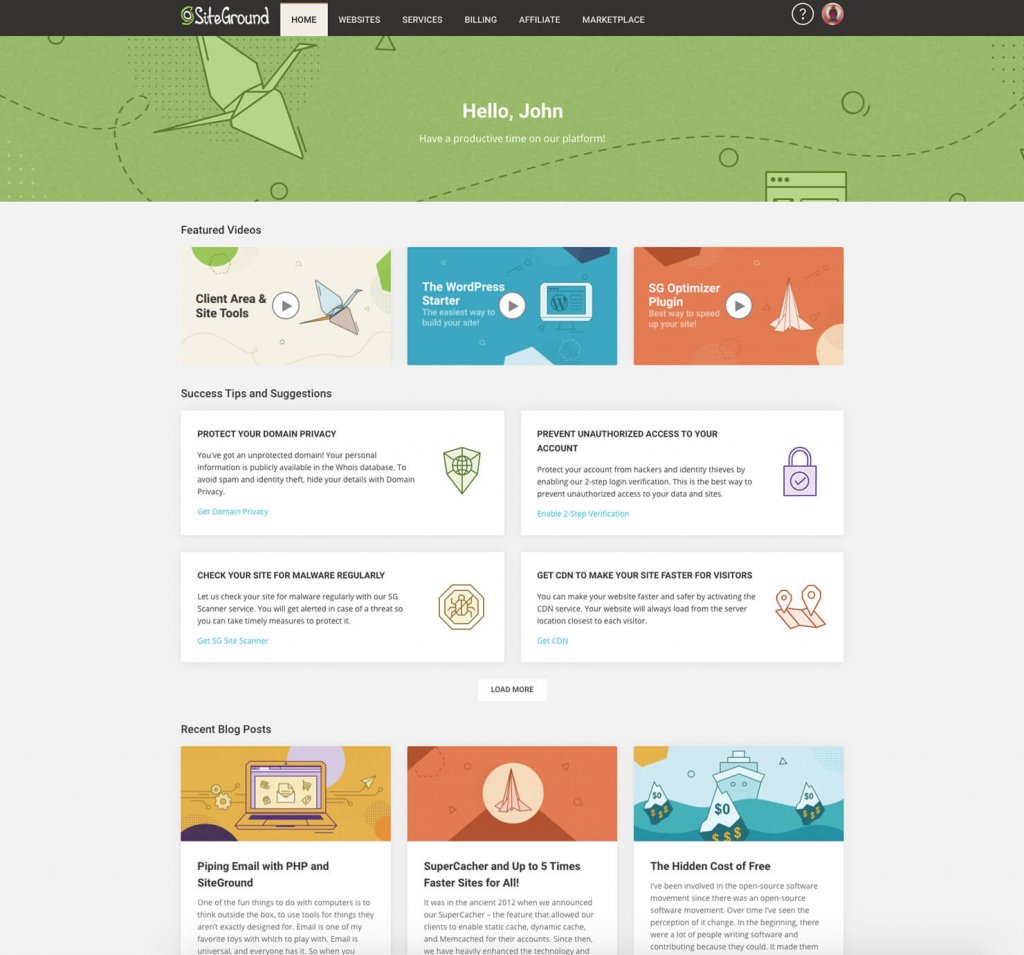
Now with our renewed User Area and Site Tools interfaces, which are already available for ALL clients on our shared hosting servers and almost all of our Cloud ones, the experience of managing a website has become easier than ever and accessible to all.

SiteGround User Area from 2019 onwards

Developing the fanciest, high-quality hosting platform

Our platform has evolved tremendously since when we started back in 2004. Moving from bare metal servers with a pretty standard LAMP setup (Linux-Apache-MySQL-PHP) with cPanel (a control panel used by pretty much every other host out there) to a sophisticated cutting-edge platform with in-house developed technologies and a unique control panel is our pride and joy.  Our clients now enjoy one of the fastest and safest hosting services thanks to a unique configuration built over the years by some of the best IT experts. To remind you about a few of the more recent ones:

  • Unique Ultrafast PHP configuration for up to 30% faster sites;
  • Custom MySQL setup to reduce the number of slow queries on our servers;
  • Nginx Direct Delivery for caching of static resources like images and CSS and dynamic caching mechanism now available to all clients for up to 5 times faster sites;
  • The one and only SiteGround Optimizer plugin that allows users to enable tons of performance boosting features on their WordPress sites;
  • An ultrafast Daily Backup System that saves hours in data recovery;
  • AI antibot system to prevent the most obnoxious brute force attacks;
  • Infrastructure powered by Google Cloud that helps us be even more stable, faster and greener, and more…

Maturing as a socially responsible company

Part of growing up means maturing in many different ways. One of the aspects that we are much proud of is how we evolved with regard to our corporate social responsibility. Although we don’t often put our good deeds in writing, nor do we have a corporate page officializing these responsibilities (yet),  we care and we get involved. 

The COVID crisis hit all of us hard both personally and professionally. In a moment when so many people were in need and such a large number of businesses had the urgency to go online, we put all our efforts to help as much as we could with our #StaySafeBeKind initiative, giving free renewals to clients and free accounts to local heroes, donating more than 350,000 EUR to hospitals, and more.

  • Thinking about the environment and creating awareness

Our increasing concern about the environment is like a red light that moves us to sponsor, support and organize various green projects – Zero-waste team building in 2019 (the last one we had unfortunately), partnering with Google Cloud and the importance of their carbon-neutrality program in our decision, building a green headquarters building, buying electric cars for our corporate needs, and more! We act whenever we can because we care.

  • Supporting open source communities

OK, let’s not forget about the open source. Ever since the beginning, we have been involved with various open source communities – Mambo, Joomla, WordPress being the forerunners. We believe in the open source software because it lowers entry barriers and makes technology more accessible and we support it by sponsoring conferences, building solutions for the communities and more.

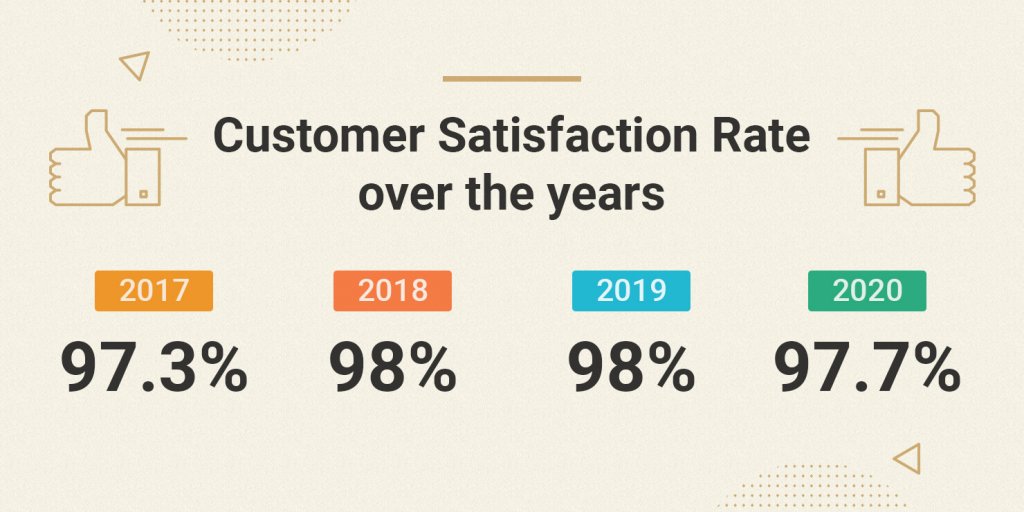
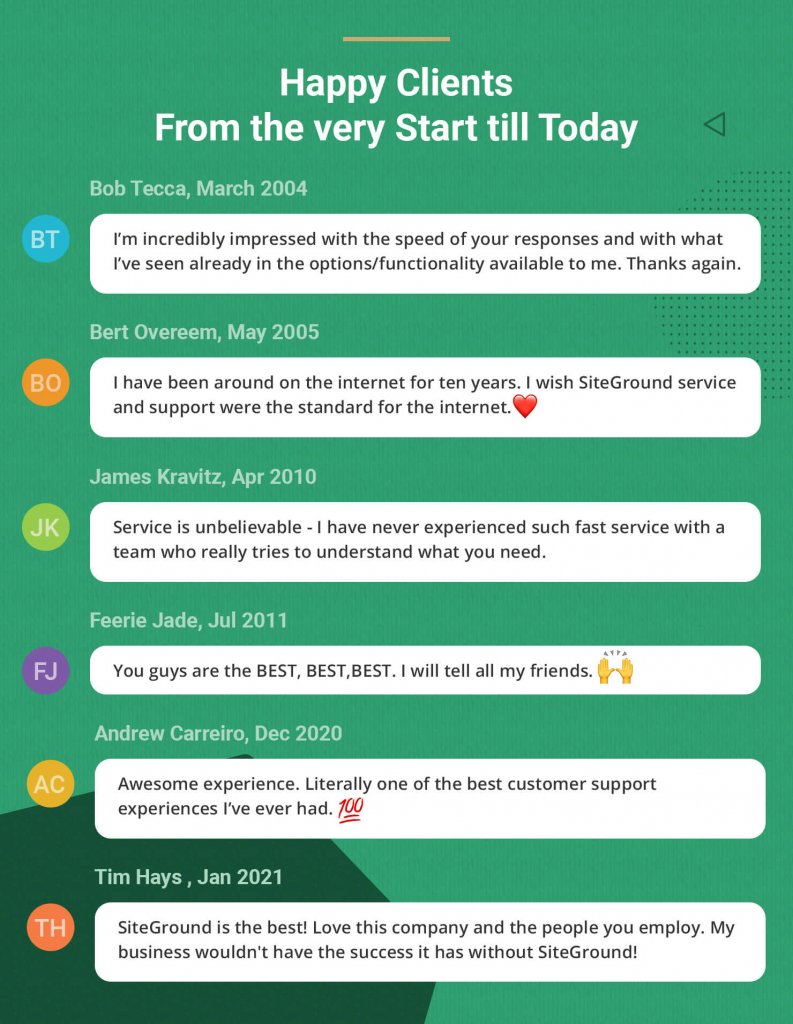
Keeping high client satisfaction rate across the years

There are many things that have changed along our journey, but one has remained unchanged over the years – the high client satisfaction rate

Our commitment to deliver the best service and experience has been strong since our beginnings, and we assure you that it will endure for many more to come.

Time for sharing…

Now that we have shared ours, let’s see what you have got down your SiteGround memory lane 😉. We invite you to comment under this post and tell us some of your best moments with SiteGround. A good story always melts our hearts and help us make this day special!

Last, but not least, we would like to thank all of You for choosing SiteGround as your hosting provider. We couldn’t have made it without you and we hope you join us on this exciting ride to our next anniversary.

[subscribe_cta]

SuperCacher and Up to 5 Times Faster Sites for All!

It was in the ancient 2012 when we announced our SuperCacher – the feature that allowed our clients to enable static cache, dynamic cache, and Memcached for their accounts. Since then, we have heavily enhanced the technology and fine-tuned its behavior and we believe it is one of the most powerful speed tools we have created for our clients. Currently, the most massively used part of our SuperCacher is the Static cache (NGINX direct delivery), as it is switched on by default on all our plans. Today we take a major step that will result in much more massive adoption of the other two SuperCacher layers and will significantly increase the speed of the sites we host. We now make Dynamic Cache and Memcached available at no additional cost on our StartUp plans too. Additionally, the dynamic cache will be activated on our servers by default. 

Dynamic caching ON for everybody!

Between 50% and 500% faster page loading

To briefly recap, dynamic caching is a technology that caches the HTML output of your PHP code. The PHP language is used so that the content of that same HTML is changed dynamically and upon a set of conditions predefined by the web creator. When using cache, next time that a page is requested, the pure HTML will be displayed from the Cache which is in the server’s RAM, as opposed to wasting CPU and I/O resources to read the PHP file from the disk. Thanks to that mechanism the web page loads significantly faster. And by “faster”, we mean like 50-500% faster based on our internal statistics for sites that have it turned on. The bigger the impact we see on heavier sites – those with more products and queries. Once you enable the cache, the pages start loading as fast as your Internet allows it, literally, since the page response is returned instantaneously from the memory of the server.

WordPress cached out-of-the-box, other applications can also be configured

Until now, the dynamic cache has been available on our GrowBig and higher plans and had to be activated by the users through our WordPress SiteGround Optimizer plugin. Now, we are making the cache available on all plans and we are activating it by default on all servers. Thus, all WordPress sites hosted on our platform will be cached out of the box. Additionally, our clients will be able to configure other applications to take advantage of the cache too. For instructions on how to use the Dynamic Cache with some of the other popular applications, you can refer to our SuperCacher Knowledge base articles.

Dynamic cache management options 

As already mentioned, our dynamic cache option will now work with WordPress installations out-of-the-box. However, WordPress users will achieve the best results through the Dynamic Cache controls of our SiteGround Optimizer plugin. The plugin acts as an additional connector between our dynamic cache and the WordPress application. For example, the SiteGround Optimizer tells your server to clean the cache automatically on each relevant content change and it provides you with an easy option to exclude URLs from being cached altogether. You can also turn off the caching through the plugin. 

If you are using another application, you may need to allow the caching from its backend in order to start using it, regardless that it is activated on server level by us.

As for the flush option, if a change on your website is not shown immediately, as the cached version is still served, you may always use the Flush button in your Site Tools. 

Memcached available on all plans to opt-in

Memcached is probably the most popular memory caching system that is used by thousands of database-driven sites, which speeds up these websites by caching results from database queries in the server’s RAM. Thus, if the result of the same query is needed again, it will be instantaneously taken from the RAM, rather than generated again from the Database, which is usually a slower process and requires more computing power.

Memcached is now available on StartUp plans with Site Tools as well. You can enable it from Site Tools > Speed > Caching, look for tab Memcached. However, please bear in mind that you also need to configure your application to use this cache, once you switch it on from our interface. For WordPress, this takes just a click in our SiteGround Optimizer plugin > Memcached control section, for some of the other popular applications you can refer to our SuperCacher Knowledge base articles

Note:

The described changes will affect only our Site Tools based servers. However, in case your account is still on cPanel, don’t you worry – by the end of March 2021 we aim to complete all migrations from cPanel to Site Tools so you’ll also get these SuperCacher enhancements soon.

[subscribe_cta]

New MySQL Setup For Faster Query Processing

Update

We’re currently migrating all our servers to MySQL 8. Learn more about the migration process in our blog post.

Two of the most frequent reasons a site might be slow are unoptimized PHP processes and heavy MySQL queries. Website code optimization is always a crucial part of the constant battle for more website speed. However, webmasters hosting with SiteGround, have always had a reliable ally by their side in this quest.

Recently we have announced the new Ultrafast PHP, which significantly speeds up the processing of PHP scripts and improve the website performance up to 30%. 
As a natural next step in our efforts to offer a premium and superfast service, we deployed a server-side solution to optimise database queries which has already brought down the number of slow queries between 10 and 20 times!

What are slow MySQL queries and why they matter ?

If you are managing an active site with a database, you probably understand that when a visitor enters your site, there are tons of scripts that start running, some of which ask your database for information. For example, if you have an online shop and a visitor is trying to purchase an item, your store should check for its availability in the database and display if it’s possible to be ordered. That check triggers a MySQL query. And depending on how that query is written it may be quite heavy and time-consuming to be processed by the server. For you as a webmaster, these slow queries are a problem because you will be losing clients. You know how visitors drop out of the site when they have to wait longer than 2-3 seconds for a page to load? Well, you get it. For us as your host, we don’t like it when our servers get throttled processing too many slow queries because this means that the CPU and RAM of the machine get blocked and cannot be used for other processes, which are also important for yours and the other websites hosted on the server.

What did we do?

The battle with slow MySQL queries is an ongoing process, which involves both the webmaster and the host. That is why we recently launched a new MySQL setup on our servers, which takes an innovative approach to distributing the server RAM and allocating it to the MySQL. The new setup allows a much higher number of parallel requests to be processed simultaneously and this has a great impact on the effective handling of heavy MySQL queries. So great that the Sys Admins, watching the server load after the new MySQL setup launch, still don’t believe it – they saw a drop in slow queries between 10 and 20 times! 

All of our latest service improvements such as the Ultrafast PHP and now the MySQL setup are possible thanks to two things – the Google Cloud platform and the switch from cPanel to Site Tools. Since moving to Google Cloud, we upgraded our server configurations with more RAM. The RAM unit price is not cheaper, but working in the cloud offers possibilities for better distribution of that resource among different machines. And the fact that we don’t comply with third-party’s software resource requirements such as cPanel, gives us more freedom to innovate. Our DevOps feel empowered to create and keep developing smart technologies that benefit the greater majority of the sites we host spot on!

Who gets it?

Everyone hosted on our shared Site Tools servers already got the new MySQL setup! If you have been seeing an enhancement in the performance for the last week or so, it’s because of the new setup.

That means it’s less likely that you hear from us asking you to fix a slow query and “socially-distancing” your site due to that. Fewer slow queries, faster servers, less hassle for you!


Cloud accounts are also scheduled to receive the new MySQL setup by the end of February, 2021.

Still a SiteGround client on cPanel? We expect to migrate everyone by the end of March 2021 so all you need to do is wait just a little bit longer.

[subscribe_cta]

More Site Speed Gains with Brotli Compression Algorithm

We are happy to announce that we have deployed and enabled by default the Brotli compression algorithm on our Site Tools servers so websites hosted there could get up to 15-20% speed gains from using it. 

What is Brotli?

Brotli is a next generation compression algorithm developed by Google as a successor to the popular gzip method that we’ve had running on our servers for ages. The idea is simple – once your application produces the HTML output of your website and the output is compressed together with all the resources it loads, the data is transmitted over the Internet and then the browser decompresses the content before rendering it. This process significantly reduces the size of data that’s been moved from the server to the visitor, resulting in speed gains multiple times bigger than the milliseconds lost for compression and decompression.

How much faster is Brotli compared to gzip?

The new algorithm provided by Brotli compresses the website into smaller data size, which makes it faster to transfer. JavaScript files compressed with Brotli are roughly 15% smaller than the ones compressed with gzip. HTML files are around 20% smaller and CSS files get around 16% size reduction. Those numbers of course will differ depending on your particular files.

A test with one of the WordPress’s default themes – TwentyTwenty shows that it produces a 19584 bytes of data uncompressed, 6003 bytes compressed with gzip and only 4863 bytes when compressed with Brotli! This means that you get more than 75% reduction in size from uncompressed content and 19.5% from gzip. 

How to use Brotli?

We have enabled Brotli on all our Site Tools servers and if your account is hosted on one of these, your site will automatically take advantage of it. You don’t have to do anything to get it! 🙂 Browsers that support Brotli compression, which are the majority of the browsers now, pass the appropriate “accept-encoding: br” header when performing the request and get the Brotli-compressed content. Older browsers that don’t support it will be served with gzip-compressed data. If you are still hosted on a cPanel server, don’t worry – we expect migrations to Site Tools to be completed by the end of March 2021 so you won’t have to wait long to get it as well.

[subscribe_cta]

Wrapping Up 2020: Service Enhancements, 97.7% Client Satisfaction (& A Gift To You)

2020 was unquestionably a memorable and overwhelming year for all of us. It was full of challenges, worries about staying safe, working, and living in isolation. Throughout a rough year, our team has found comfort and motivation in providing lots of service enhancements to YOU, our clients, and supporting different communities the way we can.

⚙️ New Tools & Service Enhancements

In just 12 months, we managed to introduce many new tools and service upgrades. They make your website faster, help you manage it more comfortably, and give you more resources than before.

Some of the great improvements we did in 2020 are the complete switch to the Google Cloud platform, the development of the Ultrafast PHP setup, many speed optimizers for WordPress sites, the additional resources we added for free to our hosting plans, and more!

Learn more >>

❤️ Support for Communities in Need

Alongside upgrading our service, we also dedicated time and effort to support our communities in their battle with the COVID-19 challenges. We made donations to various medical institutions, gave away free hosting and renewals to highly affected clients, and helped our employees adapt to the new normality of working entirely remotely with a special wellness program.

Learn more >>

🥇97.7% Customer Satisfaction Rate & Awards Received

We are proud to see that all our efforts paid off with the appreciation we got from our customers and other stakeholders. Traditionally, at the beginning of December, we ask clients what they think about our service. We’re incredibly proud and happy to see that we earned an average of 97.7% client satisfaction across the key service indicators – speed, security, support, uptime, value for money, and range of tools.

We were also honored to receive 2 Stevie awards for Customer Service, BigSEE award for our HQ building, and 12 Employer Awards! We couldn’t be happier and more thankful for that evaluation, and we hope we will keep up to it this year too!

🎁 Share Our Recap & Win Bose Headphones

You can read the full 2020 recap here and share the page on your Facebook, Twitter, or Instagram profile until January 29, 2021, along with the hashtag #SiteGroundRecap2020. One lucky winner will get a special prize from SiteGround – branded Bose headphones!

We hope our work throughout the year has managed to generate value and positivity for You, our clients! Stay tuned for more service enhancements coming up in 2021! 🎉

>> SHARE RECAP & WIN

[subscribe_cta]

PHP 8 Available on Our Servers (What’s New + Game)

We’re happy to announce that we have deployed the latest release candidate version of PHP 8 on all our servers. As always we are among the first companies to provide the new PHP on their hosting platform. PHP 8 is expected to facilitate developers to write cleaner code with better quality that gets executed faster. Since release candidates are not suitable for live sites, we invite you to try it out on a staging copy of your site or on projects that are not live yet. We’ll give away awesome PHP elephants to 10 of the early adopters who share their opinion about PHP 8 with us. 

PHP 8.4: Stay Updated! 🚀 Check out our latest blog post to explore the newest features and enhancements in PHP 8.4.

What are the PHP 8 improvements and features

Faster code execution

The latest PHP version brings a lot of new things but the one we are obsessed with is JIT (just in time compiler). It is the first time that PHP version has a compiler – JIT – that caches a version of your already interpreted code and generates a machine code as an output (machine code is on with 0’s and 1’s only). The “just in time” compiler promises speed improvements for complex tasks and algorithms and opens new opportunities for the PHP language to broaden its reach and applications. 

Some of you may wonder how JIT relates to the Opcache, which brought significant performance gains to many websites? The main job of the Opcache is to cut the processes of tokenization, parsing, and compiling of Opcodes, which then get processed by the Zend engine. The role of JIT is to save on the execution of the Opcodes by the Zend engine, so it joins forces and intervenes to spare resources where the Opcache cannot help.

It’s worth mentioning a few downsides we have noticed so far:

  • Running PHP 8 with JIT might make it harder for you to troubleshoot code errors because it may be harder to locate which piece of your code in this interpreted version is actually at fault.
  • If you are running a WordPress site you may not be able to note significant performance improvements thanks to JIT. The WP developers are still working on making WP compatible with PHP 8 and are now calling for testers, meaning you won’t be really able to test PHP8 on your WP site right away. Also, because of the way WP interacts with MySQL, a lot of the waiting time does not come from the PHP compilation, but from the MySQL response time, which cannot be solved with the help of the JIT compiler.  

Code with higher quality 

One of the major differences that you will notice is that many of the warnings and notices that weren’t catchable are now exceptions or errors, which can be caught and logged. It is possible that due to this change, a lot of problems that remained hidden with the previous PHP versions will now surface. This is a great improvement, as it will allow developers to spot potential issues easier. However,  have in mind that it may be a good idea to set display_errors=Off if you decide to use PHP 8 on a live site to not show such errors to your site visitors.

Cleaner, shorter code

Some of the new elements, such as the nullsafe operator, greatly improve the readability of the code, making it shorter and neater.  Instead of nesting several “if’s” you can use the “null” operator to write all those in just 1 line of code. 

The “type” trend

For several versions now, PHP has been trying to define the arguments that each method could adopt and become more of a typed language. In this latest release, there is a feature called “union types” which allows you to define 2 value types for each function, which is a natural continuation of that trend. As the example below shows, the function can return an integer or a float: 

public function getNumber(): int|float {
return $this->number;
}

The list of new features keeps going and we suggest this article as a good reference point for PHP developers:

https://stitcher.io/blog/new-in-php-8
https://stitcher.io/blog/php-jit
https://wiki.php.net/rfc/nullsafe_operator

How to take advantage of PHP 8 on our platform?

All our clients can change the PHP version of their sites from their control panel – Site Tools > Dev section, or cPanel > PHP versions. With PHP8 still being a Release Candidate, we strongly advise that you do not enable it for your live sites, but run tests with it on our staging environment (staging is available for GrowBig, GoGeek and Cloud plans), or create copies of your sites in your accounts if you do not have the staging functionality. 

At the moment, we have deployed PHP 8 without the following modules: mcrypt, geoip, ioncube.

Tell us what you think and win a PHP elephant

We tried to give you the big picture on what the new PHP8 is all about. Now we would like to hear what you actually think about it, once you get the chance to try it out. What do you like and what do you dislike? How does it work on your website? Do you see any performance improvements? We are looking to explore how our more experienced users take advantage of this early release candidate before it becomes official.

To stimulate you to share your tests and opinions with us, we have styled and branded the original PHP elephants to celebrate this new release. We’ll give away 10 elephants to 10 random users who share their thoughts on PHP8 by November 26, 2020 in a comment under this post, or on Facebook or Twitter, tagging @SiteGround and using the hashtag #PHP8 in their post.

[subscribe_cta]