Stay ahead of the curve with expert updates on server technology, security protocols, and performance optimizations. This section covers essential hosting advancements, from PHP and MySQL upgrades to practical tips for securing and scaling your online presence.
The last few weeks have been busy for anyone who runs Linux servers for a living. Between late April and mid-May, security researchers disclosed five serious kernel vulnerabilities, each one giving any logged-in user a path to full root access on the machine. Several of them came with working exploit code published on day one.
SiteGround applied fixes for every single one of them on our hosting infrastructure without rebooting a single server and without interrupting a single customer’s service.
What this would have meant for your sites
In plain terms: if any one of these vulnerabilities had been exploited on a server before being patched, an attacker who already had even the smallest foothold (a compromised WordPress plugin, a leaked FTP password, a vulnerable script) could have escalated from a single low-privilege account inside one site to full control of the underlying host. From there, the usual playbook: read other tenants’ files, plant persistent backdoors, harvest credentials, pivot deeper into the network.
These aren’t theoretical risks. Public exploit code existed for every single one of these flaws. Copy Fail in particular was being actively used in the wild within days of disclosure.
What actually happened
In rough order, here’s what hit the Linux world:
April 29, Copy Fail (CVE-2026-31431)Disclosed – A single 732-byte Python script could turn any normal user into root on essentially every Linux distribution shipped since 2017. No timing tricks, no guesswork, just a logic bug in the kernel’s crypto subsystem. CISA added it to their actively-exploited list within days.
May 7, Dirty Frag – xfrm/ESP flaw (CVE-2026-43284)Disclosed – A flaw in the kernel’s IPsec ESP networking code that lets an attacker write arbitrary data into the memory copy of read-only system files. Often referred to as “Copy Fail 2.”
May 7, Dirty Frag – RxRPC flaw (the second half of the chain) – A companion bug in the kernel’s RxRPC networking module. Chained with the xfrm/ESP flaw above, it gives a normal user full root.
May 13, Fragnesia / Copy Fail 3.0 (CVE-2026-46300) Disclosed – The third bug in three weeks, same family as Dirty Frag, also in the kernel’s IPsec subsystem. A working proof-of-concept was published the same day.
May 14, ssh-keysign / chage pidfd flawDisclosed and patched by Linus Torvalds – A different kind of bug – not root escalation, but it let any unprivileged user read root-owned files like /etc/shadow (the password hashes) and SSH host keys.
How we fixed it without downtime
Four choices we’ve made about how SiteGround operates made this manageable, and given what’s coming, all four are going to matter even more, not less.
We watch the threat landscape constantly. Our security team monitors kernel mailing lists, CVE feeds, and disclosure channels around the clock. We knew about Copy Fail the day it was disclosed, Dirty Frag the day it dropped, and Fragnesia within hours of the proof-of-concept being posted. There’s no substitute for having eyes on this in real time. By the time these stories hit mainstream tech news, the exploit code has usually already been out for days. As AI-driven discovery accelerates the disclosure cadence, this kind of constant monitoring becomes essential rather than optional.
We have engineers on call 24/7. Critical kernel patches don’t wait for business hours, and neither do we. For every one of these vulnerabilities, we had patches built, tested, and rolled out across our fleet within 48 hours of public disclosure, which is usually well before most distributions had even released their official packages.
We use live kernel patching. This is the part that matters most for you. Traditional kernel patching requires a reboot, which means downtime for every service running on the machine. Live patching applies the fix to the running kernel in memory, so the vulnerability is closed without restarting anything. Your websites, databases, mail, and SSH sessions all kept running through every single one of these patch cycles. When patch frequency goes up, the cost of “just reboot the server” goes up with it — live patching is what keeps that cost at zero for you.
We keep our kernels lean. A big part of why these bugs are dangerous is that the vulnerable code ships enabled by default on most distributions. Copy Fail lived in the AF_ALG kernel crypto interface. Dirty Frag and Fragnesia lived in the esp4, esp6, and rxrpc modules — IPsec and AFS networking code that the vast majority of web servers will never use in their lifetime. We don’t load kernel modules we don’t need. That means a chunk of the attack surface for these exploits simply didn’t exist on our machines in the first place, giving us extra breathing room to apply the proper fix.
The AI factor, and why this is only the beginning
One detail in the Copy Fail disclosure deserves special attention. The bug wasn’t found by a human researcher staring at code for weeks. It was surfaced by an AI-powered code auditing tool (Xint Code) in roughly one hour of scan time against the Linux kernel’s crypto subsystem. The same scan also surfaced “other high-severity bugs, still in coordinated disclosure,” meaning more disclosures are already in the pipeline.
This is a major shift in how vulnerabilities get found. For years, the bottleneck on discovering critical kernel bugs was the limited number of expert humans willing to spend months reading kernel source code. That bottleneck is gone. AI auditing tools can now scan entire subsystems at machine speed, and they’re finding things that have been sitting in stable kernels for nearly a decade.
What this means practically: the rate of serious vulnerability disclosures is going to keep climbing. Three universal local-root exploits in three weeks isn’t a fluke; it’s a preview. The reactive patching cycles that worked when one critical kernel bug landed every six months are not going to work when one lands every two weeks. The ability to detect, react, and patch within hours rather than days is no longer a nice-to-have. Instead it’s the baseline for staying safe.
The takeaway
Linux is going through an unusually rough stretch for kernel security: three universal local-root exploits in three weeks is not normal, and it’s not slowing down. With AI-powered auditing tools now scanning the kernel at speeds no human team could match, we expect the discovery rate of serious vulnerabilities to keep accelerating. The bugs that have been sitting quietly in stable kernels for years are getting found, one subsystem at a time.
What we can promise is that the way we handled these is the way we handle every serious vulnerability: monitor early, patch fast, fix live, and keep the attack surface as small as possible in the first place. Your sites stay up. The exploits don’t. And as the cadence picks up, that’s only going to matter more.
It all started with a passion for the web. Eleven years ago, when Marcos Ramajo founded Frikitek, he was simply “a geek” with technical skills and a drive to build better websites. Fast-forward to today, and the agency has blossomed into a team of 16 professionals. Fernan Díez, the current CTO and a key technical lead, joined the team a few years later to help scale the operation, managing over 400 WordPress sites for clients across Spain and beyond.
Throughout their growth journey, one challenge remained constant: delivering optimal website performance. However, as their client base grew, so did the complexity of their infrastructure and the pressure to keep every site fast, secure, and online.
“We would try absolutely everything to improve site performance. We’d optimize plugins, configure caching systems, tune every possible setting in the control panel. And sometimes, no matter what we did, we couldn’t hit the speed metrics we needed.” – Marcos, CEO at Frikitek
That’s when Frikitek had a game-changing realization: the foundation is more important than the finishing touches. No matter how much you optimize WordPress, you can’t overcome the drawbacks of unreliable hosting.
The Breaking Point
For years, Frikitek hopped between hosting providers, trying to find the right balance of performance, security, and support. Along the way, they gathered plenty of “battle scars” – servers that couldn’t isolate problems between sites, backups that failed when needed most, and the never-ending struggle against ever-evolving cyber threats.
“We started to lose that feeling of confidence. We could see that if a really important problem arose, we wouldn’t be covered. We’d detect things that weren’t working quite right behind the scenes, and we wanted to avoid that.” – Fernan, CTO at Frikitek
Fernan’s extensive 10-year technical hosting background gave him the expertise to address the complex challenges that many agency owners might overlook: infrastructure issues aren’t always visible until they become critical.
“When you’re on the same bank of servers and one site is attacked with a denial of service, or has unusual traffic spikes, you can’t explain to other clients why their sites are suffering too. You have no arguments. It’s simply unacceptable.” – Fernan, CTO at Frikitek
That was the tipping point. Frikitek realised that without strong isolation, flexible resources, and guaranteed support, even their best efforts wouldn’t be enough. Hosting couldn’t be the weak link anymore.
“A large part of our infrastructure is now with SiteGround because it gives us peace of mind knowing they’ll be there for us. Their trajectory aligns with our needs, and they’ll lend a hand whenever necessary.” – Fernan, CTO at Frikitek
The agency standardized on a cloud server configuration that perfectly balanced performance and value:
4 CPU cores
8GB RAM
40-100GB SSD storage (depending on the client group and project size)
Frikitek ultimately chose SiteGround after evaluating providers based on five key needs:
Time-saving tools like staging and automation capabilities
Responsive, native-language support (in Spanish)
Reliability and uptime guarantees
This setup, replicated across multiple cloud instances to isolate different client groups, gave Frikitek something they’d never had before: true scalability without migration headaches.
“Migration is like overtaking on the road – it’s the most dangerous maneuver you can face. With SiteGround’s Cloud plans, there is no maneuver. You scale automatically and already have the resources you need. Nobody notices the change.” – Fernan, CTO at Frikitek
Key Results
The impact of switching to SiteGround quickly became measurable:
1. Migration Efficiency That Changes Everything
Previously, migrating clients’ websites the traditional way took Frikitek’s team over an hour per site, totaling 200-250 hours annually. With our SiteGround Migrator Plugin, this time was slashed to just 5-6 minutes per site, saving Frikitek over 200 hours each year.
“With SiteGround Migrator, after a few clicks, you can move to other tasks while the system does all the work. The time could almost be said to be zero.” – Fernan, CTO at Frikitek
For a team of 16 managing hundreds of sites, reclaiming 200+ hours annually translates directly to improved client service and business growth.
2. Security That Sleeps Never
Cybersecurity threats with hackers developing increasingly sophisticated bots and discovering new attack surfaces. For Frikitek, this meant security could never be an afterthought.
“Nobody understands why their site can be hacked. To prevent that, you must always do proactive maintenance work, continuously eliminate vulnerabilities, and count on the best technologies.” – Marcos, CEO at Frikitek
To protect the 400+ websites they manage, Frikitek has built a layered defense strategy inspired by industrial maintenance models. They group their efforts into four types of ongoing care:
Preventive: Regular updates of WordPress core, plugins, and themes
Corrective: Fast restoration using automated backups when incidents occur
Predictive: Monitoring usage stats, traffic patterns, and IP access logs to detect threats early
Proactive: Pentesting and ongoing improvements in infrastructure to avoid future vulnerabilities
SiteGround’s integrated security features and tools – malware scanning, vulnerability monitoring, and automated backups – have become central to Frikitek’s defense strategy. The team now maintains three dedicated monitoring systems:
Uptime monitor
Security monitor
Site reputation monitor
This multilayered approach has transformed how they handle security incidents.
“We love detecting problems before the client finds them. And then telling the client we’ve already fixed it. For us, that’s putting on a medal. We had the information immediately, resolved it in record time because we have the tools and knowledge, and we inform the client what we’ve done. It’s a win-win.” – Marcos, CEO at Frikitek
3. Staging Environment
The one-click staging system allows Frikitek to test updates, new features, and compatibility issues before pushing changes to production:
“SiteGround has quite an interesting staging system, which with a couple of clicks allows us to have a copy of the website, work on it, test what we need to test, and then deploy it to production.”
4. White Label Client Access
Frikitek rarely grants clients direct access to hosting panels, they prefer to act as the expert layer. However, for clients who require it, SiteGround’s white-label functionality enables Frikitek to provide a branded experience:
“You can give that link to your client with a username and password. They enter the portal and don’t see our logo or branding – it simply appears as a panel you created for that client.“
Operational Excellence, One Update at a Time
Perhaps the most remarkable part of Frikitek’s story isn’t just about technology – it’s about people. The agency has built a culture where everyone, regardless of role, contributes to website maintenance and security.
“What we want is for people on the Frikitek team to be capable of working day-to-day with a website. Today, it’s not just about using a visual editor or installing WordPress. The service quality we can offer improves dramatically when we train our team in WordPress and server maintenance.” – Fernan, CTO at Frikitek
To make this scalable, Frikitek developed an “opportunity update” approach: whenever team members make minor website changes, whether it’s uploading an image, publishing a blog post, or making a small tweak, they also take a few minutes to update the WordPress core, plugin, and themes.
“We update hundreds of websites weekly simply through our day-to-day work. We’ve incorporated a 5-10 minute routine with each website intervention.” – Fernan, CTO at Frikitek
This mindset, combined with SiteGround’s stability and tools, has helped Frikitek:
Update hundreds of websites weekly without dedicated maintenance time
Add only 5-10 minutes to each site intervention
Significantly reduce security vulnerabilities from outdated components
Distribute knowledge across the agency, not just silo it with developers
The result? Better performance, fewer security vulnerabilities, and a team where knowledge flows “transversally” rather than being siloed with technical specialists.
Partners in Growth
Frikitek’s partnership with SiteGround remains central to their growth strategy. The agency continues to refine its processes, leveraging SiteGround’s tools to automate routine tasks and deliver consistent quality at scale.
“What will allow you to live more comfortably is making strategic decisions like migrating to SiteGround’s Cloud platform. You’re making an upgrade for your clients and providing better service.” – Marcos, CEO at Frikitek
For the “geek” who now leads a thriving digital agency, the journey has truly come full circle. What started with a passion for the web, and through partnership with SiteGround, has transformed Frikitek into a business that delivers on that passion for hundreds of clients every day.
“We believe that if we want to give a quality service to our clients, we have to work with providers who give us that quality. Within that quality, we look for competitive prices – but we’re aligned in the understanding that the biggest goal in this area is to minimize problems and solve them as quickly as possible.” – Fernan, CTO at Frikitek
The internet can often feel like the Wild West—a vast frontier filled with opportunities but also teeming with hidden dangers. Cyber threats are everywhere, and while website security vulnerabilities might not sound as thrilling as a high-stakes showdown, it’s absolutely vital.
Imagine leaving your front door wide open—hackers are like unwelcome visitors who can sneak in to steal sensitive data, damage your reputation, or drain your wallet. Sounds rather unpleasant, doesn’t it? This guide addresses the most common website security vulnerabilities, breaking it all down in plain English, with explanations that are easy to understand and actions you can take to keep your site safe.
What are Website Security Vulnerabilities?
Website security vulnerabilities are weaknesses or flaws in a website’s code, architecture, or implementation that can be exploited by attackers. These web vulnerabilities may allow unauthorized access by hackers to sensitive information, to manipulate data, or even to attain total control over a website. They can arise from various sources, including poor coding practices, outdated software, and human error. These include website vulnerabilities as well as web application security vulnerabilities, which specifically target the functionality of web applications and their underlying code.
Not only can dealing with these kinds of issues create loads of extra work for you and your business, but the fallout can be much more widespread: loss of sales or, worse, loss of consumer confidence. So that’s why it’s so very important to understand how to prevent, identify and fix website vulnerabilities.
Most Common Website Security Vulnerabilities
While there’s an unfortunately long list of ways your website could be vulnerable to hackers and other bad actors, most web security vulnerabilities boil down to just a common handful. So today we’re tackling the top seven most-likely issues, and, thankfully, explaining them—and how to address them—in terms that we can all understand and act on.
First, we’ll tackle the most common website vulnerabilities in order to understand what they are and how they impact your site. Then, we’ll discuss the solutions separately, as many fixes address multiple vulnerabilities at once, making them more efficient and impactful.
1. SQL Injection
So let’s say your website has a form—as it probably does!—such as a login box or a search bar. With SQL injection, hackers trick the form into giving them access to your website’s database, where all the important information is stored. This can happen if the website doesn’t double-check what users type into these fields. Hackers might steal customer information, change data, or even erase everything.
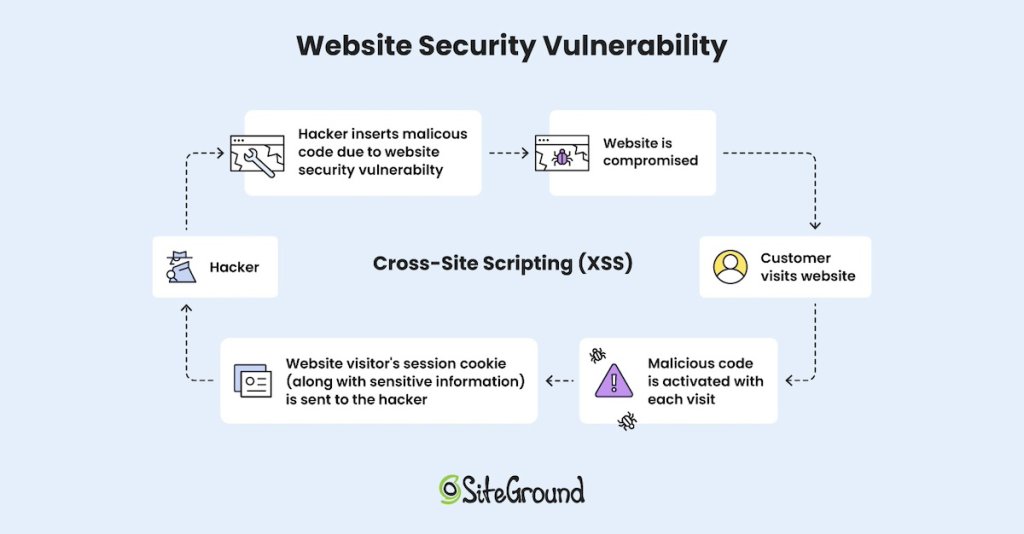
2. Cross-Site Scripting (XSS)
Cross-site scripting (XSS) is like someone slipping a harmful note into your website that your visitors accidentally read. These harmful notes (scripts, or malicious codes, as they are called) are a threat to site security, as they can steal personal information, mess up how your site looks, or send users to dangerous websites. The worst part? Your visitors might think it’s your fault, even though the hacker is behind it.
3. Broken Access Controls
This happens when your website doesn’t do a good job of keeping certain areas or actions off-limits to unauthorized users. For example, picture someone sneaking into a staff-only area of a store—that’s what broken access controls are like online. Hackers might use this lack of login security to view private information or make changes they shouldn’t be allowed to.
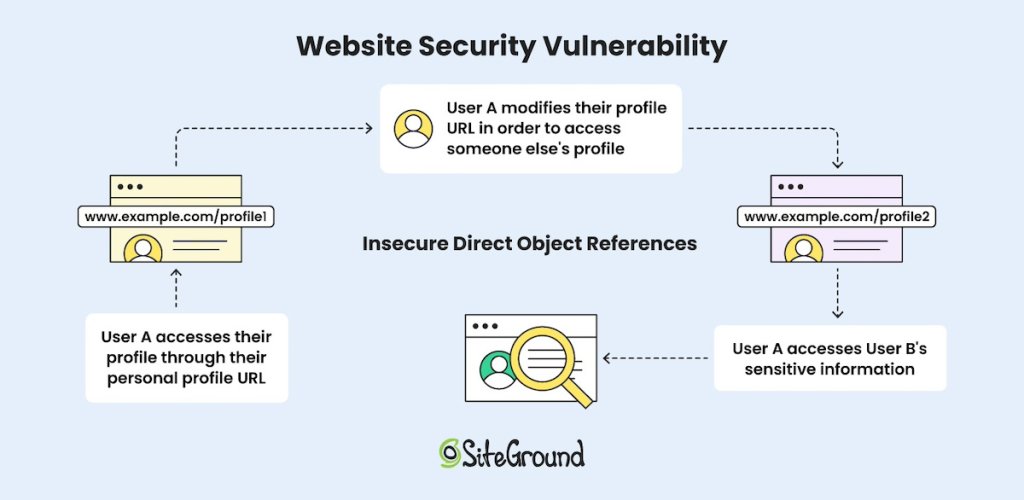
4. Insecure Direct Object References (IDOR)
Would you leave a key under the doormat where anyone could easily and predictably find it? With IDOR you’re doing just that if you give website users direct links to sensitive information (such as “www.example.com/profile1”). That’s because a hacker could guess or change those links (like to “www.example.com/profile2”) to see someone else’s sensitive information. As such, IDOR happens when websites don’t check who’s allowed to see what, and pay close attention to user roles and access and other security measures.
5. Security Misconfiguration
Security misconfiguration occurs when websites are launched with default settings, outdated software, or unnecessary features enabled, leaving the door wide open for hackers. Common examples include using default passwords, failing to apply security patches, or enabling services that aren’t needed. These oversights give attackers more opportunities to exploit vulnerabilities, gain unauthorized access, or steal sensitive information.
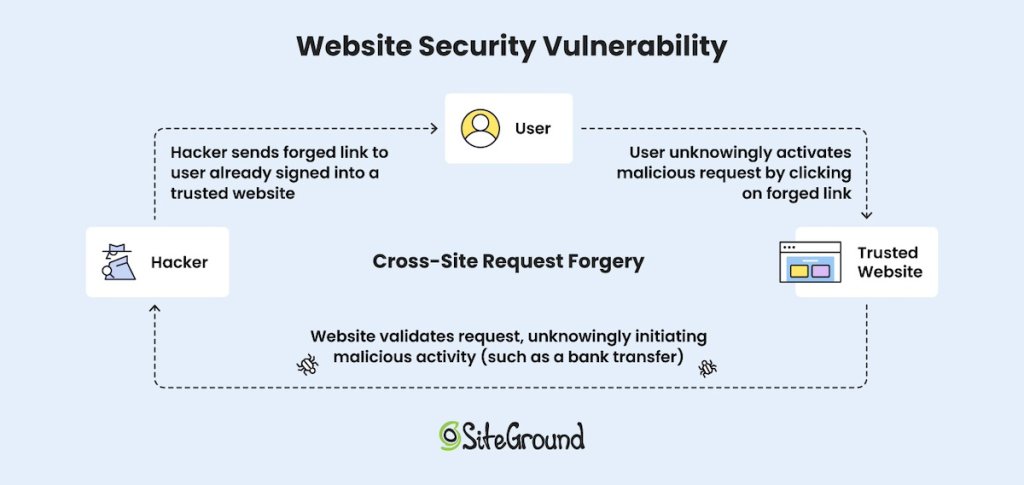
6. Cross-Site Request Forgery (CSRF)
CSRF is when hackers trick you into doing something you didn’t mean to do. For example, you’re already signed into your bank account, then you receive a bogus email with a link or button that’s disguised as something harmless. You innocently click on it, and it ends up transferring money from your account to the hacker, or perhaps it performs some other malicious action on the website where you’re logged in. You’ve essentially just been fooled into signing a virtual blank check.
7. Unvalidated Redirects and Forwards
This issue occurs when a website sends users to another page without checking if the destination is safe. Hackers can use this to redirect your visitors to harmful sites, like phishing pages or ones that install viruses. Think of it as though someone handed you directions to a fake address where bad things happen.
With all of these web vulnerabilities, it might seem a bit intimidating to even think about how to mitigate them. But there’s great news: we’re going to break it down into simple solutions that can quickly and easily improve your website security outlook.
Simple Fixes to Address Website Security Vulnerabilities
Now that you understand the most common website security vulnerabilities, let’s discuss some of the straightforward ways you can address them, as well as other website security tips. The bonus is that these web vulnerability solutions are easy to understand and act on, even if you don’t have a technical background.
1. Choose a Good Hosting Provider
The first and most important step you can make in this process is choosing a solid hosting provider—it’s essentially the online home for your website, and it plays a vital role in protecting your site from the website security vulnerabilities we’ve discussed above. Not only that, but a good hosting provider will offer maximum uptime and optimized website speed, ensuring that your website performance is reliable and top notch.
How to do it:
Look for a hosting provider that provides a free SSL certificate and daily backups, as well as other important security measures, such as daily malware scans, and a server-level WAF (not sure what we’re talking about here? Don’t worry, we’ll cover it all in a minute!). Do your research, and check reviews to make sure the provider you choose has a good reputation, along with superb customer service.
2. Perform Regular Maintenance and Updates
Keeping your website’s software, plugins, and tools up to date is a no-brainer on your list for stronger web security. Developers frequently release updates to fix vulnerabilities and improve performance. By staying on top of these updates, you can protect your site from previously mentioned web vulnerabilities, such as SQL injection, cross-site scripting (XSS), and insecure direct object references.
How to do it:
Create a schedule to check your CMS (such as WordPress), plugins, themes, and tools weekly, or enable automatic updates if your platform supports them. This is where those free daily backups are essential, though, because before you make any updates, always back up your website to prevent data loss or compatibility issues.
For added safety, test updates in a staging environment to ensure everything works smoothly before applying them to your live site.
To make web management easier and less stressful, consider using a managed WordPress hosting with free backups that handles updates, (free!) backups, and maintenance for you, helping keep your site secure without all the extra effort on your part.
[80]
3. Implement Input Validation
Input validation verifies that any data users enter into forms or search bars is checked and cleaned to fit the expected format, thus blocking harmful code. This security measure helps prevent hackers from injecting malicious commands, protecting your website from SQL injection and cross-site scripting (XSS) attacks that could compromise data or functionality.
How to do it:
Use easy-to-install tools or plugins that automatically clean up and check the information users enter on your site.
Focus on areas like forms, search bars, and comment sections.
For extra protection, set up these checks both on the user’s side (their browser) and on your website’s server, so you catch anything suspicious before it can cause harm.
4. Strengthen Access Control
Access control means deciding who can do what on your website. This includes using strong passwords, setting up roles like “admin” or “user,” and limiting what each role can access or change. These steps help keep hackers out of sensitive areas and protect your website from common vulnerabilities like unauthorized access or data leaks.
How to do it:
Assign user roles carefully, making sure each person only has the permissions they need.
Also be sure to implement strong, unique passwords for all accounts and enable two-factor authentication (2FA) for an extra layer of security.
It’s also helpful to install a plugin that keeps an activity log of your website, tracking events like login attempts, user activity, and bot visits, so you can quickly spot and address suspicious behavior.
5. Use Monitoring Tools and Scanners
Monitoring tools and scanners act as security guards for your website by watching for unusual activity or hidden threats. They can alert you to suspicious or malicious behavior, such as injected code, compromised files, or web vulnerabilities that could be exploited by attackers. This helps you catch problems early before they cause serious harm.
How to do it:
Look for a malware scanner tool that offers automated file scans and malware cleanups. A good tool will offer detailed reports and recommendations for resolving issues, making it easier to maintain a secure website. This can also help prevent future attacks by identifying weak points in your website’s security configuration.
6. Secure Your Connections
A secure connection encrypts data sent between your website and its users, often using HTTPS (look for the padlock symbol in the browser). The distinction between HTTPS versus HTTP is an important one: it signals this secure connection—and thus trust and confidence—to your website users. It also keeps hackers from intercepting sensitive information, adding extra protection against data theft.
How to do it:
Make sure your site uses HTTPS by installing an SSL certificate. Certain hosting providers, including SiteGround, will provide you with a free SSL certificate that can easily be implemented on your website, making HTTPS implementation as easy as the flip of a switch.
7. Improve Redirection Security
A redirect is when a user is automatically taken from one URL to another. So redirection security involves checking these links or forwards from your website to make sure they lead to safe destinations. This stops hackers from tricking your site into redirecting visitors to malicious websites.
How to do it:
Limit the use of redirections and always verify that any destination URLs are trustworthy before implementing them. Regularly review your redirects to ensure they haven’t been altered or exploited, and consider using tools to monitor and secure your redirection paths.
8. Employ a Web Application Firewall (WAF)
A Web Application Firewall (WAF) is specifically designed to protect your website from security vulnerabilities, such as SQL injection, XSS, and CSRF, by safeguarding features like user forms, search fields, and API endpoints. It works by stopping harmful requests before they can cause damage, ensuring your site remains secure.
How to do it:
Many hosting providers offer built-in WAF options, as it’s an essential security feature. While there are numerous WAF options available, including WordPress plugins and third-party services, having a server-level WAF is imperative. This type of WAF operates with large-scale data and provides real-time protection, ensuring a higher level of security.
At SiteGround, our security team keeps a close eye on security bulletins to identify potential exploits and web vulnerabilities. In doing so, they promptly develop custom security rules and integrate them into an advanced, in-house managed WAF. This robust protection is automatically applied to all websites hosted on our platform.
A CDN, or Content Delivery Network—as it’s called—helps protect your website by spreading traffic across multiple servers around the world.It not only improves your site’s speed but also provides an essential layer of protection against web server vulnerabilities. By distributing traffic and blocking harmful bots, a CDN prevents malicious traffic from overwhelming your server, keeps data safe with encryption, and stops potential attacks before they reach your site.
How to do it:
Quite simply, select a hosting provider that leverages a CDN. SiteGround’s CDN, for example, helps safeguard your website by mitigating web server vulnerabilities, blocking harmful traffic, and encrypting data. Additionally, with the Always Online feature, even if your server goes down, the CDN enables a cached version of your site that remains accessible and secure.
10. Install a Reliable Security Plugin
There are many plugins out there to help address the web security vulnerabilities mentioned above. And if you’re using WordPress, the SiteGround Optimizer Plugin is particularly ideal, as it allows you to prevent many of the aforementioned web vulnerabilities but with just one plugin – easily and for free.
The SiteGround Security Optimizer Plugin provides a combination of enhanced login security, firewall settings, and activity tracking, with an all-in-one solution that fortifies your site. It safeguards key system directories, enables protection against XSS, prevents unauthorized access, hardens login security, and continuously monitors for any unusual activity. In the event of a breach, the comprehensive activity logs allow you to swiftly identify what occurred and take the necessary steps to resolve it. It’s basically a one-stop shop for securing your WordPress site.
Final Word on Website Security Vulnerabilities
In the end, website security doesn’t have to be a daunting task. By applying simple fixes to these common website security vulnerabilities, you not only protect your site but also build trust with your visitors. Take action today to lock down your site and keep those Wild Western cyber bandits at bay—after all, a little effort now can save you a lot of headaches down the road.
Meanwhile, you can make addressing website security extra worry-free by taking advantage of SiteGround Hosting. We put our all into security measures that go above and beyond so that you can rest easy. Plus, we offer unparalleled speed and service.
Back in May, we shared the news that PHP 8.2 is becoming the default version for all new sites hosted on our servers. Now, as of this month, we’re thrilled to announce that PHP 8.2 is fully rolled out across our entire infrastructure for existing sites as well. This significant upgrade provides SiteGround clients with enhanced security improvements and superior performance, ensuring you get the best out of PHP 8.2 right from the start.
Implementing this change on such a large scale was a complex and extensive process, but we carefully planned and executed it. Our unique approach was guided by our commitment to providing clients with seamless, high-quality service and ensuring each of their websites is faster, safer, and better equipped for the future. Here’s more about the journey behind this upgrade.
PHP 8.4: Stay Updated! 🚀 Check out our latest blog post to explore the newest features and enhancements in PHP 8.4.
Smooth Transition and Optimized PHP Experience for Faster and Safer Hosting
The scale of this project was immense, involving hundreds of hours of planning, testing, and implementation by our DevOps team. All this to ensure a smooth, free-of-charge transition to PHP 8.2 for customers who have switched on their Managed PHP service. Here’s a snapshot of the results:
✅ Our team spent 88 days on preparation and gradual upgrades across shared and cloud servers.
📊 Millions of websites with managed PHP underwent comprehensive compatibility checks.
🎉 A massive 92.92% of sites passed the PHP 8.2 check with no issues and were classified as low-risk and directly upgraded to PHP 8.2.
⏰ Only about 7% of sites were identified as high-risk and were granted additional time to use PHP 7.4 to ensure stability and client peace of mind.
Why the PHP 8.2 Upgrade is Complex – and Necessary
PHP 8.2 brings powerful improvements to our customers’ websites in terms of speed, security, and efficiency. It is designed to handle PHP requests faster, which improves performance across all types of websites. PHP 8.2 is considered a mature release and is the primary version actively supported by PHP core developers, ensuring it remains well-patched.
It includes new functionalities such as read-only properties and deprecation of dynamic properties, allowing developers to produce safer code and leading to a more secure website overall. Plus, it is completely compatible with other software hosted on our platform, and all major apps, like WordPress and Joomla, already support PHP 8.2.
With all this in mind, this was the right time for SiteGround to make PHP 8.2 the default and ensure our clients get the best from their hosting environment. However, moving to a major PHP version like this one is challenging because it affects almost every application and domain hosted on our servers.
Moreover, some website elements, like old plugins or custom code, may have compatibility issues when moving to a new PHP version. This is why the transition to PHP 8.2 was both important and complex. While new websites on our servers have been using PHP 8.2 by default since May 2024, updating all sites using our Managed PHP service required a meticulous approach.
Initial Testing, Compatibility Checks, and Risk Management
In July, we began a phased upgrade process for clients using our Managed PHP service. We started with the first shared server test and performed detailed checks with sites to verify if they would load correctly with PHP 8.2. These tests were performed in isolation, ensuring that live client sites were unaffected during the assessment process.
This test allowed us to understand whether the sites were ready for PHP 8.2. Our comprehensive compatibility checks helped us categorize websites into low-risk and high-risk groups to better manage the rollout and reduce potential risks for clients.
Low-risk: websites that our tests detect as properly loading on PHP 8.2
High-risk: websites that we have detected as having some compatibility issues
To all sites that loaded without a problem, we sent a notification a week before the actual upgrade, ensuring complete transparency and zero surprises for our clients. For sites that did not pass the compatibility check, we kept them on PHP 7.4. This allowed clients to update their site’s code for compatibility while remaining fully functional.
We also contacted such clients with a recommendation to switch back to managed PHP after they resolve the compatibility issues so that we could continue updating their sites automatically and save them time and effort.
Gradual Upgrade of Clients’ Sites with Managed PHP
To ensure stability and minimize risks, our PHP 8.2 upgrade process was gradual and carefully controlled. After the initial server test, we performed a phased upgrade, starting with a five-server batch, then scaling up to 50, 250, and finally 500 shared servers per week. This gradual approach ensured that we could quickly catch and resolve any issues that arose.
By mid-September, the PHP 8.2 upgrade was complete for all our shared hosting servers. At the end of August, we started the upgrade process to our cloud servers which was on track and successfully completed by the end of October.
For Those Still On PHP 7.4, We Strongly Recommend Moving to PHP 8.2 For clients who manage their own PHP version and are still using PHP 7.4, we encourage you to upgrade to PHP 8.2 soon, as this version is more secure, faster, and fully supported. Versions below 8.2 are no longer supported by the core PHP developers and will become more and more vulnerable as time passes. Note that PHP 7.3 will be removed from SiteGround servers in 2025, as it reaches the end of its lifecycle. For your convenience, we provide a PHP compatibility check,performed by our technical experts as part of the Expert Care service.
We’re happy to have achieved the huge upgrade to PHP 8.2 successfully, maintaining our commitment to a secure and up-to-date hosting environment. As always, our team is here to help with any questions and guidance you may need to ensure you get the most out of PHP and beyond!
At SiteGround, we proudly embrace our reputation as “security freaks” – we continually enhance our infrastructure, systems, and tools to protect our customers’ websites and information. Since launching our Site Scanner service, we’ve been inspired by your stories of how it has shielded your websites from potential security disasters. Now, we’re excited to take your protection to the next level with Site Scanner’s latest updates.
New in Site Scanner Basic: Automated Weekly File Scan
Our current Site Scanner Basic plan features an automated Daily URL Scan that checks your website’s URLs every day for any publicly detectable malware. However, when it came to File Scans, up until now you had to initiate that type of scan manually yourself.
We’ve rectified that with the addition of an automated Weekly File Scan, making our Site Scanner Basic plan even more convenient. Now your website’s files will be automatically scanned for malware every 7 days, ensuring regular and thorough protection without any extra effort on your part. Site Scanner Basic users can now enjoy enhanced security and peace of mind with our new weekly file scans!
New in Site Scanner Premium: Unlimited 1-Click Malware Cleanups
Our Site Scanner tool has been a favorite among our clients, but there was one feature you’ve been eagerly anticipating – Malware Cleaning. Until now, Site Scanner provided valuable timely information about potential malware threats found on your account. Now, we’re excited to offer not just insights and timely alerts, but also an easy resolution with our new 1-click Malware Cleanup feature, exclusively available for Site Scanner Premium users.
Here’s an overview of the two methods for using the malware cleanup feature:
Scenario 1: Malware is detected after a scan
Imagine malware is detected on your website. With Site Scanner on, you’ll receive an immediate notification via email. Your next step is to go to your Site Scanner interface in Site Tools. Here, you’ll see more information about the detected threat and have the option to remove the malicious code identified during the scan. Our Malware Cleanup feature now allows you to swiftly remove the malware from your site and eliminates the need for third-party solutions, saving you both time and money. You can initiate the cleanup with 1 click. The possible results will be:
Successful Cleanup: The malware is effectively removed, and a subsequent scan verifies that your site is clean.
Unsuccessful Cleanup: If the cleanup tool encounters issues, an automatic support ticket is created for further investigation by our support team experts.
In the CLEANUPS tab of your Site Scanner interface, you can access your history of all cleanups, with successful ones accompanied by a detailed report of the files that were cleaned.
And voila! Your site is malware-free again.
Scenario 2: Quarantine files
If you have your Site Scanner quarantine setting enabled and there is a malicious attempt to upload potentially harmful files to your site, these will be detected and not automatically published in your public website folder, but safely quarantined in a folder isolated from your website.
Now you have the option to use our automatic cleanup process for these files too. When initiated, our Malware Cleanup feature will automatically delete the content it considers malicious from the quarantine files and will safely move the cleaned files to the public folder.
For more detailed guidance on using the Site Scanner tool and how it protects your website, please refer to our Site Scanner Knowledge Base tutorial.
Activate or Upgrade Site Scanner for Unmatched Peace of Mind
With Site Scanner’s new automated Weekly File Scans in the Basic Plan and 1-click Malware Cleanup in the Premium Plan, along with many other site protection features, you can enjoy seamless defense against malware threats.
PHP 8.4 is now out of beta. The official release was announced on November 21th, 2024 and is fully available on SiteGround! Read our latest comprehensive article to learn more about the new features and how you can use it.
We are glad to announce that PHP 8.4 (Beta 3) is now available for testing on all SiteGround servers – way ahead of its scheduled official release date on November 21, 2024. Once again, we are among the first companies to provide PHP 8.4 (Beta 3) for testing on our hosting platform. Thanks to our unique PHP server setup, we are able to offer the latest PHP versions for our clients to test safely on their websites hosted with us.
Discover more about the new features that the latest PHP version brings to the table in the next section.
What’s new in PHP 8.4 (Beta 3)
This latest version introduces some very important new features that will improve the PHP development experience even further. Let’s dive into some of the biggest changes that PHP 8.4 (Beta 3) offers:
Property hooks
One of the new features in PHP 8.4 (Beta 3) includes the ability to define property hooks which will eliminate the need for a lot of boilerplate code. This is one of the biggest changes in PHP history. Property hooks will help remove a lot of getters and setters by allowing each property to define its own get and set hooks. What’s more, an exciting addition is that in PHP 8.4 (Beta 3) property hooks can be defined in interfaces.
We can take this pretty standard class for example:
<?php
declare(strict_types=1);

class Website
{
   private $domain;

   public function __construct(string $domain) {
       $this->domain = $domain;
   }

   public function getDomain(): string {
       return $this->domain;
   }

   public function setDomain(string $domain): void {
       if (strlen($domain) === 0) {
           throw new ValueError("Domain must be non-empty");
       }
       $this->domain = $domain;
   }
}
As of PHP8.4 (Beta 3) we can use Property Hooks to achieve the same result with the following syntax:
<?php
declare(strict_types=1);

class Website
{
   public string $domain {
       set {
           if (strlen($value) === 0) {
               throw new ValueError("Domain must be non-empty");
           }
           $this->domain = $value;
       }

       get => $this->domain;
   }

   public function __construct(string $domain) {
       $this->domain = $domain;
   }
}
newwithout additional parentheses
Another new feature that will save lots of boilerplate code is that you don’t have to wrap newly created objects within parentheses anymore in order to be able to chain methods on them.
What’s more, it works not only for methods – you can also chain properties, static methods, constants – basically whatever you want. Bottom line is that the new feature will simplify the syntax and make the code more concise and readable.
Example:
The “class member access on instantiation” feature was introduced in PHP 5.4.0. Since then constants, properties and methods can be accessed on a newly created instance without an intermediate variable, but only if the new expression is wrapped in parentheses:
class Website
{
   ...

   public function getDomain(): string {
       return $this->domain;
   }
}

// Valid syntax
$myDomain = (new Website('siteground.com'))->getDomain();

// Invalid syntax until PHP8.4
$myDomain = new Website('siteground.com')->getDomain();
New Array functions
Another notable change in PHP is the introduction of several new Array functions. PHP 8.4 introduced several new array functions with callback function:
array_find()
A function that returns the value of the first array element that matched the condition. If none of the elements matched the condition, the function will return `null`.
array_find_key()
Returns the key of the first element for which the callback was true. If none of the elements matched the condition, the function returns `null`.
array_all()
Checks if the callback returns true for all of the array elements
array_any()
Checks the callback returns true for any of the elements of an array.
These new functions make it easier to search and manipulate arrays based on custom conditions which in terms will lead to cleaner and easier to read code.
How to test PHP 8.4 (Beta 3) on SiteGround servers
As a SiteGround client, you can easily test PHP 8.4 (Beta 3) on your website. Simply log in to your Site Tools > Devs > PHP Manager section and you’ll be able to replace the current PHP version used by your site with PHP 8.4 (Beta 3) with a single click.
Please keep in mind that PHP 8.4 (Beta 3) is mostly available for testing purposes and as usual, we strongly advise you not to use it at your production site before its scheduled official release date (November 21, 2024).
If you need to test PHP 8.4 (Beta 3) with your existing site, we recommend that you create a new site for testing and clone your production site into it to test different things. For this purpose, you can use our WordPress Staging tool. While testing, make sure that nothing fails and check your log files to see if any warnings or errors appear. Once you are done testing, you can simply delete that site.
Wrap-up
At SiteGround, we are constantly working to introduce the newest PHP technology ahead of the others. That’s why we are excited to provide our clients with the latest PHP version which brings to the table some big improvements that could significantly enhance the PHP development experience. Take your time to test the new version before the official release date and stay tuned for more updates from the PHP community.
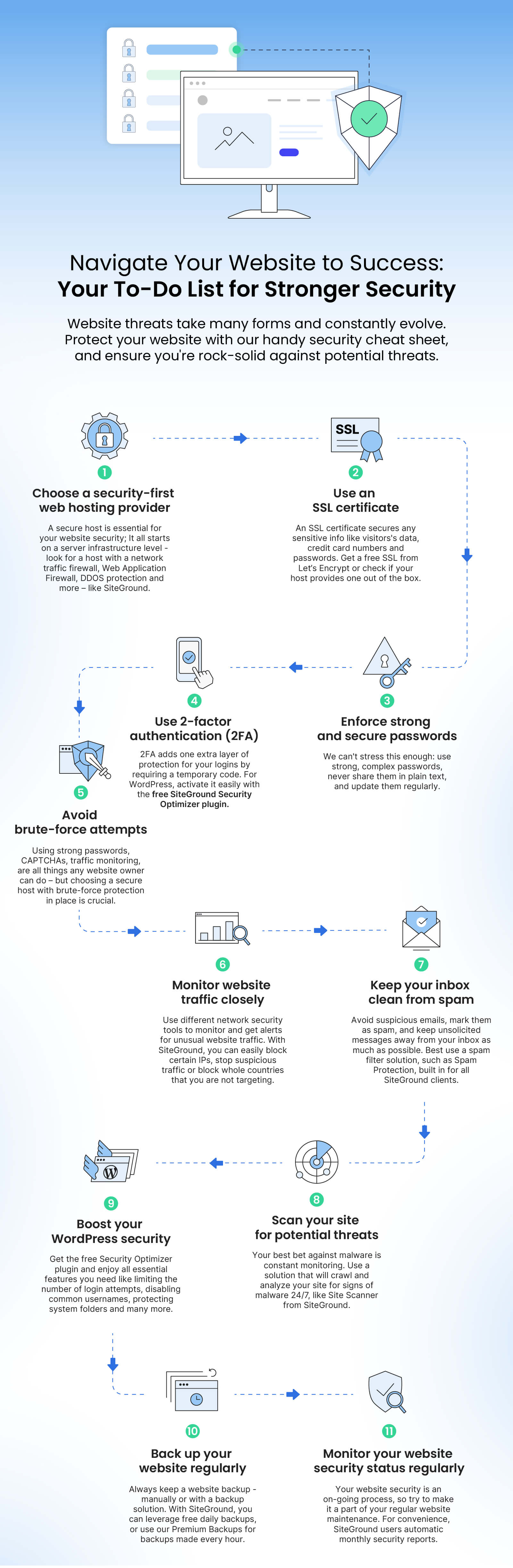
On your journey to a more successful online presence, there’s one essential step you should never neglect – website security. At SiteGround we’re constantly updating your security arsenal with out-of-the-box security technology and additional features. But there are a few extra steps you can take to protect your site so that when your online business gathers speed, you and your clients have ultimate peace of mind.
Your Ultimate Website Security Improvement To-do List:
Website threats take many forms and constantly evolve: phishing, malware, ransomware, DDoS attacks, identity theft, customer data leakage, and even human error. To protect your website on multiple levels, we’ve compiled an extensive but easy-to-follow list with actionable tips. Complete each step to make sure your website is rock-solid against potential threats.
1. Choose a hosting provider that safeguards server infrastructure
💡WHY: Choosing a secure web hosting provider is the first step towards a secure website. A good hosting provider would protect your website on various levels, starting with their servers’ infrastructure security. Some essential and effective security measures on server-level include a network traffic firewall, Web Application Firewall, DDOS protection and more. All these help filter bad traffic and block brute-force attacks, denial of service, malware injections, and others.
❓HOW: When choosing or switching to a new hosting provider, research their hosting infrastructure and security measures provided. Check their website for security tech info or better yet, contact them directly with specific questions.
At SiteGround, we not only provide all essential security measures, but we go the extra mile. Instead of making them operate stand-alone, we have built a Central Security System that ensures all our servers are protected at all times by constantly gathering and analyzing data from all individual server security systems, and distributing smart security rules, applied to all machines. At SiteGround, your website is safe with:
24/7 server monitoring system that checks the server status every 0.5 seconds, far more often than standard monitoring systems in our industry. On top of detecting and fixing current issues, it also foresees and prevents a variety of problems automatically.
Smart web application firewall system on server-level that monitors the traffic and prevents hackers from exploiting the most popular CMSs and their plugins. Our Security Team constantly creates new custom security rules and adds them to our smart WAF to protect sites hosted with us out-of-the-box.
Powerful AI anti-bot system that stops malicious traffic before it reaches our customers’ websites, blocking between 25 and 30 million brute-force attempts per hour across all our servers.
Daily geographically distributed backups, stored in a data center location, different from the one hosting the live account, and Premium Backup service that provides up to 60 additional backup copies of our clients’ websites and allows downloading all backups to our clients’ local machines.
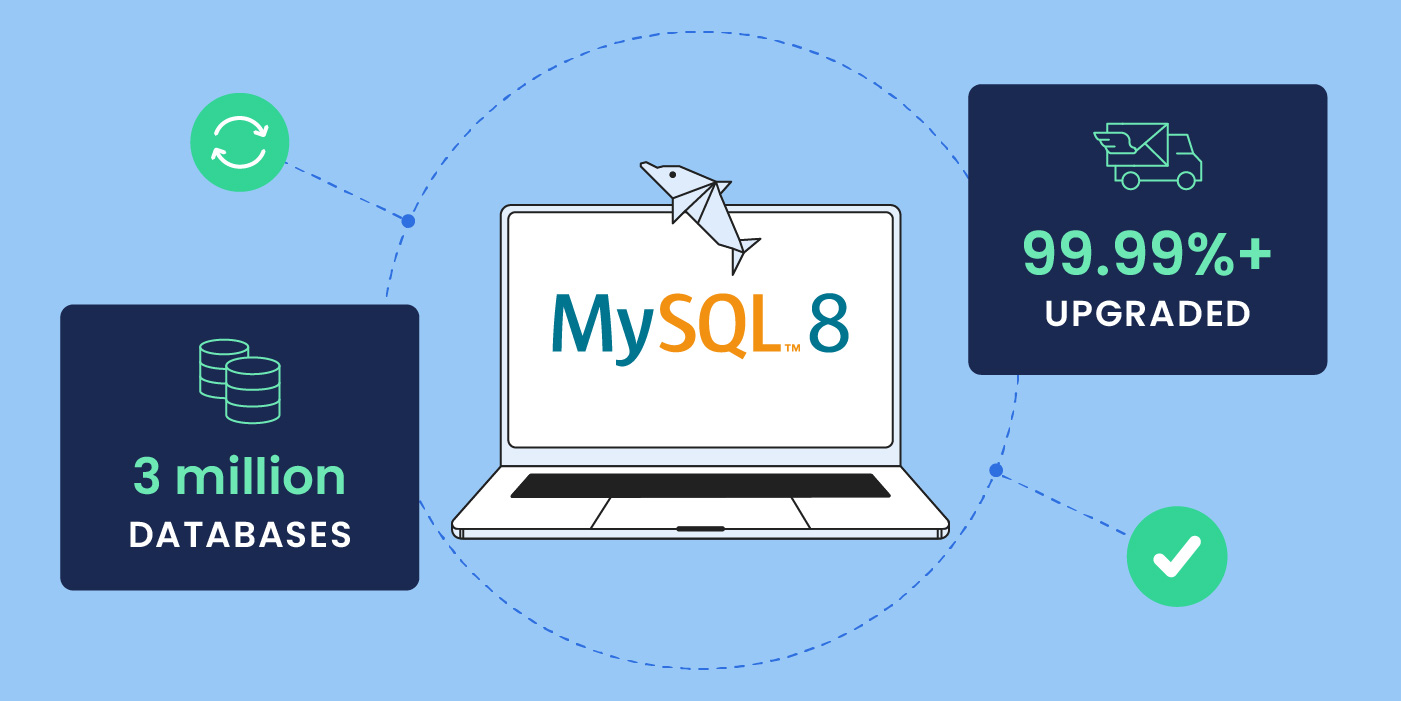
The latest software versions, such as the default PHP 8.2 and the latest MySQL 8 that are used on all SiteGround servers. It’s important that your software is up-to-date at all times, because older software versions inevitably become vulnerable to hacker attacks with time.
2. Protect your data with an SSL certificate
💡WHY: Having an SSL certificate on your website is a must and an industry standard. Here are some of the main reasons why you should have one – an SSL certificate secures sensitive information, such as credit card numbers, IDs, passwords, messages, etc. by encryption; verifies your website’s identity; and ensures that your website meets the requirements of search engines which flag unsecured sites.
❓HOW: As a website owner, you can get a free SSL certificate from Let’s Encrypt, for example, or you can ask your hosting provider whether they offer SSL certificates. As a SiteGround client, you get free Standard and Wildcard SSL certificates with all our hosting plans, for all your websites. Мanage your active SSL certificates easily from your Site Tools control panel – just go to Site Tools > Security > SSL Manager. Once logged in, you can also switch from the free Standard SSL to the free Wildcard SSL (for medium-sized websites), or upgrade to the Premium Wildcard SSL (for large business websites).
3. Enforce strong and secure passwords
💡WHY: The password for logging in to your website admin panel is one of the first things that hackers will try to crack. If your password is weak, such as your name, or your date of birth, for example, hackers would need just a few attempts to guess it successfully and get access to all your website information. That’s why it’s crucial to use strong and secure passwords for your login.
❓HOW: To have a strong and secure password, make sure you use long passwords, with numbers, uppercase and lowercase letters, special characters, numbers, etc. Never write it down (neither physically, nor electronically), but keep it in a secure password vault management system. And remember to update them regularly, since if you use the same one over and over again, it will get vulnerable at some point.
4. Use 2-factor authentication
💡WHY: Even with the hardest to guess passwords, there’s still a possibility that it can be compromised. This could be due to a human error, or a brute-force attack, where hackers use different combinations to guess your password – on a huge scale, hundreds of thousands of attempts per hour, for example.
❓HOW: To further strengthen your login, implement 2-factor authentication (2FA). It requires one additional step to be completed before anyone can access your data. That’s one more layer of authentication – a temporary dynamically generated code on your phone or email. The 2-factor authentication feature is a click away in the free SiteGround Security Optimizer plugin for WordPress websites.
5. Stop brute-force attempts
💡WHY: Brute-force attacks by bots are a severe global issue for any website nowadays. They cover a huge scale of multiple websites on one or more servers, making it a very serious issue whether your site is big or small, business-critical or just an online portfolio. A brute-force attack is a hacking technique that uses trial and error to guess and crack your passwords, login credentials, and encryption keys, on a massive scale. A successful brute-force attack can cause huge financial losses; steal personal information, such as bank details, confidential medical information, etc.; and many other damages.
❓HOW: There are multiple measures that you can take in order to protect your site from brute-force attacks. These include having strong passwords, limiting the login attempts to your website admin panel, monitoring IP addresses for anomalous behavior, using CAPTCHAs, creating a unique login URL for your website admin panel, and others.
All of the above aside, your choice of web hosting provider plays a crucial role in securing your site against brute-force attempts. At SiteGround, we have developed a sophisticated AI anti-bot system that blocks millions of brute-force attempts per hour.After the system’s latest upgrade, it filters 95% more of the malicious queries by constantly learning from thousands of brute-force attempts per day and adding a traffic validation functionality that minimizes the number of brute-force attacks. SiteGround clients benefit from this advanced system by default, no action needed on their part.
6. Monitor your website traffic closely
💡WHY: As a website owner, you can sometimes notice specific patterns or suspicious traffic coming to your website. Imagine that you monitor abnormally high traffic from a country you’re not targeting, you receive too many spam comments on your blog from а specific location, or any other unusual behavior from a certain geographical region.
In such cases, it would be useful to be able to stop the traffic from that location, as many times it might turn out to be malicious. Stopping the traffic from a specific country could also benefit your business, if, for example, legal requirements prevent you from providing your service in that country, or there are heavy taxation requirements, and others.
❓HOW: To monitor your website traffic, you can use different network security tools that alert you of potential malicious activity in your network, or you can also set up alerts yourself, whenever you encounter login attempts or suspicious activity from certain IP addresses.
SiteGround clients can easily block specific IP addresses or whole countries and stop traffic from countries that are not relevant to your business or online presence. If you are a SiteGround client, control your website traffic in Site Tools > Security > Blocked Traffic.
7. Keep your inbox clean from spam messages
💡WHY: Dealing with multiple emails is part of our daily work routine nowadays. Yet, when there are a number of spam messages in your inbox by the hour, the task becomes even more tedious and annoying. You have to manually process each email and mark as spam those that sneaked into your inbox. But there’s more to spam than simply a cluttered inbox – it’s dangerous, because it can be the main source of phishing and other hacker attacks. It goes the other way round, too.
Spam messages can negatively affect not only the receiver, but the sender as well. If another user on your server has sent uncontrolled spam, then there’s a chance that your entire server address will get blacklisted. This will affect you when you try to send an otherwise legitimate email, which might not get to the recipient simply because it’s coming from an already compromised server address.
❓HOW: First and foremost, make sure to not delete spam messages from your inbox, but rather mark them as spam, so that your spam filter will know not to let any more messages from this address into your inbox. Second, if you can tell that the message is spam, even before opening it, then delete it without clicking on it, or downloading anything. Such messages can contain malicious software! Other rules to follow in order to avoid spam, include keeping your email address as private as possible, unsubscribing from email lists, or simply using a third-party spam filtering service.
SiteGround clients enjoy an in-house built Spam Protection solution that keeps both incoming and outgoing spam away. Our solution not only efficiently minimizes the amount of spam messages delivered to your inbox, but it also constantly learns from your email reading behavior and actions to add even more custom rules for spam messages. As a result, our system blocks 12 Million spam emails from even reaching your mailboxes every day, while 600,000 get filtered directly in the spam folder. It also extremely efficiently detects and stops outgoing spam messages from our servers, giving you an extra layer of security.
SiteGround clients have our built-in Spam Protection features enabled by default, but can also easily control them via an easy interface to allow and block senders. They simply need to go to Site Tools > Email > Spam Protection and directly tell the system how to treat a certain sender by adding an email address or an entire domain to their block/allow lists.
8. Scan your website for potential threats regularly
💡WHY: Hackers invent new and smarter ways to “hijack” websites, by the hour. Your website can get infected with malware in numerous ways – compromised login credentials, corrupted or outdated software, infected or fake plugins and themes, and many others. If your site gets infected with malware, this can have serious consequences on your whole business, not only on the website itself.
❓HOW: Your best bet against malware is constant monitoring. However, as a website owner, you have many other responsibilities in regard to your website. You simply cannot monitor it for suspicious behavior on your own 24/7. But your hosting provider can and should.
With SiteGround, our clients can activate Site Scanner – a security add-on that crawls your websites daily, warns you of potential malware and other security threats, and provides tools for reaction if your sites are under attack. Here’s how Site Scanner protects your websites.
9. Boost your WordPress security
💡WHY: WordPress is the most popular CMS platform in the world, and as such, it’s also a preferred target for hackers. Even though all of the above tips apply to WordPress as well, there are a few extra things you can do to make sure that your WordPress website is fully secured against malicious threats.
❓HOW: We have identified some important, yet easy-to-follow tips to help you take special security care of your WordPress website:
Keep your WordPress version and plugins up-to-date
It’s important to keep your WordPress version and plugins up-to-date with their latest possible versions, because hackers use any vulnerability or backdoor to get access to your website’s files, sensitive information, etc. Simply log in to your WordPress admin and go to Settings or plugins to check if there’s a newer version.
At SiteGround, we automatically update all WordPress sites hosted with us to the latest stable WordPress version, as well as the free plugins, depending on clients’ settings in their Site Tools > WordPress > Autoupdate.
Review your user roles and permissions
Make sure to review and clean up inactive users or limit access for certain users only to the information and resources they require for that specific role. For example, let the administrator level accounts only for the people responsible for the technical aspects of your site, but give edit access to your blog only to users that manage content or users on your site.
Avoid common usernames
Remember that your WordPress login consists of your username and password. However, all WordPress installations by default come with the user “Admin” which means that hackers already know one of the two pieces of your login information. That’s why it’s important to change your username to a custom one.
Limit login attempts
Another way a hacker would try to crack your username and/or password is to try and guess them on the login form with numerous consecutive attempts. What you can do is limit the number of consecutive unsuccessful login attempts by blocking their IP for a certain period of time after they reach a set amount of attempts. With the free Security Optimizer plugin by SiteGround, you can activate this feature with a click of a button.
Clean up unused or outdated plugins and themes
Unused or outdated plugins and themes, including deactivated ones, also open the backdoor for hackers to get to your website. To avoid that possibility, simply delete any unused plugins and themes on your website.
Add an extra layer of security with a trusted plugin
With the free Security Optimizer plugin available for all WordPress websites, you get all the security features you need to protect your WordPress website. Its user-friendly interface allows you to enable a variety of safety features with a few clicks – from hiding your WordPress version, locking and protecting system folders, to hardening different aspects of your login security, as well as monitoring visits, bots, etc. in a detailed activity log.
10. Back up your website regularly
💡WHY: Even if you’ve taken multiple security measures, unexpected events still happen – an update might go wrong, you can accidentally break something on your site, or any other unforeseen circumstances can require you to revert to an older version of your website. Just like an UNDO button in real life. That’s why it’s a must to keep several backup copies of your website in order to revert any mishaps in due time.
❓HOW: There are two main ways to back up your website – manually and with a third-party backup service. If you want to back up your site yourself, you need to log in to your web hosting account, locate the directory with your website’s files, use an FTP client to download this directory on your local computer and store it in a safe place. This is useful but can be impractical because you never know when mistakes will happen – so having an automated backup is crucial.
At SiteGround, we know how often backups can save an emergency situation with your website. That’s why we have a sophisticated system for creating and keeping backups of your website automatically. We generate a backup of your website every day and store each for up to 30 days. What’s more, we keep these backups in a data center location different from the one hosting the live account, which is an extra layer of security for your data, in case something affects your whole data center. SiteGround clients can easily manage backups from Site Tools > Security > Backups.
For the ultimate peace of mind of our clients, we have recently launched our new Premium Backup service that provides clients with automatic backups made every hour, on-demand backups for a full backup of their sites (whenever they need it), 7 additional automated daily backups on top of the ones included in their plan, and allows for downloading all backups to their local machine.
11. Keep an eye on your website security status regularly
💡WHY: Even if your site is secured and backed up, you still need to check its security status regularly. It’s important to know how secure your site is and whether the security level has changed – keep an eye on how many attacks have been mitigated, or find new ways to further protect your site from incidents.
❓HOW: To check your website security status, you can use a free open-source web security testing tool. There are many such tools available online. If you’re using WordPress, you can also run a security scan with various free plugins to scan your website and detect vulnerabilities. After you check the status of your website security, it’s important to analyze the results and take measures where necessary.
SiteGround clients receive free monthly security reports, delivered straight into their inboxes. In these reports, they get a summary result of their site’s security check, along with actionable advice on how to reduce the risk of malicious attacks, if there are any weak areas identified. All this information is compiled in a user-friendly format, and the feature is enabled by default for all our clients. To manage their preferences for the reports for any of their websites, they simply need to go to their Client Area > Click on User Avatar > Notification Preferences and click the pencil icon next to Monthly Security Reports.
Wrap-up
A website is the most important and valuable digital asset you have, so you would want to make sure that it’s as secure as possible, time after time. By constantly reviewing and implementing new security measures, you ensure your site’s at maximum security level. This way your business, your visitors’ information, and your reputation will be safe during any business season.
With summer in full swing in the Northern Hemisphere and business slowing down, now is the perfect time to optimize your website for the busy season in September. Use this quieter period to improve your site’s speed and implement new features, so that you’ll be well-prepared to attract and engage more customers when business picks up.
Why optimize website speed?
A website is considered fast if it loads for under 2 seconds. If your page takes more than 3 seconds to display all of its assets, the chance of bounce triples as visitors nowadays aren’t willing to wait anymore!
Having a fast site is critical, as it directly affects user experience, engagement, conversions, and SEO. Here’s how:
User experience: consumers expect websites to load quickly, and if that doesn’t happen, the likelihood of them leaving the website – bouncing – before it fully loads increases.
Engagement: an optimized website responds more quickly to visitors’ interactions (e.g. clicking on menus, buttons, filling out forms) and respectively, encourages visitors to engage more with the website’s content.
Conversions: the more visitors interact with the website, the bigger the chance of them completing desired actions such as making a purchase, signing up for your newsletter, etc.
SEO: Web page speed is a ranking factor in Google’s search algorithm as it impacts user experience. Faster sites rank better!
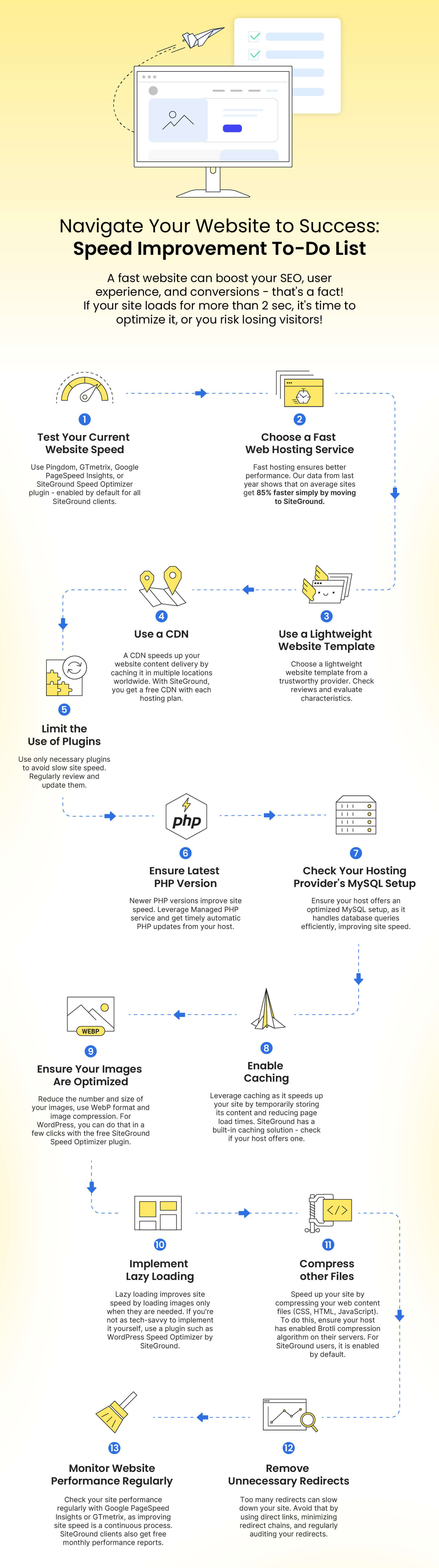
Website Speed Improvement To-Do List:
To help you improve your speed, we’ve created an easy-to-apply to-do list with essential steps. Follow it to make a noticeable difference in your site’s performance.
1. Test your current website speed
💡WHY: When it comes to website speed, every second counts, so it’s a good practice to test your website periodically. As we mentioned, if your website loads for more than 2 seconds, then it’s considered slow, and applying the next steps is crucial.
Along with your website loading time, these tools can help you observe: your page size, content size by content type, performance grade (an assessment of your website overall performance), the load time of the largest content element (e.g. your hero image), suggestions on how to improve page speed, and more.
2. Choose a fast web hosting service
💡WHY: As a website owner, choosing the right web hosting solution is the first critical decision you have to make. Having your website hosted on a fast infrastructure is the foundation of a well-performing website. It has a direct impact on key aspects like server performance, the way traffic is handled and allocated (especially important for sites with traffic spikes during busy periods), network latency, caching and CDN mechanisms, redundancy, uptime, server-level security, and many many more.It can also save you quite a lot of the work mentioned in this to-do list.
❓HOW: Before choosing a web hosting provider, or transferring to a new host, research their hosting infrastructure and technologies provided. With SiteGround, you can rest assured that your website will have one of the best foundations for optimal performance, powered by the latest technologies in the industry. As a company with 20 years of experience in providing advanced web hosting and trusted by the owners of over 3,000,000 domains, we have crafted a robust, ultrafast infrastructure:
powered by Google Cloud with one of the fastest networks with multiple redundancies
advanced caching which speeds up sites up to 5 times
custom MySQL setup for highly optimized database queries
ultrafast PHP setup leading to up to 30% faster page load
💡WHY: Having a lightweight and reputable website template for your website is an important aspect of its good performance. Such templates usually have well-written, optimized code which makes it easier and quicker for a browser to render the page. They are optimized for mobile devices, have smaller graphic file sizes, and respectively – less data to be downloaded.
❓HOW: When choosing a template for your website, make sure to select a lightweight one from a trustworthy provider. Spend some time browsing reviews and evaluating its characteristics. If you’re looking for a WordPress theme, check out our detailed article on how to choose a theme. If you already have a website but wish to change its WordPress theme due to non-optimal performance, follow the steps in our article on what to do before changing a WordPress theme. If you’re using another content management system (Joomla, Magento, Drupal, etc.), browse their knowledge base resources to find similar guides on the steps you should not miss.
4. Use a Content Delivery Network (CDN)
💡 WHY: Using a CDN is a smart decision if you have visitors from different countries or continents and you want your website to load quickly from any part of the world. A CDN caches your site’s content and distributes it across multiple data centers worldwide. So when a visitor opens your website, it loads faster from the nearest to that visitor data center for optimal performance.
❓HOW: At SiteGround, you get a standard CDN integrated and free with every hosting plan. You can also enjoy our Premium CDN at 50% OFF (a limited-time promo!) – a powerful upgrade of the standard service that will turbocharge your website. With it, you can activate the CDN service for all your domains (subdomains, parked, etc.) and cache unlimited CDN traffic. The Premium CDN stores not only the static, but also the dynamic content of your website which makes it a top performance enhancement for dynamic websites.
5. Limit the use of plugins and third-party scripts on your website
💡 WHY: Third-party plugins, scripts, and extensions can introduce important and useful new functionalities to your website, however, it’s crucial to limit their use as they can also contribute to a slow website. The more add-ons you get, the higher the risk of cluttering and deteriorating website performance.
❓HOW: As a start, make sure you’re using only the solutions you actually need. Regularly review them and remove the ones you don’t use anymore or those that have overlapping functionalities. Opt for lightweight plugins with good reputation and reviews as they have a greater chance of being well-coded and optimized for performance. Regularly update them as developers often release updates to improve performance and security issues.
6. Ensure your site is running on the latest stable version of PHP
💡 WHY: PHP is a widely used open-source language for web development. Many popular website content management systems like WordPress, Magento, Drupal, and Joomla are built using PHP. If your website is PHP-based, make sure it is on the latest PHP version as it influences both security and performance. Newer versions typically include optimizations that can greatly improve the speed of code execution, and provide important security improvements.
❓HOW: Managing the PHP of your website depends on the control panel and functionality that your web host provides. With SiteGround, you get a Managed PHP service which means that we will update your PHP whenever there is a new, stable version so that you don’t have to worry about it. The service is enabled by default for all new websites, and clients can switch it OFF and ON in their Site Tools. To check if your Managed PHP is enabled, go to Devs > PHP Manager > PHP Version > pencil icon.
7. Check your hosting provider’s MySQL setup
💡 WHY: MySQL, as one of the most popular database management systems, is used for storing and retrieving data efficiently on countless modern applications and websites.
Having a fast MySQL setup is vital for the overall performance of your database-driven websites (online stores, blogs, news sites, online forums and communities, streaming and educational sites, job portals, financial, and many more). A well-optimized setup would be able to handle a large number of database queries much more efficiently, thus leading to significantly improved website loading time.
❓HOW: While having a fast MySQL setup is important, it is also quite technical and is usually in the hands of the web hosting provider so make sure they do their best to make their MySQL work fast. For SiteGround clients, we created an out-of-the-box server-side solution years ago to optimize the processing of MySQL database queries. It is enabled by default and brings down the number of slow queries between 10 and 20 times.
8. Enable caching
💡WHY: Caching is an effective technique to optimize the load time of your website by storing a copy of its content temporarily on the server. This significantly reduces the time it takes for a web page to load for visitors and enhances their website navigation experience.
❓HOW: Reputable web hosting providers usually provide their users with built-in caching solutions that can be enabled with a few clicks. For instance, at SiteGround, we have an in-house caching system called SuperCacher. It offers three caching layers:
NGINX Direct Delivery for caching static content like images, CSS and JavaScript files;
Dynamic Cache – a full-page caching mechanism for dynamic resources;
Memcached which caches and speeds up database queries results.
With Dynamic and Memcached solutions enabled on top of the static cache, you can expect a website boost by up to 5X!
Alternatively, for WordPress, you may activate plugins that would cache the content of your site, but the level of performance improvements they would deliver cannot match the boost you would get when the caching happens in the server memory.
9. Ensure your images are optimized
💡 WHY: It’s a good practice to resize your images before even uploading them to your website as large image files can significantly slow down your website. Having them optimized after upload is crucial to improve loading time and lower bandwidth costs.
❓HOW: There are several basic things that you can do to optimize your images.
Reduce their number: browse your website’s images and leave only those that add value to your website, delete the rest.
Reduce their size: before uploading images to your website, make sure they are optimal in size, not bigger than the size you’ll be displaying them in, and preferably save them in the WebP format which offers good compression while keeping high quality. As for the images that are already on your site, use image compression to reduce their size. There are different third-party tools and plugins you can use for that purpose. If you’re on WordPress, the Speed Optimizer can again come in handy.
10. Implement lazy loading
💡 WHY: Lazy loading is a technique used to optimize web page performance by loading images and other resources only when they are needed. By deferring the loading of non-essential content until it’s about to come into view, lazy loading significantly reduces initial page load times and data usage. This is especially beneficial for visitors on slower connections or mobile devices.
❓HOW: If you’re using WordPress, you can use a plugin such as the Speed Optimizer plugin with the built-in lazy load media functionality. For non-WordPress websites, consider exploring different lazy loading techniques outlined here, ensuring your websites enjoy faster loading times.
11. Compress other files
💡 WHY: Another way to reduce your website loading speed is by compressing your web content files (CSS files, HTML, JavaScript files) to make them smaller. For that purpose, you can use Brotli which is a highly effective compression algorithm developed by Google. Other popular algorithms include Gzip and Deflate. Learn more about them in our article where we explain the difference between Brotli and Gzip in detail.
❓HOW: Brotli needs to be enabled on your server by your web hosting provider. If you’re more tech-savvy and manage your own server, check out this article on Brotli compression for details. For SiteGround users, it is enabled by default. 🎉
12. Remove unnecessary redirects
💡 WHY: Redirects are used for forwarding visitors (or search engines) of a specific URL to another URL (for example, when redirecting from a deleted page to an existing one). Having too many unnecessary redirects is considered a bad practice and can slow down your website. The reason is that each redirect adds extra HTTP requests and delays the loading time.
❓HOW: To avoid that, there are several steps that you can follow such as using direct links, minimizing redirect chains, and more. Go to our article on how to avoid unnecessary redirects for more details.
13. Monitor website performance regularly
💡WHY: Improving your website’s speed and performance is an ongoing process as you constantly upload new content to it. To ensure your website is always well-optimized, you need to regularly monitor its performance.
❓HOW: As we mentioned in the beginning, you can easily do so, using tools like Google PageSpeed Insights or GTmetrix, which can also hint at specific recommendations for improvement. On our side, to make performance monitoring easier for SiteGround customers, we send monthly performance reports. These reports provide valuable insights into your total website performance score, web traffic cache utilization, CDN usage, data center and network speed, and more.
By regularly reviewing this information, you can identify performance bottlenecks and take steps to resolve them, enhancing your site’s performance. To ensure that you are subscribed to them, go to your Client Area > Notification Preferences > Monthly Performance Reports. Don’t forget to pay attention to the recommendations we provide there for improving your site’s performance and use this info to pinpoint areas that need improvement.
Summary
All these steps are quick and easy. They will enhance your website’s speed, ensuring a more enjoyable experience for your visitors. Apply them now to make your site lighter yet stronger, preparing to attract and engage visitors as the busy period approaches.
Quick Cheat Sheet
If you’ve found this checklist helpful, share the blog post or the infographic link with your friends to help them improve their websites too!
We are happy to announce that we’ve successfully upgraded our servers to MySQL 8, and that roughly 3 million databases are now using it at full steam. More importantly, this massive transition required zero effort on the behalf of webmasters and site owners! Our unique approach to this task allowed us to provide customers with all the benefits of the newest MySQL version, and at the same time mitigate the high risk of updating such a vital underlying website technology.
While many web hosts would change their MySQL version and let customers deal with the consequences, that just doesn’t align with our values. We took it upon ourselves to bring the benefits of MySQL 8 to all our clients, and prepared extensively in order to make the adoption painless and risk-free for them. That meant testing and evaluating seemingly countless application configurations (Joomla, Drupal, WordPress and other CMSs, and all their extensions and themes that come in different setups) to foresee the tons of possible post-upgrade problems – and then eliminate them proactively and swiftly without any work or hassle for the clients.
Let’s dive into how we made that happen.
The Challenge: MySQL8 upgrade is risky and creates heavy workload for the website owners and webmasters
Upgrading a website’s MySQL is always risky: these big version updates bring with them truly innovative features, but it also means that existing applications and web setups may not be compatible. Because of that, it usually takes years until they get largely adopted. For example, the first version of MySQL 8 premiered in 2018 and a year after its release it only had a 17% global adoption rate.
The decision about if and when to switch to a newer MySQL version requires the webmaster to weigh potential problems that might occur against the benefits it brings, and invest time and money in fixing post-upgrade problems. This creates a huge burden for website owners and webmasters.
That’s where web hosting companies might be of huge help – or not – depending on how they manage their servers and the level of service they provide to their customers. Among our competitors there are two popular approaches to such large-scale upgrades: either enable the new MySQL version on only the new servers you launch, and if current clients want the new version they need to relocate to the new servers; or put both the old and new MySQL’s on one server, which would increase the resource usage of the server and might ultimately deteriorate the performance of the sites hosted on it.
Neither of these options is ideal though. In both cases, the burden of risk still falls on the website owner or webmaster, as they would need to do the work to make their sites compatible with the new MySQL. The likely outcome is that many would just not upgrade, thus missing out on performance, security and other benefits. What’s worse, many clients would continue using an older version of MySQL for so long that it would become vulnerable and unsupported by the official developers. This would put their websites at serious risk. Not a great plan.
SiteGround’s unique approach: millions of databases automatically updated to MySQL8 without hassle for the clients
At SiteGround our philosophy is to ensure that all our customers can benefit from the latest technologies, and with the least possible hassle: no work, no risk, no extra investment, just take it out of the box and use it. When we offer a new software like MySQL 8 that comes with multiple benefits, we make sure all clients can safely and easily enjoy it.
This is why our approach to this upgrade was different. We didn’t leave it to our clients to figure out how to upgrade to MySQL8; we did it for them and took on all the work to eliminate incompatibilities and resolve post-upgrade problems. That upgrade process included evaluating the level of risk, researching all possible incompatibilities and upgrade errors, automatically fixing problems, and manually verifying the results. As a result, millions of sites are now using MySQL 8 without any extra headaches.
Extensive research and multiple dry runs to reduce upgrade fail rate
We began by extensively researching the incompatibilities of MySQL 5.7 (the previously used version of MySQL). The goal was to discover which issues could act as potential blockers to updating a database to MySQL 8.
Next, we copied and isolated hundreds of servers and started dry-run upgrades. The objective was to identify problematic software and setups that break after the transition, find solutions for them in advance, and document all results carefully. We used all that data to minimize the upgrade fail rate and to automate the aftermath problem resolution.
Automated and quick fixes of broken sites
Building on the extensive research and testing, our engineers developed a smart system that essentially served as a skilled mechanic for your website. It would run a compatibility check with MySQL 8 based on your specific application configuration and database structure. If it detected incompatibilities, it would patch them on the spot.
As a result, after the upgrade this automatic system helped us to immediately remove errors and broken queries for thousands of websites, and it spared us tons of manual work, in addition to resolution wait time for the clients.
Manual fix of 7518 websites by our experts (free of charge for the clients)
The automated checks did a tremendous job, but we went even further. After a server was upgraded, our technicians would open pretty much all websites hosted on it to make sure they were fully functional. Of those, they identified 7518 websites with issues, which they then fixed manually after the migration in due time.
804 sites provided with a time extension (at our expense)
All our automated and manual checks left us with an impressively low number of sites that remained incompatible with the new MySQL version — below 0.001% of all. For these clients we provided a custom server setup where they would be able to use MySQL 5.7 for two additional months allowing them enough time to address significant query incompatibilities and to get ready for the new version. We believe each of our users should be given the option to receive the best service, so at this time we’ve absorbed the cost of maintaining the old version on additional servers.
Efficient server upgrade schedule paid off in fast problem resolution
One of the internal challenges during the process was to schedule the servers for upgrade so that we would have had enough people to not only address potential issues, but also complete the upgrade successfully in the shortest possible time frame. Based on our statistics from the dry runs, we could predict how many websites would have had issues per server, and therefore knew how many servers to schedule and how many technicians to staff so that we could address problems quickly. At some point, our process was so efficient that it allowed us to successfully upgrade as many as 180,000 websites in 24 hours!
Timely and honest communication with customers
Those of you who’ve been customers for a while surely already know how much we value transparent and clear communication when it comes to events that impact your websites. This upgrade to MySQL8 was no exception. We notified each client at least seven days prior to the transition, informing them of the day and hours we would upgrade their websites (always non-business hours for their respective region).
The Summary
Our top priority in this upgrade process was that all sites would be fully functional as usual after the upgrade – no problems, just benefits from the newer MySQL. The outcome? We had a 99.99%+ success rate of the migration process!
With solid planning, preparation and precise execution, we successfully upgraded roughly 3 million databases and made them fully compatible with MySQL 8 without any work for our clients.
It took us only 63 migration days to achieve this for all websites hosted on our platform, totally free of charge, all while making sure that every single client website had been thoroughly taken care of. Well, let’s not forget the month or two we invested in preparation work,including research, dry runs, and automations.
A special team of 34 people worked for a total of 1228 hours on the actual upgrade, completing the process with utmost efficiency and professionalism – it took them an average of seven minutes per server to switch and resolve issues.
It was an enormous task on a staggering scale, especially considering the high bar we set for ourselves. But in the end all the hard work on our part paid off in absolutely no work for our clients. And that in itself, for us, is the end goal that justifies all the effort.
Reducing our carbon footprint is an enormous endeavor on a global scale – countries and individuals unite together to decrease carbon emissions. Given the fact how difficult it is to minimize carbon emissions, you might feel that your every day efforts are a drop in the ocean. On the contrary, every effort counts – each recycled plastic item, every website made greener, contributes to this worldwide struggle.
You read that one correctly – a website should be eco-friendly, too. One would think that since websites are digital assets, they don’t leave a carbon footprint. However, websites consume large amounts of energy to load for users and appear in search results.
Here’s how your website impacts the environment and how to reduce its carbon footprint.
What Impact Does a Website Have on the Environment
There are nearly 2 billion websites in the world, according to Statista. These make the Internet the sixth largest consumer of electricity on the planet. As a result, on a global scale, it produces around 2% of global CO2 emissions annually, equivalent to the aviation industry.
To calculate your website’s carbon footprint, you can use one of the carbon footprint calculators, available online for free.
4 Ways To Make Your Website Greener
Once you’ve calculated your website’s carbon footprint, there are steps that you can take to reduce this number even further. Have a look at the actions below and think if you can implement the ones you haven’t already taken.
Choose a Green Hosting Provider
Having a green hosting partner for your website is the first step to an eco-friendly website. If you’re still deciding on your hosting provider, or want to check whether yours offers green hosting services, you can simply visit their website and look for green practices and initiatives, such as using renewable energy sources (e.g. wind and solar power) to power their servers, recycling or reducing waste, and similar commitments to the environment.
Why is that so important? Here are some statistics that show how important is the role of your hosting provider in creating and maintaining an environmentally friendly website.
An average website produces 4.61 grams of CO2 for every page view. However, at SiteGround, we dedicate much time and effort to host greener websites. As a result, for websites hosted with us, each site visit amounts to approximately 1.7 grams of CO2 emissions – nearly three times more carbon-efficient than the industry average. Here’s a glimpse of some of the things we do to achieve that:
100% energy match
Our data center infrastructure is powered by the Google Cloud platform which matches 100% of the electricity consumed by the servers with energy from renewable sources. This strategy ensures high redundancy, optimal site speed and sustainability.
Data centers close to end users
SiteGround uses more than 10 data centers around the globe for hosting our clients’ websites. The closer that server is to the majority of their website visitors, the faster their website loads for users, and the less energy it consumes.
Servers run on the latest tech stack
We constantly optimize our server software and develop powerful tools to maximize efficiency and minimize resource usage. Some of these tools are our in-house built CDN that caches site content on multiple servers on different continents, custom PHP setup that improves page load by up to 30%, SuperCacher that enables full-page caching to make websites up to 5x faster.
Optimize Your Website Performance
If you’ve already using a green hosting provider for your website, that’s a solid foundation for having an environmentally friendly website. The next thing you need to think about is your website loading speed.
A slow website consumes more energy to load. If your website is slow, it will require a lot of processing power from the server, for every visitor that comes and tries to load it. Thus, your site produces more carbon emissions.
Improving your site’s loading times will result in less energy consumption, it will undeniably improve the user experience of your website visitors, and at the end of the day, you’ll have a more eco-friendly website. Here are some practical tips on how to increase your website loading speed:
Optimize your use of images
To improve your website’s loading speed, you need to optimize the way you use images on your site. First and foremost, consider what images you use and reduce them by removing the unnecessary ones and/or concentrating them into single files. Second, prioritize and load critical images first – those above-the-fold should load first, while non-critical images could use lazy-loading only after critical images or when they are needed. Next, compress images in size as much as possible, without compromising on their quality. Last, but not least, leverage caching for static images, in order to minimize redundant user requests.
Leverage website caching
To speed up your website even further, leverage one of the most powerful technologies – caching. What’s more, it can be applied on different levels of your website – on server and on browser level. Server-side caching reduces the website’s loading times by keeping a copy of the web page on the server. SiteGround clients take advantage of three levels of server-side caching – Nginx Direct Delivery for static content, Dynamic caching for dynamic content, and Memcached (for object caching). Browser-caching, on the other hand, can also significantly reduce your site loading times – when a user visits a website for more than once, their browser will load the cached version of the page, stored on their device.
Use a CDN
To speed up your website even more, use a content delivery network (CDN). A CDN distributes copies of your website to users in different geographical locations by loading your website from servers that are located closer to the end user. SiteGround clients leverage our free in-house built CDN which provides their websites with blazingly-fast loading speed, requires no configuration on their side, and is easy-to-manage. But, surely, there are multiple paid CDN products and options out there.
Clean up your website from unnecessary weight
Decluttering your website should be just as common as spring cleaning your home. There are some pages, plugins, themes, redirects, files, content and more that slow down your website and increase its carbon footprint. Here are a few things to keep in mind when cleaning up your website:
First, get rid of unused plugins and themes, because of the straight-forward rule: “the less code, the faster your site”. Next, remove outdated content and files from your site. These also take space on your site and further slow it down. Last, but not least, reduce unnecessary redirects that affect website speed by adding extra steps to the page load process – keep your pages and content a click away. To clean up your site even further, explore more techniques in our blog post.
Improve SEO Visibility
Even if your website is hosted with a green host and is optimized for performance, there are still other steps that you can take to make it even more environmentally friendly.
When people search for your website on search engines, that requires a lot of energy. In terms of greenhouse gases, one Google search is equivalent to about 0.2 grams of CO2. To put that into perspective, an average car driven for 0.6 miles (1 km) produces as many greenhouse gases as a thousand Google searches.
That’s why if you optimize your website for search engines, the end users will spend less time searching for it, which in turn will result in less energy spent on server requests, and ultimately a more environmentally friendly website.
Let’s explore the top three SEO practices you can try in order to improve your website’s visibility:
Optimize your site structure and navigation
Your website structure is how you organize your pages and content into (sub)categories. Navigation, on the other hand, is how you guide your users to these pages and content. To optimize website structure and navigation, you need to have descriptive URLs with relevant keywords, logically structured and easy-to-follow navigation menu, and use internal links that lead to your own content and pages. All these will help you create a user-friendly site hierarchy, which in turn improves the way search engines crawl your site and its visibility in search engines results pages.
Target relevant keywords
Keywords are what users put in search engines to find what they’re looking for, and at the same time keywords tell search engines what your website is all about. That’s why it’s important to use words wisely. Create clear and concise content that corresponds to what users search for and expect to see on your site. Research and use keywords that your audience looks for in order to match their search intent. Use synonyms and variations as well, in order to cover a wider range of their searches.
Audit your website regularly
Analyze the performance of your site regularly to make sure that your website is ranking well and is providing good user experience. For this purpose, you can use different tools, such as Google Analytics, or various SEO tools, that will help you monitor and identify areas for improvement. Common issues include duplicate content, broken links, or slow loading speed.
Strive for User-Friendly Design
Last, but not least, your website design should also be user-friendly in order to make your website more environmentally friendly. Why is design so important? When users land on your site and it provides them with an optimal user experience, this mitigates energy usage and thus, carbon footprint. Let’s explore some effective design strategies:
Minimalistic design
When it comes to website design – less is more. Make sure you provide your users with what they are looking for in a user-friendly manner. Avoid unnecessary assets and too many visuals that will distract the users from what they’re looking for. Include only visuals that will somehow benefit your users in their end goal on your site. Keep your design clean in order to reduce page size, your website’s rendering and thus, carbon emissions.
Easy navigation
Ensure your website navigation and finding what users are looking for is easy and can be done in a few steps (clicks). Help your users way-find your content easily by structuring your navigation menus with their user experience in mind. Including internal links to your products and services will also allow users and search engines alike to identify key information easily. Intuitive navigation makes visitors spend less time and energy finding what they require, accomplish tasks with reduced steps and thereby lowers carbon emissions.
Mobile and desktop friendly
Another aspect of the user experience is to ensure your visitors can do all of the above just as easily and quickly as on any device they use. Whether they visit your website from a mobile or a desktop device, there shouldn’t be an issue for them to navigate or reach what they’re looking for. What’s more, mobile devices use less processing power than larger devices. Making your website fully responsive helps reduce energy consumption, improve performance and create a seamless user experience.
Wrap Up
Having an environmentally friendly website is just as important as your other sustainable daily practices, such as reducing plastic usage, using public transportation, recycling waste, and others.
However, creating and maintaining a green website takes time and effort. That’s why it’s important to have a reliable green hosting partner like SiteGround on your side, in order to not be alone in the journey to an eco-friendly website.