
Build a Complete Online Store with SiteGround Ecommerce (Live Demo + Your Questions Answered)

How to start selling online in hours - live demo with the SiteGround Ecommerce team

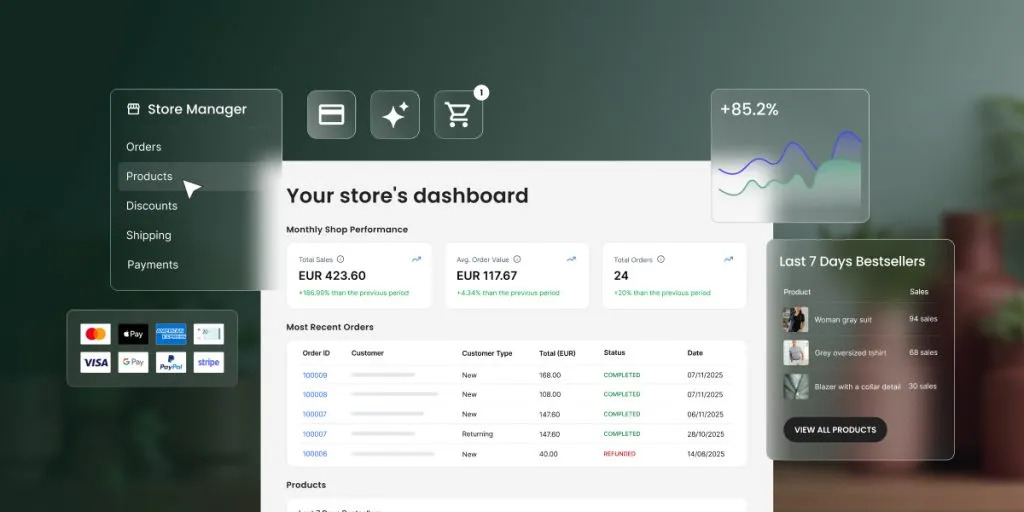
In our recent live webinar our Product Innovation Director Hristo Pandjarov and Product Marketing Manager Pavel Valkanov built an online store with SiteGround Ecommerce, showcasing how easy it is to go from an idea to a live online store. 

It was exciting to see how many of you joined us to follow along and start building your own stores.

The webinar covered the main steps of setting up a store, showed the power of our new drag-and-drop editor and answered many of your questions. If you missed it or want to rewatch, the full recording is now available below:

Below are the key takeaways and some of the questions we didn’t manage to get to during the session.

Key takeaways

Building a complete online store in hours is really possible

It sounds like a marketing claim, but the webinar backed it up. The demo walked through the entire process from product setup to a completed test order in under an hour. 

That was on a tight timeline, of course, and your store will need more thought and attention. But the point stands: what used to take weeks of configuration and troubleshooting is now genuinely doable in a few hours or days, even if you’re starting from scratch. 

You can design, build, and sell with a single solution

Payments, shipping, taxes, SEO, discount codes, marketing tools, and a full drag-and-drop site editor are all built into one platform. There’s no plugin stack to maintain, no compatibility issues after updates, and no need to patch together separate tools for separate jobs. If you’ve ever managed a store across multiple platforms and plugins, you already know why that matters.

You don’t need technical skills to build and launch an online store

The webinar showed pages being edited visually: moving elements, changing fonts and colors, creating new sections from templates. Аll of this without writing a single line of code. And helpful tools such as the alignment grid and contrast indicator help you design like a professional.

There’s even built-in AI for generating text and images, so you’re not starting from a blank page. The whole point is that you can set up your store, make it look the way you want, and update it yourself whenever you need to.

SiteGround Ecommerce – your questions answered

What is the difference between SiteGround Ecommerce and WooCommerce?

SiteGround Ecommerce is a fully integrated platform where website building, store management, checkout, hosting, and marketing tools are all built into one product. WooCommerce, by contrast, is a plugin that adds ecommerce on top of WordPress, with capabilities that depend on stacking additional plugins for payments, shipping, tax, design, and more. That flexibility suits businesses with complex, custom requirements, but it comes at the cost of ongoing technical maintenance, additional themes and plugins cost, and management overhead. SiteGround Ecommerce is designed to be the more practical choice for small business owners who want to get selling quickly without becoming part-time website administrators.

Can I migrate my existing store to SiteGround Ecommerce?

We are very excited about providing an option to migrate existing online stores to SiteGround Ecommerce. The team is actively working on such an option for WooCommerce stores and will share more about the release of it soon. In the meantime you can try the new Website Builder and Ecommerce and see how easy it is to build pages and add products. We bet that recreating your existing website might be easier than you think. Plus, starting fresh means that you will have a chance to streamline your content and get rid of old pages or product drafts. If you are still interested in migrating from another platform, please share this feedback with us via the feedback form inside of the SiteGround Ecommerce store manager.

What payment methods are supported?

SiteGround Ecommerce supports multiple payment methods such as: 

  • Stripe, and through it debit and credit card payments, Apple Pay, Google Pay, several pay later options such as Afterpay and Klarna and another 120+ payment options 
  • PayPal, and through it PayPal wallet, PayPal pay later, card payments,  and Venmo 
  • Pay on Delivery, or when the item is picked up from your physical location
  • Bank (wire) transfers via SEPA, SWIFT, BACS, CHAPS, etc.

You can offer multiple payment methods simultaneously, for example, PayPal for wallet payments and Stripe for card payments at the same time. Mollie and Worldpay are not currently supported, however we are looking to expand payment options and your feedback will be key in our decision on how to prioritise them.

What kind of products can I sell?

The platform supports three main product types depending on their delivery method but in reality there is no limit of what you can sell. You can set up physical products, non-deliverable ones, such as services, courses, memberships, and downloadable, such as files and ebooks. You can easily create product variations based on pre-built or custom attributes such as size, weight, colour, gender and age. There is also no limit on the number of products you can list regardless of the plan you choose.

How does tax configuration work?

The SiteGround Ecommerce has a built-in tax calculator with preset standard rates. Through the Basic Tax Setup, you register only for the countries and states where you are legally required to collect tax, which means you can effectively leave tax off for markets where you have no obligation. You can also set up tax overrides at the state, county, city, or ZIP level for the USA. For EU stores, domestic or OSS registration is supported. The Advanced Tax Setup via Stripe Tax handles more complex international scenarios and supports product-level tax codes. Note that it remains the store owner’s legal responsibility to ensure compliance, we recommend consulting a local tax professional.

What shipping options are available?

You can easily set up and manage shipping with SiteGround Ecommerce. We support creating shipping zones by country or state, and set flat-rate shipping, free shipping above a minimum order amount, or local pickup. We will soon launch our native integration with Shippo to easily add advanced shipping options to your site. You will be able to get discounted rates from top carriers,  optimise margins by applying dynamic shipping pricing, and save time by creating and printing shipping labels in seconds. Customers using the integration will have access to many major carriers such as USPS, UPS, FedEx, DHL, Canada Post, Correos, Deutsche Post, DPD DE, and Evri.

How much does SiteGround Ecommerce cost?

SiteGround Ecommerce is free to try for 14 days with no credit card required. After the trial, there are three plans that have been designed to meet your needs regardless of where in your ecommerce journey you are: 

  • Sell: designed for people that are just starting their online journey; 
  • Grow: for those with some experience selling and looking for a platform that will help them take the next step;
  • Scale: for experienced sellers looking for professional tools that will take them to the next level. 

All plans can be billed either monthly or annually. There is also a Build plan which gives access to the Website Builder only, without ecommerce features. For the most up to date pricing of each plan and all features included visit the product page.

How can I promote my online store?

The platform provides many powerful marketing features out of the box to help you set up and promote your store. You can generate AI descriptions and images to bring life to your products and speed up product creation. Built-in SEO tools help with making your products and pages discoverable by search engines and AI chat bots: automatic sitemaps, SEO-friendly URLs, and meta fields. Google Tag Manager integration also comes out of the box and enables adding tracking and advertising pixels such as Google Analytics, Google Ads, and Facebook Pixel. 

You can make your products more discoverable and set up shopping ads using our automatically generated product feeds for Google Merchant Center, Meta Commerce Manager as well as OpenAI product feed for agentic commerce. Discount codes and promotions (including scheduled campaigns) also come out of the box to boost your conversion rates and average order value. Abandoned cart recovery emails are also available on higher plans. Finally, you can keep an eye on your sales and understand how your store is performing using the easy-to-use analytics,  covering orders and revenue, product performance, inventory, and traffic, with trend comparisons across periods.

Can I add an ecommerce store to my existing hosting plan?

SiteGround Ecommerce is a separate service and ecommerce stores cannot be added to existing hosting plans. The ecommerce plans include their own hosting infrastructure, so you are not paying for hosting twice, instead you get a fully integrated platform where website building, store management, checkout, hosting, and marketing tools are all built into one product. The 14-day free trial is available to both new users and existing SiteGround customers to help you evaluate the platform before you commit to it.

Do you offer support for SiteGround Ecommerce?

Yes! All plans include 24/7 support via chat and tickets, plus a built-in AI assistant that offers contextual help right inside the store manager. Our support team works hard to be fast and friendly, and we’re proud that customers consistently rate their experience highly. And don’t just take our word for it, our reviews and 98% customer satisfaction speak for themselves.

What’s coming next for SiteGround Ecommerce

The platform is evolving fast, and the roadmap is packed.

Advanced shipping options are coming to the platform very soon, thanks to the integration with Shippo, which will allow you to easily pick from a wide range of shipping providers and print labels for your orders.

Beyond that, we are working on an exciting new blogging/news functionality that will help you quickly and easily publish regular content and updates to your website. This has been one of the most frequent requests by users and we are working on making it available very soon. In addition we will soon provide you with the option to create product add-ons, such as custom text for engraving, descriptive attributes and thumbnail variations – all of these will come built in, no plugins or add-ons required.

SiteGround Ecommerce already makes it very easy to create and grow your online store. What’s coming next will make it even harder to find a reason not to start.

Have an idea about an online business or want to see how easy it will be to create a new store? Why not give it a try today? SiteGround Ecommerce comes with a free 14-day trial, no credit card required.


From bold idea to production: the story behind our new Ecommerce Platform

For the past months, multiple teams across SiteGround — engineers, designers, product managers, QA specialists — have been tirelessly working toward a shared goal: the launch of our Ecommerce Platform. It started with a complete redesign of our Website Builder with a grid-based drag-and-drop editor that gives users full creative control over their site, and on top of it, they layered a full set of tools for online store building and management. Why? To let anyone go from zero to a working online store without plugins, third-party tools, or weeks of setup. On March 17, both went live.

True to our mission to help anyone, anywhere, manage a complete online presence with ease, we built both platforms entirely in-house, from scratch. But how did we make it happen? We asked the two main leads behind the development: Hristo Pandjarov, Product Innovation Director, and George Penkov, Engineering Director. 

What was the single biggest bet we made with the Website Builder & Ecommerce Platform, the one decision that shaped everything else?

Screenshot

Hristo: Honestly, it was our decision not to compromise on quality and excellence, regardless of how much development that required.

In the early stages of planning and development, we explored using existing solutions, but we quickly realized that nothing available would meet our needs or deliver the architectural quality we required. So we started from scratch and built on the knowledge we’ve gathered over two decades of hosting websites at the scale and quality we’re known for.

What does ‘from zero to launching an online store in hours, not weeks’ actually require on the engineering side?

Screenshot

George: Having been in web development for 20+ years, it still amazes me how many setup steps are now engineered away: like getting an SSL certificate, setting up DNS records, installing a CMS, and many more. And that’s before you even think about content. Nowadays, even choosing a domain name is simplified with the power of AI. A couple of clicks and you have a fully set-up website. But on the engineering side, all the steps users used to do manually still need to happen.

To build this seamless experience, we built our Ecommerce Platform on top of SiteGround’s already optimized hosting infrastructure— the same one powering over 3 million domains worldwide.

So, we had the infrastructure in place, then it was all about the content. Underneath our simple Ecommerce Builder, where you choose a ready-made template and customize every element to your liking, sits a robust page-editing and rendering engine. We designed its persistence model to prioritize a mature desktop application feel with keyboard handling, undo/redo stacks, zero latency, and generative AI support. Imagine editing a Google Doc, but for your entire website – everything feels instant, you can undo any mistake, and AI is right there to help.

And finally, on top of all that, comes the e-commerce set of tools, including product management, order management, customer profiles, analytics, marketing, shipping, payments, taxes, and more. Implementing all of those features is a monumental engineering effort, and at the same time, the UX is just as critical — because if a user can’t navigate their dashboard, every store update becomes a headache. We are tackling this challenge with several layers of systems to help. Most of the focus is on the initial steps: a templating feature to give you a complete website in a click, a guided tour through your first steps, and we will soon add a very helpful AI assistant that can handle most tasks across the entire vertical with just a prompt.

What’s the hardest problem your team solved that users will never even notice?

Hristo: Our biggest challenge was to strike a balance between maintaining the platform’s simplicity and adding all the necessary functionalities. That’s something a lot of other platforms neglect as they ship countless features, and, in the end, website owners are stuck with an overly complicated interface. 

George: The fluidity of actually using the Website Builder and E-commerce Platform. Users see a desktop app-like experience — instant previews when dragging the color picker, responsive undo and redo, and complex tasks like dragging, resizing, and arranging elements that feel as smooth as using a graphic design tool. That fluidity was essential, and it took serious engineering effort to achieve. We didn’t just need to make it work — we needed to make it feel effortless, so there’s zero frustration when building a site.

We have more features coming soon that will streamline online store management even further with a helpful AI assistant that can handle most tasks across the entire workflow with just a prompt.

With all the platforms for online store building, why did you decide to build one as well?

Hristo: For the past 20+ years, we’ve been striving to empower small businesses and entrepreneurs to succeed online. We saw that in the landscape of tools, many focus on a rich set of functionalities that overwhelm users, and instead of simplifying processes, they create more bottlenecks. So we focused our efforts on simplifying and streamlining each of the e-commerce business pillars: product management, payments, deliveries, and taxes. This way, we strive to make it easy for anyone without a technical background to build a fully functional website on their own. Our main goal was to support businesses by letting them focus on generating revenue rather than managing their websites.

Our mission is the success of our clients

This launch isn’t just about a new platform. It’s about enabling people all around the world to achieve more without dealing with the technical complexity. Because there are no bad business ideas — just ones that never make it past the idea stage.

If you want to be part of a team where every decision enables millions of users around the globe to create their successful online business, apply to our open positions.

Visual Edit and AI image generation are now live in Coderick AI

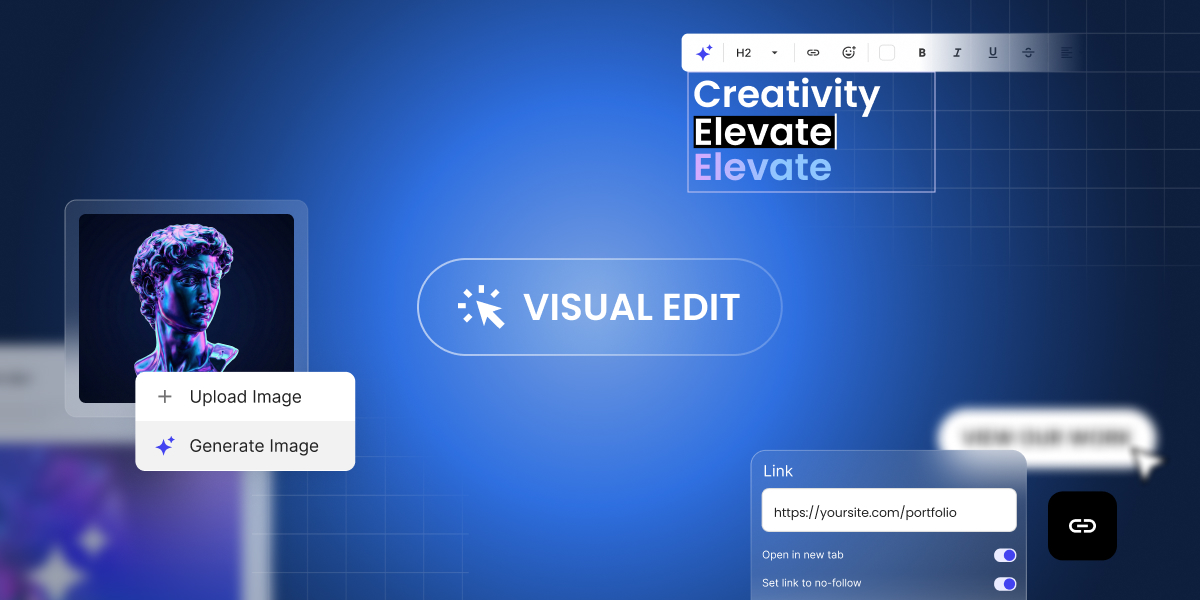
Coderick AI Visual Edit preview showing click-to-edit text, link settings, and image options to upload or generate an AI image.

If you’ve been building with Coderick AI, you know the drill: describe what you want, and Coderick AI builds it for you. It’s fast, it’s intuitive, and it works. But once your project starts taking shape, not every change needs a full prompt. Sometimes you just want to fix a typo, swap out an image, or adjust a button color – and you want to do it now, not through another round of back-and-forth with the AI.

That’s exactly why we built Visual Edit in Coderick AI.

Click, change, done – that’s Visual Edit

Visual Edit mode button in Coderick AI for editing directly in the project preview.

Visual Edit is a new way to make changes to your Coderick AI projects – directly in the preview, with a click. Instead of going to chat and writing a new prompt every time you want to tweak something small, you can now click on any text, button, image, link, or section and change it on the spot.

Update a headline. Fix a typo. Change a button label. Swap a link. Adjust a color. All of it happens right where you see it, with no prompt needed – and zero credits used.

It’s the kind of editing that feels obvious once you have it – and frustrating to live without once you’ve tried it.  

Generate images with AI, right where you need them

Coderick AI image menu in Visual Edit with options to upload an image or generate an AI image and swap it in place.

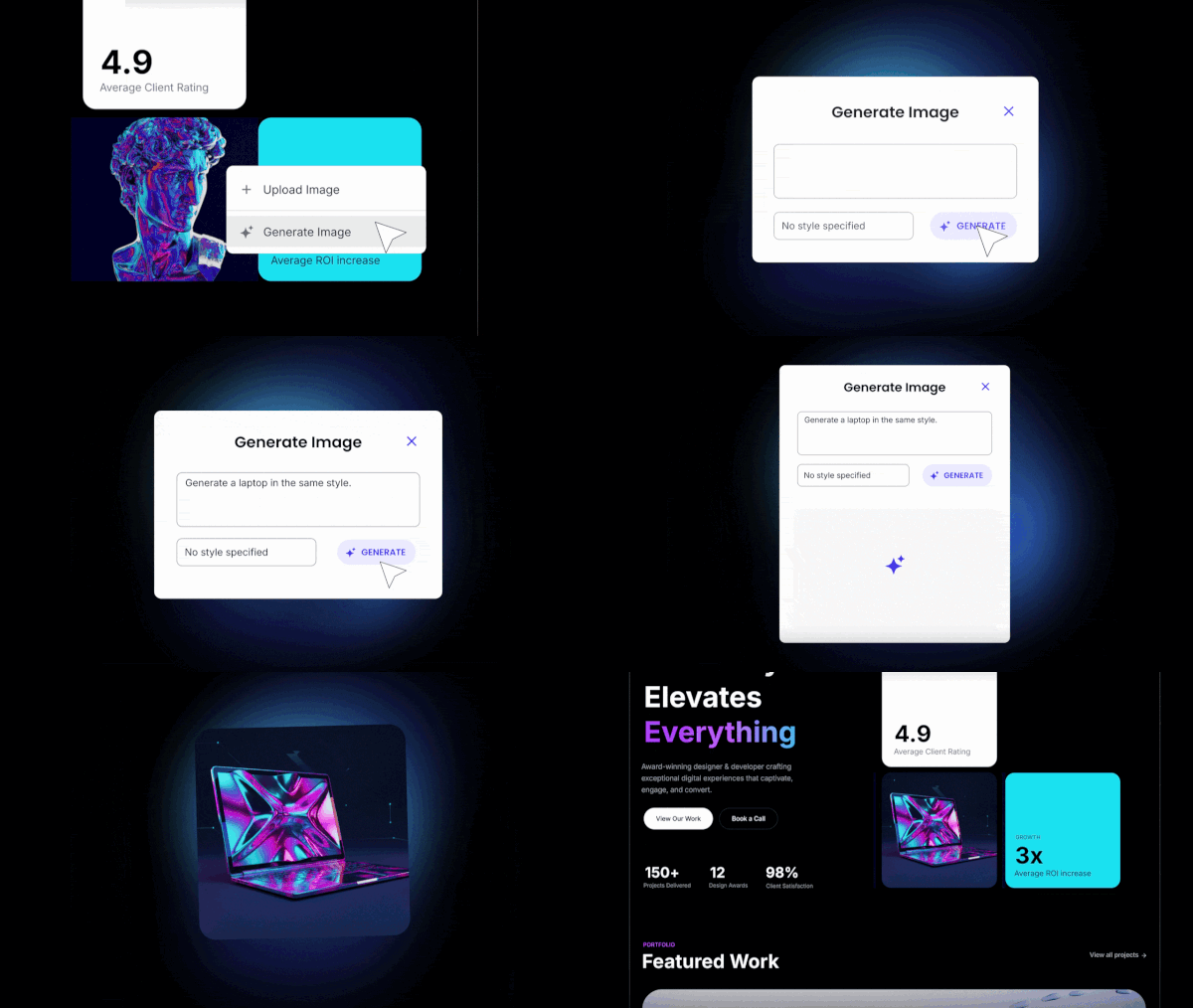
Building a project usually means you’ll need images – and until now, that meant leaving Coderick AI, finding or creating an image somewhere else, and uploading it back. With AI image generation in Coderick AI, you can now click on any image in your project, generate a new one with AI, and swap it in on the spot. Review it in context and move on – no extra tools, no context-switching, no manual uploads.

And if you already have the right image for the spot, upload and replace it directly. This action doesn’t need AI and costs you zero credits.

Transform sections or update elements at scale with focused AI edits

Edit with AI in Visual Edit: selecting a section and prompting Coderick AI to rework only the chosen element in the preview.

Some changes go beyond a quick text swap but don’t need a full project prompt either. Maybe your pricing section needs a completely different layout. Or the navigation bar of your site needs a different design direction. These aren’t small tweaks, but they’re not “build me a new page” territory either.

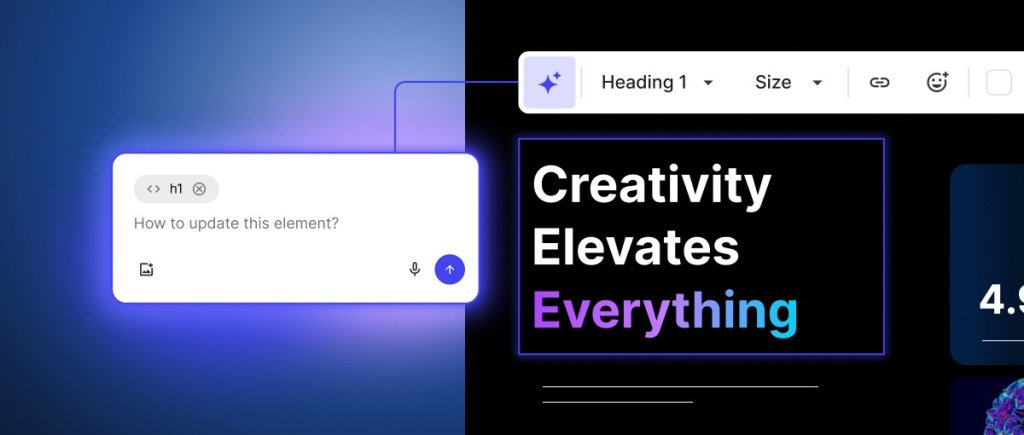
That’s what focused AI edits in the Visual Edit are for. From Visual Edit, select a section or an element, and click Edit with AI. The Coderick AI chat locks onto your selected element – describe what you want changed, and the AI reworks just that part. The rest of your project stays exactly as it is.

The difference from the main Coderick AI chat is simple: the chat is for full-project work like adding new pages or making structural changes. Focused AI edits are for when you already know what needs to change and you just need the AI to do it, precisely, in that one spot or section. Shorter prompts, no unintended side effects, better results.

Save credits for the work that matters

Not every edit needs AI, and now, not every edit costs credits. Quick edits through Visual Edit use zero credits. Your balance stays untouched for the work that actually needs AI – generating new sections, reworking layouts, or creating images. And when you do use Edit with AI, it targets only the section you select, so you get more precise results with fewer credits per edit.

Here’s how credits work:

What you’re doingHowCredits

Edit text, buttons, links, colors
Visual Edit (direct click)Zero
Swap or upload your own imagesVisual Edit (direct click)Zero
Generate an image with AIAI image generationUses credits
Rework a specific sectionEdit with AIUses credits (section-level, not full project)
Build something new from scratchChat prompt
Uses credits

How to use Visual Edit?

Getting started takes seconds:

  1. Open any project in Coderick AI.
  2. Click the Visual Edit button to switch from the chat-based builder to the visual editor (preview editing).
  3. Click on any element in your project preview – text, buttons, images, links – and edit it directly.
  4. To generate an image, click on an existing image and use the AI image generation option.
  5. For bigger changes, select a section and choose Edit with AI to rework it with a targeted prompt.

When you’re done, click Save to keep your changes, or Exit to discard them.

Ready to try it?

Coderick AI was built to get your vibe coding from idea to live project as fast as possible. But speed isn’t just about the first build – it’s about everything that comes after. The tweaks, the refinements, the “can you just change that one thing” moments that add up.

Visual Edit makes those moments faster and cheaper. Quick edits cost zero credits. Bigger changes are more targeted. And AI image generation means one less reason to leave your project or your workflow.

Visual Edit and AI image generation are now available in all Coderick AI projects. Open a project, switch to Visual Edit, and see how it feels to click, change, and keep building.

START BUILDING WITH CODERICK AI →

Why MarketingDirecto.com hasn’t switched hosts in 8 years

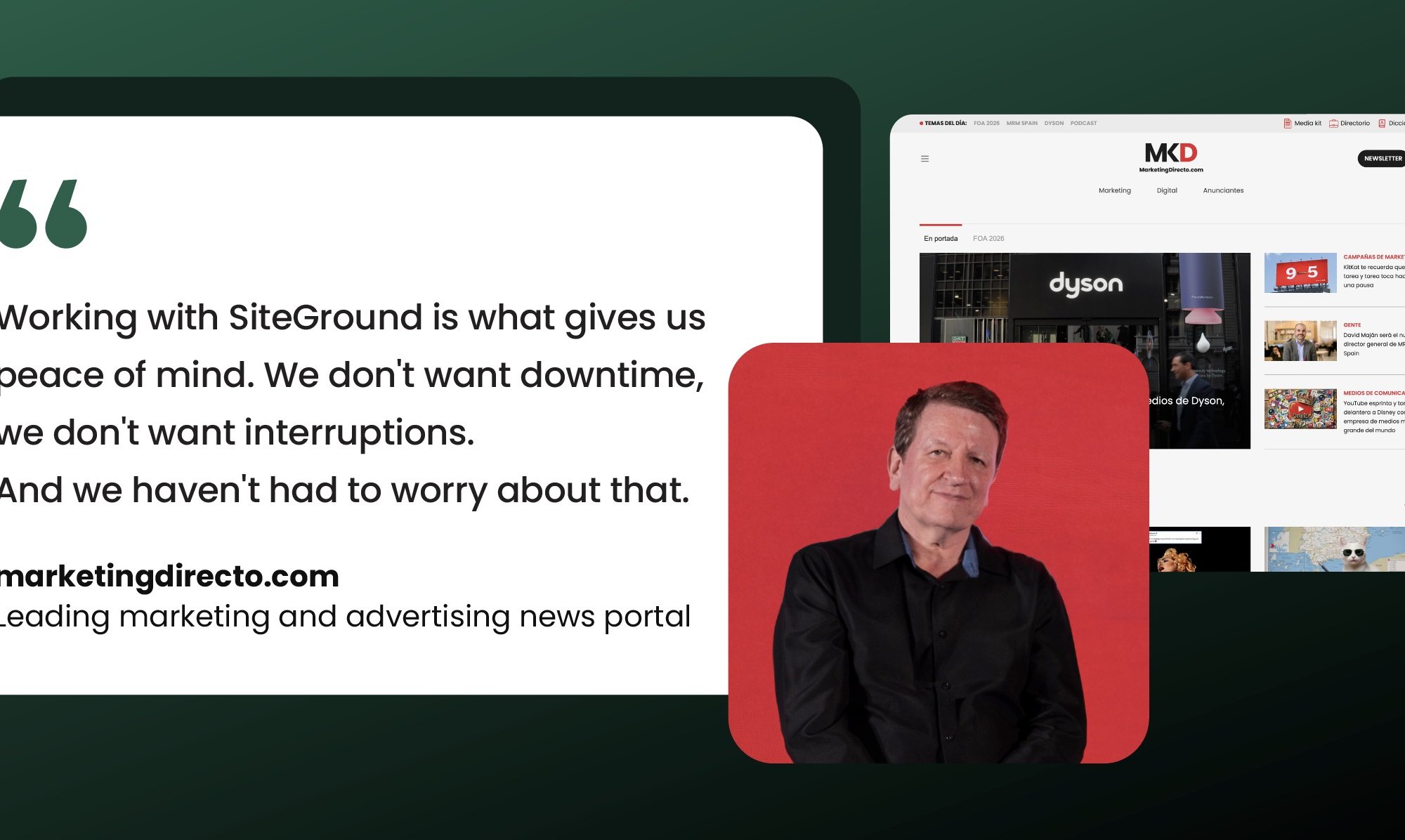
Quote card featuring Javier Piedrahita, founder of MarketingDirecto.com, saying "Working with SiteGround is what gives us peace of mind. We don't want downtime, we don't want interruptions. And we haven't had to worry about that." alongside a screenshot of the MarketingDirecto.com homepage.

When your website is your business, downtime isn’t an inconvenience. It’s lost revenue, lost trust, and lost visibility in search. Whether you’re running an online store, a service business, or a content-driven site, your audience expects it to just work.

MarketingDirecto.com’s CEO & Founder Javier Piedrahita knows that pressure better than most. As one of the longest-running marketing and advertising news portals in the Spanish-speaking world, they’ve been publishing daily since 1999: a quarter century of content that professionals still search for, reference, and share.

But keeping a site like that online: fast, stable, and accessible, turned out to be harder than it should have been.

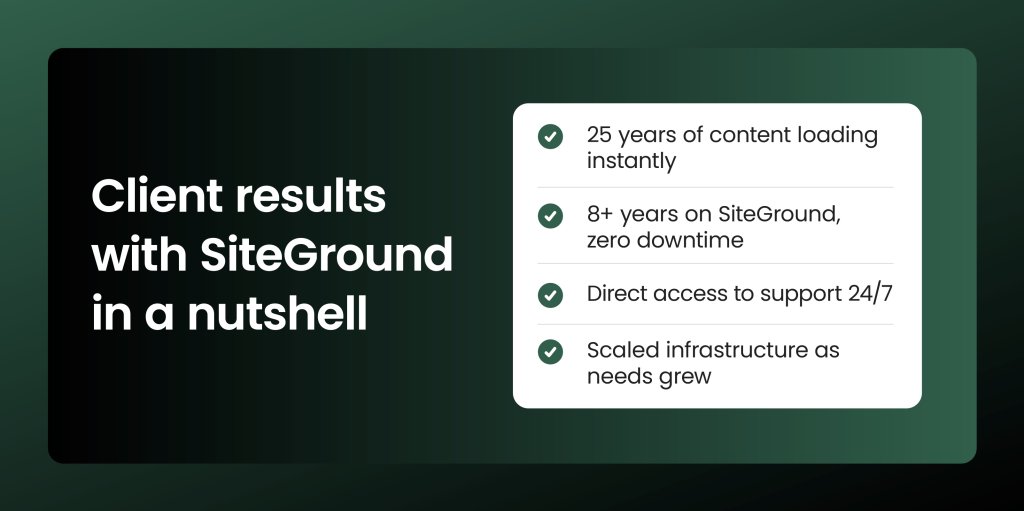
Summary card of MarketingDirecto.com's results with SiteGround: 25 years of content loading instantly, 8+ years on SiteGround with zero downtime, direct access to 24/7 support, and scaled infrastructure as needs grew.

The problems that kept piling up

Before SiteGround, MarketingDirecto.com was dealing with constant downtime, growing technical concerns, and a hosting provider that couldn’t keep up.

Constant downtime with no explanation

Imagine it’s Friday evening, you’re trying to step away from work, and a thought creeps in: is the site still up? For MarketingDirecto.com, that wasn’t occasional paranoia. It was a pattern.

“I remember the stability issues. It scared me a lot. The weekend would arrive, and I’d wonder: what’s happening with the website? Why is the site down? What’s going on?”

But the outages were only part of it. On top of that, they were dealing with:

  • CMS issues with no clear fix
  • Security concerns with no dedicated team to handle them
  • A hosting provider with no real answers

“All of this gave us worries and headaches. When you suffer from the downtime, you suffer in Google, you suffer in positioning, long faces all around.”

When your site depends on Google traffic, that last part hits hard. When your site goes down, you don’t just lose visitors right then. You can also slip in search results, and climbing back up takes a lot longer than going down.

A site that outgrew its hosting

The more content you publish, the heavier your site gets. Blog posts, images, landing pages, product listings: it all adds up. And at some point, the hosting that worked fine with 50 pages starts buckling under 500. Or 5,000.

MarketingDirecto.com has 25 years of daily content in their archive: thousands of articles and images that readers still access every day. Their previous hosting simply couldn’t keep up with that volume.

No technical backup when things broke

And through all of this, MarketingDirecto.com didn’t have a dedicated technical team to lean on. Most small and mid-sized businesses don’t. You’re relying on your hosting provider to catch problems, explain what went wrong, and fix things quickly.

When that provider can’t deliver, when you’re left guessing why your site went down and when it might happen again, you spend time on server issues instead of the work that actually moves things forward.

“There wasn’t a technical service team on top of things. Security was always a concern and that’s something we’d dealt with at some point.”

What changed with SiteGround

MarketingDirecto.com moved to SiteGround in 2017, and just like that, the “weekend anxiety” was gone.

“Since 2017 we’ve been working with you, and I’m very happy because I know this is what gives us peace of mind. We don’t want downtime, we don’t want interruptions, we don’t want problems. And with you, this has been working very well.”

For MarketingDirecto.com, it came down to three things: 

  1. A site that finally stayed fast and stable
  2. Support they could actually reach
  3. Infrastructure that scaled with them instead of holding them back

Speed and stability that hold up under pressure

The site just stayed up. No more unexplained crashes. The 25-year archive of content loaded quickly and consistently, even as the team kept publishing new articles daily.

For a site carrying that much content, performance isn’t just about visitor experience; it’s about protecting the search visibility they’d spent decades building. 

Stable hosting meant stable rankings.

Support that actually picks up the phone

But speed and uptime only tell part of the story. What stands out for MarketingDirecto.com is the ability to talk to real people who understand their setup and to report something the moment it looks off, without waiting in a ticket queue.

Their developer, Luis, works directly with SiteGround’s team when the site needs to scale: adding server capacity, expanding resources, adjusting configurations. And that process has always been straightforward.

Scaling without the headaches

As MarketingDirecto.com’s needs grew, SiteGround’s infrastructure grew with them. No drawn-out migrations. No “you’ve outgrown your plan, good luck” moments. Just a team that already understood the site’s architecture and could expand capacity when needed.

What eight years with SiteGround looks like

Nobody switches hosting providers for fun. You switch because something broke, because support couldn’t help, or because you’ve outgrown what they can offer. MarketingDirecto.com went through all of that before landing with SiteGround and haven’t had a reason to look elsewhere since.

“That’s what brands want: stable, long, trusting relationships. And that’s what I have with SiteGround.”

A hosting team that already knows your site inside out makes a difference. No re-explaining your setup every time you need something. No starting from scratch. Just people who get it and can act on it.

Pick a hosting provider you’ll actually want to stick with

When asked what advice he’d give to other companies choosing a hosting provider, Javier kept it practical:

“Look around. Read reviews, check forums. Look at which clients they work with: ‘Oh look, they work with brands that I even know.’ That’s extremely important. That’s what I’ve done myself.”

Solid advice. The clients a hosting provider serves tell you a lot about whether they can handle what you need, especially if your site carries years of content, faces real security threats, and can’t afford to go dark on a Friday night.

Running a growing business or any project that people depend on? Your hosting should be the thing you think about least. That’s what MarketingDirecto.com found with SiteGround, and it’s why they’re still with the same hosting eight years later.

[86]

Meet the new SiteGround website builder: from an essential site builder to a complete platform to build, sell, and grow online

The New SiteGround Website Builder – build, sell, and grow online

Since we launched SiteGround Website Builder last year, thousands of you have used it to build websites, open online stores, and grow your online presence. We’ve been building right alongside you, working to give you a more powerful design experience, stronger ecommerce capabilities, and the tools you need to do more with your site at every stage.

Today, we’re announcing a major new version of SiteGround Website Builder. It’s a significant step forward for the entire platform, and it comes with new dedicated plans designed around how you actually build and grow online.

More design freedom with new drag-and-drop builder

Gif showing SiteGround Website Builder drag-and-drop grid editor in action

At the heart of the building experience is a grid-based drag-and-drop editor that gives you full creative control over your layout. Place any element (text, images, buttons, forms) exactly where you want on the page. Drag it, resize it, layer it. Smart alignment guides keep everything polished, but the design is entirely yours.

And the control goes well beyond layout. Choose independent colors for any component. Select different fonts for each heading type and paragraph. Crop images directly on the canvas. Fine-tune borders and corner rounding. You have full control to customize your site.

Start from a professionally designed template, bring in ready-made sections and blocks, or build from scratch. Use the AI assistant to generate copy, pull from the built-in image gallery, and let automatic mobile optimization handle the rest. Whether you spend twenty minutes or two hours customizing, the result is a site that looks like it was built specifically for your brand.

A complete ecommerce platform, built right in

A professional website is a great starting point. But if your goal is to sell online, you shouldn’t need a separate platform to make it happen.

SiteGround Ecommerce lets you run a full online store from the same place you design your site. Go from zero to selling in hours, not weeks. No plugins, no third-party integrations, no separate systems to learn.

Start with a store template designed to showcase and sell your products effectively, then customize it to match your brand. From there, you have everything you need to get selling:

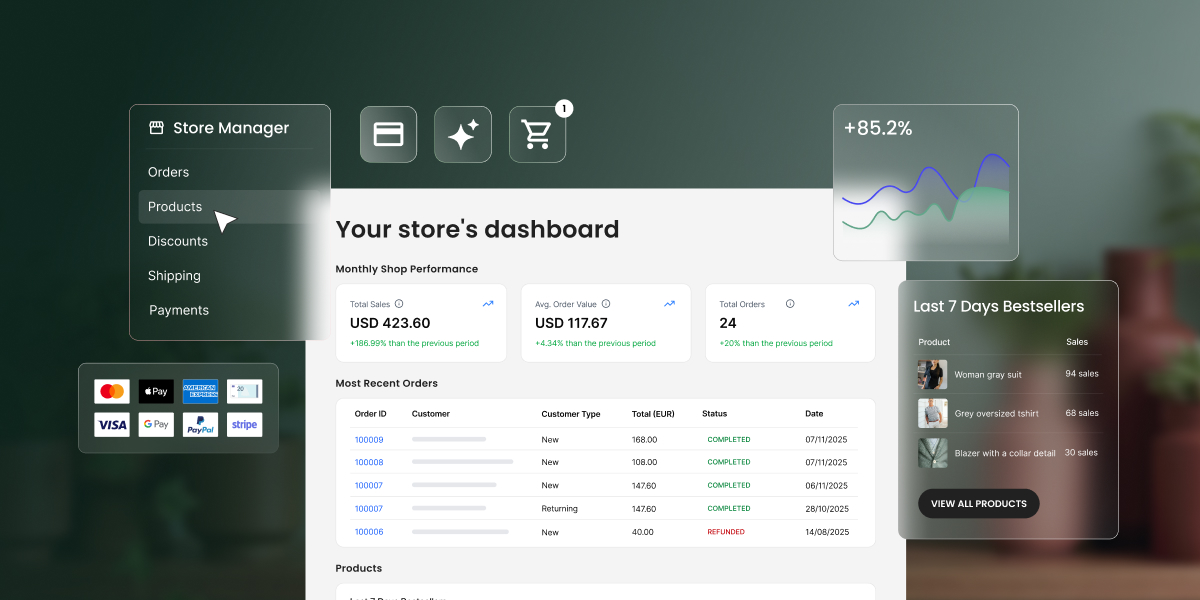
SiteGround Website Builder ecommerce tools – manage products, orders, and customers in one place

Setup your online store

  • Products. Sell physical goods, downloadable products, or services. Add product variations, upload images, and manage your catalog in bulk. The built-in AI assistant helps you generate product titles, descriptions, and categories, so you can populate your store faster.
  • Payments. Accept payments with multiple options right out of the box. Your checkout is optimized for conversion, following ecommerce best practices, and runs at your own domain.
  • Shipping and taxes. Set shipping rules in minutes with easily modifiable shipping zones. Tax calculation is built in and customizable.
  • Order management. Process orders, issue refunds, and manage deliveries from a single dashboard. Track inventory at a glance, including low stock alerts and best-selling products.
  • Customers. View customer information, monitor purchase behavior, and let buyers create accounts to track orders and come back easily.
SiteGround Website Builder marketing tools – SEO, analytics, discounts, and multi-channel product feeds

Grow and convert better 

  • Discounts and promotions. Create targeted offers with full control over discount types, duration, and availability. Launch immediately or schedule for a specific date. Add wishlists so shoppers can save products and return when they’re ready.
  • Product feeds and tracking. Connect your store to social platforms, Google Merchant Center, ChatGPT feeds, and Meta Commerce Manager for multi-channel selling. Track performance across channels with Google Tag Manager and Meta Pixel integrations.
  • SEO and analytics. Built-in SEO tools with automatic sitemaps, SEO-friendly URLs, and AI product categorization help your products get found. Real-time analytics for orders, sales, and traffic let you see what’s working and where to focus next.

Everything you need to launch, manage, and grow an online store without stitching tools together.

New plans designed for each phase of your growth

As the SiteGround Website Builder has grown from a simple site creator into a full platform for building, selling, and growing online, we’ve introduced dedicated plans to match. Each plan is tailored to a different stage of your journey.

All plans include premium SiteGround hosting, powerful AI tools, and 24/7 expert support. And you can try any plan free for 14 days with full access to every feature, no credit card required.

Try the new Website Builder

Your feedback shaped every part of this upgrade, from the grid editor to the ecommerce toolkit to the plans themselves. Now we want you to try it for yourself.

Start a free trial, start building, and tell us what you think.

150+ Sites, zero hosting chaos

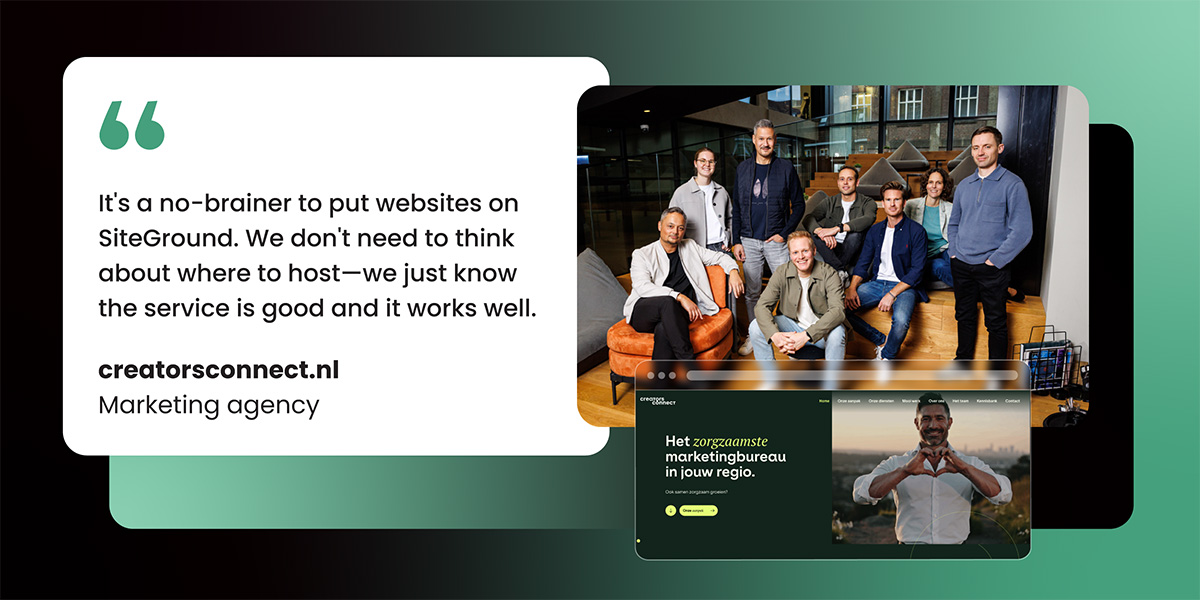
Quote card from creatorsconnect.nl reading "It's a no-brainer to put websites on SiteGround. We don't need to think about where to host—we just know the service is good and it works well," alongside a team photo and a screenshot of their website.

Agencies don’t lose sleep because of strategy. They lose sleep because of instability.

Jeroen Hardenberg, Founder, and Mathijn Vermeer, Partner & Co-Owner of marketing agency Creators Connect, know this firsthand. They experienced what many agencies recognize: new provider, new dashboard, same recurring issues. Not dramatic failures; just a constant low hum of things that shouldn’t need fixing.

As the agency grew (in clients, team members, and responsibility) that approach no longer fit. The standard shifted from “good enough” to “structurally reliable.”

Eventually, after enough testing and enough letdowns, they moved everything to SiteGround.

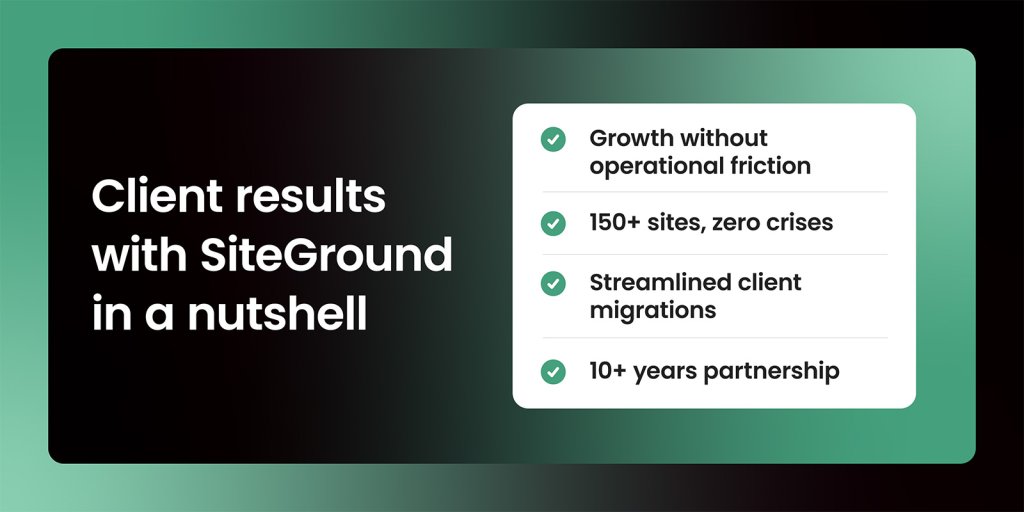
Summary graphic showing Creators Connect's results with SiteGround: 10x revenue, 150+ sites managed with zero crises, streamlined client migrations, and 10+ years of partnership.

The testing phase that wouldn’t end

The move to SiteGround wasn’t a single decision. It happened in stages.

Jeroen signed up for his first SiteGround package in late 2016, after comparing providers and prioritizing European data centers. The service worked, but trust takes time. He kept other options running, still hedging his bets.

His business partner Mathijn was running his own parallel testing cycle, bouncing between providers until he made the switch to SiteGround around 2020.

By 2021–2022, both had seen enough. Everything migrated to SiteGround.

What changed

Five things changed, and each one removed a different source of friction.

Hosting finally stayed in the background

“With other hosting providers, every time there’s another thing that’s broken, you get the headache again. I haven’t had that since working with SiteGround. For me it’s like a no-brainer.”

The infrastructure did what infrastructure should do: it worked, then faded into the background.

A dashboard anyone on the team could use

Creators Connect runs on a network of freelance specialists: photographers, designers, marketers, developers, each with different technical backgrounds. After years of control panels where every small task felt like a detour, SiteGround’s Site Tools were immediately different.

“SiteGround’s Site Tools user interface is so easy to use yet comprehensive that I can easily do anything. It feels more like just a really easy to scan dashboard.”

Streamlined client website migrations

Before, transferring over a client’s website meant figuring it out as you went: a different process every time, with different results, depending on the host. Taking on a new client now follows a repeatable process: assess, migrate automatically with the SiteGround WordPress Migrator, validate, launch. No data loss, no hassle, no variables, the same way every time.

Support that showed up when things went wrong

Despite all of the above, mistakes still happen. And when they do, usually it happens at scale: misconfigured settings, unexpected update breaks. What matters is whether support helps anyway.

“Even if there’s trouble which is caused by us, you guys are still really helpful. There hasn’t been any moment that we haven’t been helped.”

When some hosting plans hit their limits while others had room to spare, SiteGround’s team helped redistribute sites across plans — not to fix a crisis, but to prevent one.

Scaling without multiplying complexity

Since 2016, Creators Connect have been able to grow without hosting holding them back. The team expanded from one freelancer to 25 people. The portfolio grew to 150 managed websites.

That kind of growth usually means more operational risk. Instead, with SiteGround, hosting got simpler.

For new projects under full agency control, the hosting decision is straightforward. SiteGround is the default environment.

Not because alternatives don’t exist, but because consistency reduces operational noise.

The pattern every agency eventually sees

The co-founders keep watching the same story unfold with new clients: businesses trying to save money on hosting, then paying for it elsewhere.

“We have so many clients that move to us and they all use small hosting parties. There’s always trouble, there’s always something that is changing which makes their website go offline.”

Backups not running when disaster struck. Support that vanished when problems hit. One client had to rebuild their entire site from scratch after a provider error wiped everything.

Every hour troubleshooting hosting is an hour you can’t bill. Every site that goes down hurts your reputation, not the provider’s.

After a decade and 150+ sites with SiteGround, the hosting shuffle ended, because the problems did.

Ready for hosting decisions to become no-brainers? Join the agencies who’ve made SiteGround their last hosting switch. Not because they can’t leave, but because they don’t want to.

[86]

Build anything with Coderick AI by SiteGround (Webinar Video and Q&A)

In our recent live webinar, our Growth Marketing Director Monika Dimitrova and our Product Director Daniel Kanchev put Coderick AI to the test: taking three projects from a blank screen to fully functioning applications, in real-time.

They built a staff scheduling app, a full website with a booking system for a local vet clinic, and a brand new website using an existing one as a visual reference. Three projects, three very different use cases, all created through plain language conversation with Coderick AI.

Along the way, they shared tips on prompting effectively, showed how to iterate on designs, and answered dozens of questions live. If you missed it or want to rewatch, the full recording is now available on our YouTube channel:

Below are the key takeaways and the most common questions from the session, answered.

Key takeaways

The three builds showed very different use cases – and the same workflow

The webinar covered three projects back to back, and each one stretched Coderick AI in a different direction. The staff scheduling app was a pure internal tool – backend logic, user roles, shift management. The vet clinic was a full public-facing website with appointment booking baked in. And the third project started from an existing website used as a visual reference, showing how you can take a design you like and rebuild it as something new.

What stood out is that the workflow was the same every time: describe what you want, review what Coderick AI builds, then refine through follow-up prompts. Whether it’s a website or a web app, the process doesn’t change.

The three projects took about 40 minutes in total – but none of them were finished products. They were strong starting points. The more you iterate, the further you can take it. “Easy and in minutes” is real – it’s just the beginning, not the whole story.

How you prompt makes a difference

The better and more specific your description, the closer the first result is to what you actually need – and the fewer iterations it takes to get there.

During the vet clinic build, the prompt didn’t just say “make a vet website.” It described the pages needed, the booking flow, the kind of information to show. That level of detail meant the first version was already close to usable. Compare that to a vague prompt – you’ll get something, but you’ll spend more time (and credits) refining it.

Think of it like briefing a developer. You don’t need to know how to code, but you do need to know what you want. And if you’re not sure, just describe your goal and let Coderick AI suggest an approach – it’s a conversation, not a one-shot command.

Design isn’t locked – it’s iterative

The first result gives you something real to work with – from there, you shape it. “Make the header darker”, “switch to a two-column layout”, “use the color palette from this screenshot.” Each prompt adjusts the design without starting over. You can even describe a mood or a feeling to Coderick AI and see where it goes. During the session, a single prompt for the vet clinic produced a full warm, Japanese-aesthetic redesign complete with paw prints.

This works with visual references, too – not just words, as the third project showcased. You can share a screenshot of a design you like, and Coderick AI uses it as a starting direction. From there, you shape it into something your own.

You end up with a working project on a real URL – hosting, database, security included

Unlike most AI builders where you generate something and then figure out where to host it, Coderick AI projects go live on SiteGround’s infrastructure automatically. Database, hosting, SSL, deployment – all handled. Hit publish, and it’s live.

Coderick AI – your questions answered

Can a non-technical person really build a full app or website with Coderick AI?

Absolutely – that’s the entire point. Coderick AI was built specifically for people who don’t code. You describe what you want in everyday language, and the AI generates a complete, working project for you – structure, design, database, backend logic, and all.

If you happen to have a developer on your team (even a basic one), that’s a bonus. They can guide the prompts with a bit more technical clarity, which often means better results faster. But it’s not required. Thousands of non-technical users are already building real websites and web apps with Coderick AI – from portfolio sites and booking systems to CRM dashboards and invoice trackers.

Can Coderick AI rebuild or refresh my existing website?

Coderick AI can’t directly edit or update your current website – but it can do something arguably better. You can use it to rebuild your site from the ground up. Describe what you want, attach screenshots of your current design as a reference for the direction you’d like to take, and Coderick AI will generate a fresh, modern version.

For smaller updates like rewording text or restructuring your menu on an existing site, SiteGround’s AI Studio is a better fit – and it’s included free with your hosting plan. The two tools complement each other nicely: AI Studio for quick content updates, Coderick AI for when you’re ready for a complete transformation.

Can I customize the design of the apps built with Coderick AI?

Yes – and this is where Coderick AI really stands out compared to template-based builders. There are no preset themes limiting your design. Every project is built from scratch based on your description, which means you have complete creative freedom.

Want to change colors, layouts, fonts, spacing, or navigation? Just tell Coderick AI what you’d like. You can say things like “make the header simpler,” “switch to a dark color scheme,” “add more white space between sections,” or “make the call-to-action button larger and green.” You can also attach screenshots of designs you admire as visual references.

Every element is customizable through conversation – from the overall look and feel down to individual buttons and form fields. No CSS knowledge required. Just describe your vision, and Coderick AI brings it to life.

How is Coderick AI different from building with WordPress?

With WordPress, you’re assembling pieces – picking a theme, installing plugins, configuring settings, and often hiring a developer when things get complicated. With Coderick AI, you skip all of that. You describe what you want in plain language, and the AI builds a fully working website or web app for you – complete with frontend, backend, database, and hosting, all included from the start.

There’s no theme to configure, no plugins to maintain, and no dashboard to learn. You just chat with Coderick AI, and it handles the technical side. Think of it as going from idea to live project in minutes instead of weeks. And because everything runs on SiteGround’s infrastructure, your site is fast, secure, and production-ready the moment you hit Publish.

Can Coderick AI work alongside my existing WordPress site?

Coderick AI is a standalone platform – it doesn’t plug into WordPress or run as part of it. It’s a completely different approach to building for the web.

That said, there are practical ways to connect the two. You can build a tool, calculator, booking page, or any web app with Coderick AI and link to it from your WordPress site. Each Coderick AI project lives on its own domain, so it works beautifully as a companion to your existing setup – especially for functionality that would normally require complex plugins or custom development in WordPress.

How do credits work?

Credits are how Coderick AI measures AI usage. Every action – from generating a new project to making small tweaks – uses a certain number of credits. Simpler prompts use fewer credits, while more complex or detailed requests naturally use more.

Your credit balance resets monthly with your plan, and you can always see how many credits you’ve used and how many remain directly in the interface. The free trial comes with 50,000 credits so you can test and experiment before committing. Paid plans start from just $10/month and include premium SiteGround hosting – so there’s no separate hosting bill to worry about.

Pro tip: Building in small, focused steps isn’t just better for results – it’s also more efficient with credits.

How many credits does a typical project actually use?

It depends on scope, but here’s a useful frame. A simple landing page or single-purpose app uses far fewer credits than a multi-page site with a database, user login, and booking system.

Paid plans start at 100,000 credits per month on Essential, 200,000 on Plus, and 400,000 on Pro – so there’s room to build, iterate, and maintain without constantly watching the counter. 

Pro tip: The best way to stretch your credits is a specific, well-thought-out first prompt – the closer your brief, the less back-and-forth it takes. If you’re a SiteGround customer, a great way to plan ahead is to use AI Studio to shape and refine your idea before bringing it into Coderick AI.

How does Coderick AI compare to other AI builders like Bolt, Lovable, or Replit?

There are many AI app builders out there, and at first glance they might seem similar – you describe what you want, then AI generates it. The meaningful difference is in what happens after the build.

Most vibe coding tools are builders only and once your project is generated, you still need to figure out hosting, deployment, database, and security. Some platforms bundle these extras, but they typically come from third-party providers and cost on top of the base plan.

Coderick AI is an all-in-one platform. The building, hosting, database, SSL, and deployment are handled together from the start on SiteGround’s infrastructure – no separate bills, no configuration, no second project. You hit Publish, and it’s live. And with 20 years of hosting expertise behind it, your project runs on the same foundation that powers some of the web’s most demanding sites.

Can I build an e-commerce store with Coderick AI?

Yes – and it’s one of the most popular use cases. Coderick AI can build product catalogs, order forms, landing pages, and even membership areas with user login. You describe your products, how you want them displayed, and what the ordering flow should look like, and Coderick AI generates a clean, working storefront for you.

It’s a great fit for businesses that want an online presence without the complexity of WooCommerce or a full e-commerce platform. If your model relies on cash on delivery, bank transfers, or simple order capture, Coderick AI handles it right out of the box – no plugin setup, no overhead.

What about payments like Stripe and PayPal?

Payment gateway integrations aren’t available yet – but stay tuned. This is one of the most requested features and something we’re actively working on. For now, Coderick AI is perfect for order forms, product catalogs, and checkout flows where payment happens outside the platform (think bank transfers, invoicing, or cash on delivery). You get a fully functional storefront with a working backend that captures every order – you just handle the payment step separately for the time being.

How do I fix errors without technical knowledge?

You don’t need to understand a single line of code. If something isn’t working the way you expected, just tell Coderick AI what’s wrong – in plain language. Describe the issue, and it will debug and fix it for you.

That said, the more specific you are, the better the result, and adding a screenshot gives Coderick AI much more to work with.

And here’s the safety net: Coderick AI has built-in version control. If a fix doesn’t work or something goes sideways, you can roll back to a previous working version with one click and try a different approach. The best practice is to build in small, incremental steps – that way, issues are easy to spot and quick to resolve. Think of it as working with a developer who’s always available and never judges you for not knowing code.

How do I maintain my Coderick AI project after it’s built? 

The same way you built it – by talking to Coderick AI. Want to update a product listing, add a new page, or change the wording on your homepage? Just describe what you want, and Coderick AI applies it. 

There’s no separate admin panel to learn, no theme editor to navigate. Your ongoing conversation with Coderick AI is how you manage the site.

Can I see or edit the code that Coderick AI generates?

Coderick AI is designed so that everything happens through conversation: you describe what you want, and the AI builds it. The generated code runs under the hood, and the current interface doesn’t expose it for direct editing in the way a traditional code editor would. For most users, that’s the whole point: no code to write, read, or maintain.

For those of you who want to go deeper, a built-in code editor is in the roadmap – so if code-level control matters to your workflow, keep a look out for news and product updates.

What integrations are currently available?

Right now, Coderick AI handles everything that’s built in: databases, user authentication, email functionality for authentication, and all the backend logic your project needs. Third-party API integrations – like connecting to Stripe, Google Workspace, or external services – aren’t supported yet.

But here’s the exciting part: this is actively being worked on, and there are some big announcements coming soon. In the meantime, there are creative workarounds. 

Who owns what I build with Coderick AI?

You retain ownership of your project ideas, content, data, and everything you create – the website functionality, text, images you upload, and the overall output. It’s your work.

Coderick AI is designed as a fully managed platform, which means your projects are hosted and run on SiteGround’s infrastructure. There’s no option to download the raw source code or export projects to another hosting provider. This is by design – it’s what keeps everything fast, secure, and hassle-free. You focus on building and growing your project; the platform takes care of the rest.

What are the realistic limits of what Coderick AI can build?

Coderick AI is remarkably capable – but it’s good to know where it shines brightest. Here’s a quick breakdown:

What it does well: Business websites, landing pages, portfolios, product catalogs, dashboards, CRM systems, booking pages, membership areas with login, order management tools, task trackers, invoice generators, and internal business apps. You can also ask for animations, parallax scrolling effects, and custom design elements.

What’s coming in the future: Payment gateway integrations, connections to external APIs and third-party services, and expanded e-commerce features.

What it doesn’t do: Coderick AI builds web-based projects that run in a browser. It can’t create standalone desktop applications for Windows or Linux. It also doesn’t currently support agentic workflows or direct connections to external platforms like AWS.

The sweet spot? Any web-based tool, site, or app that you can describe clearly – Coderick AI can likely build it for you.

Can Coderick AI build apps with a database – and can I manage the data myself?

Yes, and Coderick AI creates the database automatically when your project needs to store and retrieve data (user accounts, bookings, product listings, form submissions, inventory records), Coderick AI creates a database for it. No configuration required — it’s there when you need it.

Once the database exists, you can manage it directly through the built-in database dashboard in the Coderick AI interface. From there, you can add records, edit existing entries, or create new data collections. So a real estate agent can add new property listings directly. A restaurant owner can update their menu items. A studio manager can remove past events.

One thing worth highlighting: your database is stored on SiteGround’s own infrastructure – meaning it’s part of your hosting environment, covered by the same data protection and security standards your site already runs on.

Pro tip: You can also ask Coderick AI to build you a custom admin panel – with personalised views, user roles, and exactly the controls your workflow needs.

How do I get the best results when describing what I want?

The quality of your output depends on the quality of your input – and the good news is, you don’t need to be technical to write great prompts. Here are the key principles:

Be specific. Instead of “build me a website,” try “Build a yoga studio website with a class schedule, an about page, instructor bios, and a contact form that collects name, email, and message.”

Build incrementally. Start with the core structure, review it, then add features one at a time. This keeps things clean and makes issues easy to spot.

Use screenshots as references. If you see a design you like, attach a screenshot and pair it with a description. For example: “I want a layout similar to this, with a horizontal navigation bar and a three-column feature section below the hero image.”

Describe problems clearly. If something isn’t right, tell Coderick AI exactly what’s happening and what you expected instead. The more precise your feedback, the faster the fix.

Think of it as collaborating with a talented developer – the clearer your brief, the closer the result is to your vision on the first try.

Can Coderick AI build websites in languages other than English?

Yes. Because Coderick AI generates content based on your prompts, you can build in any language. All you need to do is write in the language you want the site to use, or specify it explicitly.

The same applies to regional variations: if you want UK English rather than American English, or want to make sure dates, currencies, and formatting follow local conventions, just include that in your instructions. Coderick AI will follow your lead.

How do I publish my project live?

It’s as simple as hitting the Publish button inside Coderick AI. Once you do, your project goes live – no extra setup, no third-party hosting to configure, no deployment steps to figure out.

You can either use the system URL that’s automatically generated for your project or connect your own custom domain for a more professional look. Either way, your site is accessible and ready to share the moment you publish.

And here’s the best part: every Coderick AI plan comes with premium SiteGround hosting built in. That means your site is fast, secure, and backed by SiteGround’s infrastructure from day one – security and performance optimization all included. There’s no separate hosting bill and nothing to manage on the technical side. You build it, you publish it, and it’s live.

What’s coming next for Coderick AI

Coderick AI is evolving fast, and the roadmap is packed.

Third-party integrations are with high priority on our roadmap, including connecting to external services like payment providers. It’s a frequently requested feature and one we’re committed to building out.

Beyond that, we’re working on in-preview editing so you can make changes directly in the visual preview, text-to-speech capabilities, and deeper AI enhancements that will make the building experience even more intuitive. In addition, you can expect soon to have professional emails that you can use with your Coderick AI project’s custom domain.

Coderick AI is already a powerful vibe coding tool for building websites and web apps without writing code. What’s coming next will make it even harder to find a reason not to start.

Everything you saw in the webinar – the live builds, the tips, the speed – you can try it right now. Coderick AI comes with a free 14-day trial, no credit card required. Describe your first project, and see what happens.

What would you like to see in Coderick AI next? Drop a comment below – we read every one, and your ideas can shape the roadmap.

SiteGround AI Agent for WordPress: Your AI assistant for WordPress management

WordPress dashboard with AI management tools, a sport-themed website preview, and floating interface illustrating an AI assistant managing multiple WordPress sites.

Managing a WordPress site means endless clicks, repetitive tasks, and hours spent in the admin dashboard. But what if you could trade all of that for a simple chat with AI? 

The SiteGround AI Agent for WordPress makes this (and so much more) possible.

What is the AI Agent for WordPress?

The SiteGround AI Agent for WordPress is an AI-powered assistant that connects directly to your WordPress installation and executes real changes on your site – not just suggestions or generated text, but actual site management. It transforms tasks that typically take hours of manual WordPress admin work into minutes of simple conversation, freeing you to focus on growth and productivity.

The AI Agent for WordPress is part of the recently launched SiteGround AI Studio service, where clients get access to chat with multiple AI models and 15+ AI agents, and is available for free to all SiteGround customers with 20,000 AI tokens monthly.
The AI agent for WordPress connects directly to your WordPress sites and lets you manage content, plugins, WooCommerce, users, and more through natural language prompts, saving you precious time and reducing the learning curve and technical barriers to maintaining a successful website.

Why SiteGround’s AI Agent for WordPress is a game-changer?

The AI Agent for WordPress is a game-changer for bloggers, WooCommerce store owners, and agencies who want to spend less time on WordPress admin and more time growing their business. Unlike AI writing plugins that generate text for you to copy and paste, the AI Agent works directly on your live site – it creates, edits, publishes, updates, and deletes on your behalf.

  • Execute tasks in minutes, not hours – Tasks that used to eat up your afternoon now happen while you take your coffee.
  • Do bulk actions at scale – Update 200 images, translate 50 products, restructure an entire taxonomy. Even manage multiple WordPress sites simultaneously. One prompt can handle them all.
  • No WordPress expertise required – You won’t get instructions to follow or code to insert. The agent performs the actual task on your WordPress site based on what you ask, making it accessible to beginners and non-technical users alike.
  • Delegate entire AI Agent workflows for WordPress – Hand over not just the boring small stuff, but entire workflows, asking the AI assistant for WordPress to execute multiple consequential steps to a complete solution. 
  • Reduce errors – The agent not only performs, but also protects you from irreversible mistakes, thanks to the “Power mode” feature available. The SiteGround AI Agent Power Mode safety guide explains the permissions, confirmation steps, and live-site precautions.

What can the AI Agent for WordPress do?

Among AI plugins and AI agents, SiteGround’s AI Agent is the most powerful AI tool for managing WordPress sites right now. Here’s an overview of its capabilities:

Complete content management 

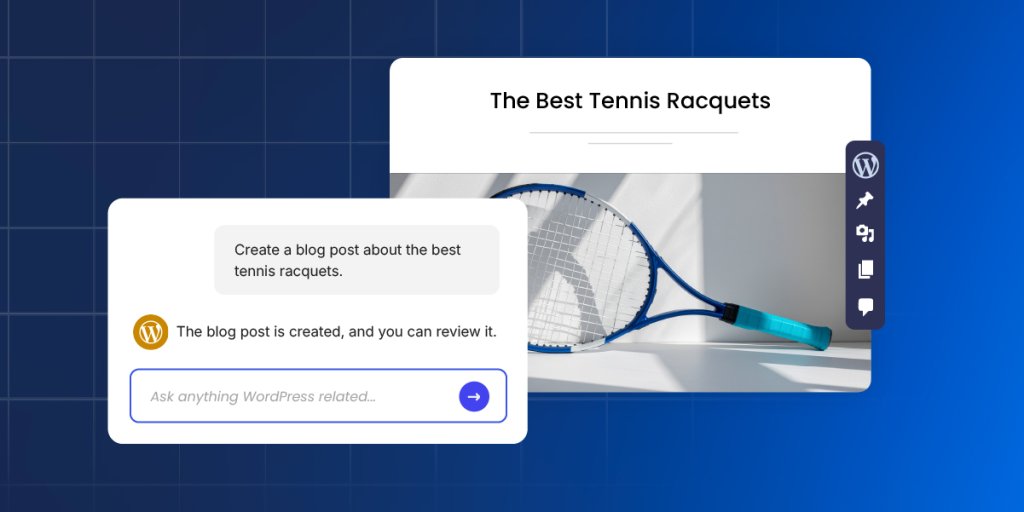
Interactive WordPress interface where a user asks an AI assistant to create a blog post about the best tennis racquets and instantly receives a completed draft preview, illustrating automated content and image generation.

Content management is where most WordPress site owners feel the daily grind. SiteGround’s AI Agent for WordPress transforms this entire experience, letting you accomplish in minutes what used to consume hours of scattered admin work.

Create, edit and publish blog posts

The AI Agent is able to create posts in WordPress, generate the necessary content, including text and images, assign them to the right categories and add tags, upload media files, and publish them when you’re ready. A single prompt can replace the entire manual workflow of drafting, formatting, categorizing, and scheduling, saving you significant time and effort on every piece of content you create. See these AI Agent for WordPress prompt examples for clear, review-friendly requests you can copy and adapt.

Updating old content is also a piece of cake. Ask the agent to make specific updates, and it makes only the targeted changes while leaving everything else untouched. Your Gutenberg blocks stay perfectly formatted. Your shortcodes keep working. 

Build site structure and pages

The agent creates and edits pages the same effortless way, whether it is a simple About page, a complex Services page with multiple sections, or an entire site architecture with parent-child page hierarchies.

What is more, you could give the agent a sitemap – just describe it or paste your planned page structure – and it creates all the new pages with proper hierarchies, builds your navigation menus (primary, secondary, footer), and assigns each page to the right menu. A full day of clicking through WordPress admin becomes a single conversation.

Organise content with categories and tags

You can have the AI agent create new categories and tags, update existing ones, rename them, change their slugs, or delete them entirely. It handles successfully complete taxonomy restructures – merging categories, creating new hierarchies, and reassigning posts to different tags.

Optimise for search engines

The agent generates metadata for new WordPress posts and pages and identifies missing such for your existing content – SEO titles, meta descriptions, keywords, alt text, and captions.

Point it at a media library with 200+ product images, and it adds the needed metadata for each one, maintaining consistent keyword usage throughout. That’s 800+ individual fields – a week and a half of mind-numbing work, finished in an afternoon.

Manage media

Upload images and files to your media library, then let the agent handle the metadata. Or point it at your existing library and have it update titles, alt text, captions, and descriptions across dozens or hundreds of files. The agent identifies unused media files bloating your library, deletes the clutter, and helps reorganize what’s left.

Moderate comments

The agent retrieves comments from any post, shows you what’s been submitted, and handles moderation. Approve pending comments, delete spam – all through conversation instead of endless clicking through the Comments section.

WooCommerce store management

Product grid of tennis accessories in a WooCommerce store with sale prices highlighted, while an AI Agent for WordPress updates the sale price of all products in the “Tennis” category, illustrating bulk e‑commerce management.

WooCommerce store owners know how overwhelming store management can be. Small tasks multiply quickly, and before you know it, store administration consumes hours that should go toward marketing, customer relationships, or strategic planning. SiteGround’s AI Agent for WordPress removes this overhead entirely – you manage your store through the same conversational interface you use for everything else.

Create, organize, update, delete products

Tell the agent to create or update one or multiple products and specify the details in your own words.

  • Create one or multiple products from a prompt 
  • Instantly build or reorganize your entire product category hierarchy from a single spreadsheet
  • Make bulk price updates across hundreds of SKUs
  • Request seasonal description changes for your entire inventory
  • Add new attributes to all items in a category
  • Update stock levels across multiple product lines
  • Delete products through a prompt with “Power mode” On

For example, you can say “Reduce all prices in the Summer Collection by 20%” – one prompt, and it ripples through your entire catalogue. Updates that would eat up a full day of copying, pasting, and double-checking happen in minutes.

Manage orders

The AI Agent helps you handle orders more quickly and efficiently, keeping your customers happier. 

  • Ask AI to find specific orders and pull details instantly – customer information, items purchased, status, shipping address, and payment method. 
  • Change order statuses from ‘processing’ to ‘shipped,’ or modify details like client address.
  • Reply to customer inquiries faster and better with relevant information retrieved and processed by AI.

Track store performance

Sales reports, trends, bestselling items, customer growth, coupon usage – get all the data you need delivered to you through a quick question to the AI agent.

Ask the agent about your sales and it not only retrieves the data – for this week, this month, last month, this year, or any custom date range you specify, but also analyzes it, reporting on changes you need to watch out for.

Want to know what’s selling best? The agent identifies your top-performing products, filtered by whatever time period matters to you. 

Translate product catalogues

Expanding into new markets stops being a choice between expensive human translators and awkward machine output. Ask the AI agent for WordPress to translate your entire product catalogue in your target language and brand tone. It will do it with commercial awareness – copy that sounds like it was written by a native speaker and expert marketer in one. Technical specifications stay accurate. HTML formatting stays intact. Products with complex details get translated without the budget you’d normally need for professional localisation.

Technical website maintenance

Every WordPress site needs ongoing maintenance – plugin and theme updates, security audits, user management, and performance optimization. It’s the work that keeps your site secure and fast, but rarely feels like a good use of your time. The AI Agent acts as your expert technical assistant, taking the entire burden off your shoulders.

Update general WordPress settings

Site title, tagline, timezone, date format, permalink structure – the core settings buried in your WordPress admin are all accessible through a simple chat with the AI agent. Tell it to change your site’s tagline or adjust how dates display, and it makes the change. 

Manage plugins

Keeping your plugins in order is one of the most critical and often tedious parts of WordPress maintenance that AI can handle for you. Between the constant update notifications, the fear that an update might break your site, and the security risk of old, forgotten plugins, it’s a job that never ends – and one that AI can help you with.

  • Find and install plugins: Tell the agent what kind of plugin you need and it will locate the best option, install it, and even activate it for you.
  • Plugin updates: You can ask it to update a single or multiple plugins at once to their latest versions. For total peace of mind, you can even tell it to back up your site before running the updates.
  • Deactivate and delete plugins: Instead of manually deleting old, deactivated plugins, you can simply tell the agent to identify them and do it for you. 
  • Audit your plugins: Not sure what’s even running on your site? Ask the agent, “Give me a list of all installed plugins and their status.” You’ll get a clean audit, helping you spot outdated or unnecessary extensions that could be slowing you down.

Handle themes

Theme management with the AI agent works the same way as the plugins maintenance. Tell the agent the name of a theme or describe what you’re looking for, and it finds and installs it for you. 

Ask for an audit, and this AI tool for WordPress lists every installed theme with version numbers and update status. Unused themes get identified and removed when you’re ready to clean house. 

Manage and delete users

The AI agent for WordPress creates new user accounts with username, email, password, and role (Administrator, Editor, Author, Contributor, or Subscriber). 

It helps you manage existing users by helping you reset passwords, change email addresses, update a display name, or modify roles. Ask for a list of everyone with access, and it shows all users with their roles and registration dates. 

When someone leaves, ask the agent to remove their account. 

Manage multiple WordPress sites simultaneously

Dashboard-like view of several WordPress websites, all linked to an AI Agent for WordPress panel that shows multiple domains marked as connected for unified multi‑site management.

The real game changer for agencies and freelancers: everything above works across multiple WordPress websites simultaneously. Just make sure all sites are connected to SiteGround AI Studio and have the AI agent for WordPress installed and activated. You can: 

  • Install, update, or delete plugins and themes across your entire portfolio with one command. 
  • Manage users at scale, like adding a new editor to all sites or auditing Admin access everywhere.
  • Perform bulk content changes, such as updating text or URLs across dozens of pages simultaneously.
  • Standardize WordPress settings, like the site title or timezone, across all your client installations instantly.

For agencies managing client sites, this transforms maintenance completely. Hours of repetitive logins become single instructions that execute everywhere they apply.

The Power Mode: your built-in protection 

Power Mode is a built-in safety layer within the SiteGround AI Agent for WordPress designed to prevent accidental or irreversible changes to your website. Disabled by default, it must be enabled before the agent can execute high-impact actions like deleting data, modifying core configurations, or performing bulk updates. The actions that typically require you to enable Power mode are:

  • Deletions: Removing plugins, themes, users, products, posts, pages, categories, tags, media files.
  • User management: Creating and updating user details.
  • Site settings: Modifying general WordPress settings such as the Site Title, Site URL, or Timezone.
  • Bulk operations: Performing mass changes, such as editing all post titles at once or mass-deleting drafts.
  • WooCommerce management: Creating or updating orders, canceling pending orders, deleting transactions, and managing products or coupons.
  • Core updates: Updating WordPress core files or language files.

By default, the Power Mode is disabled. This ensures that the agent cannot perform “risky” high-impact actions without your explicit confirmation. When you issue a command that requires high-level privileges (like deleting a plugin), the agent will display a warning message and ask you to enable “Power mode.”

How to connect SiteGround’s AI Agent for WordPress to your website?

At this time, the AI agent for WordPress and the related AI Studio service (which provides access to our AI tools) are available only to existing SiteGround customers. Regardless of whether their WordPress site is hosted with us or not, our customers can easily connect their installations and manage them with the AI agent. This includes WordPress sites hosted on other platforms.

One-click connect is available for WordPress sites hosted on SiteGround

To connect your sites, go directly to the AI Studio interface > Connectors page in your profile. You’ll see a list of all WordPress installations hosted on your SiteGround accounts, and you can connect them with a click. You could also add other instances that are not in the list. 

You can disconnect any site at any time through the Connectors page in AI Studio, or from your WordPress Admin dashboard.

Need help connecting? Learn how to connect the SiteGround AI Agent for WordPress in our step-by-step guide. Once your site is connected, follow the complete AI Agent for WordPress tutorial to learn how to manage content, WooCommerce, plugins, SEO, and maintenance tasks.

Try SiteGround’s AI Agent for WordPress today

Ready to simplify your WordPress workflow and reclaim hours of your time? Start using SiteGround’s AI Agent for WordPress and see how much easier and faster site and store maintenance could be.

How SiteGround gave Japonismo room to grow

Family of three smiling outdoors next to laptop displaying japonismo.com travel blog website with Spanish content about Japan. Quote reads: 'The biggest impact SiteGround has had is that you don't notice it. It's always there. Always working. Always fast. Even at peak traffic, visitors get the same experience.' - japonismo.com, Professional travel blog

You know that moment when your side project stops being just a side project? When the thing you started for fun—sharing what you know, building something you care about—suddenly has an audience that depends on you?

For Luis Rodríguez and his wife who run their professional travel blog Japonismo, that realization came with a phone call he’ll never forget. His hosting provider was shutting down his site—not temporarily, just off—right when his traffic was finally taking off. Everything he’d built since 2006, all those readers planning their Japan trips based on his advice, suddenly couldn’t reach him.

And his hosting provider couldn’t tell him why or how to fix it. 

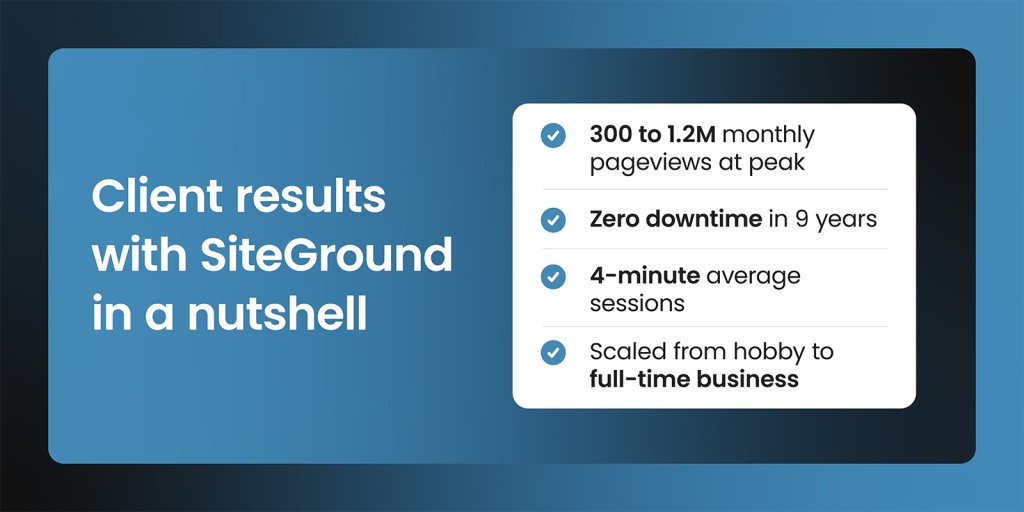
Client results summary showing japonismo.com growth metrics: 300 to 1.2M monthly pageviews at peak, zero downtime in 9 years, 4-minute average sessions, and scaled from hobby to full-time business

The breaking point: months without access

Here’s a scenario most site owners dread: You’re building something that matters. Your audience is growing. People are starting to trust you. And then your hosting provider calls to tell you they’re shutting down access to your site.

Not temporarily. Not for maintenance. Just… off. That’s exactly what happened to Luis with his previous hosting provider.

“They called me while I was in New York and said they were removing access to index.php—basically making Japonismo unavailable to everyone who wanted to visit. And they couldn’t tell me why or how to fix it.”

But that phone call was just the breaking point. The real problem had been building for months.

“We had hosting that left us without access to the website for several months—right when the site was starting to grow and gain audience trust. Just imagine what that meant for us at that critical time.”

If you’ve ever built something while working another job, you know that sinking feeling. You’re already stretched thin. Now you’re troubleshooting server issues at midnight because your hosting provider has no answers.

The problems Luis faced aren’t unusual—they’re the same frustrations many site owners hit when their hosting can’t keep up:

  • Constant crashes that knock your site offline
  • Slow loading times that send visitors straight to your competitors
  • Images that won’t optimize, killing page speed—especially painful if your content is visual
  • Support that can’t actually help when things break

“I didn’t want to spend my time on hosting technicalities that weren’t adding value to the project. I just wanted to write about Japan, share photos, and help people plan their trips. Instead, I was constantly dealing with hosting problems I didn’t understand and couldn’t solve.”

If that sounds familiar, you’re not alone.

Finding a partner, not just a provider

When a friend told Luis about SiteGround in 2016, his expectations were modest. He needed a hosting company that actually understood WordPress. One that wouldn’t leave him stranded.

“My friend told me, ‘SiteGround will save you. They’re serious people who know WordPress inside and out. Migration will be easy and everything will just work. At that point, I had nothing to lose.”

The migration was straightforward—none of the drama he’d come to expect. But more importantly, once Japonismo was on SiteGround, Luis could finally stop firefighting and start building.

Finally, room to build the site you’re envisioning

Everything that had been a daily struggle suddenly just… worked. The site was stable. Images loaded quickly. And Luis could access tools he’d never had before:

  • Staging environments to test new page designs and layouts without breaking the live site
  • Built-in image optimization that handled compression automatically—no technical expertise required
  • Early access to new technology like HTTP/2 for faster loading
  • HTTPS security certificates when they were still relatively new, making Japonismo one of the first Spanish-language travel sites with that level of security

“I remember being among the first sites with HTTPS. SiteGround was always ahead technically, allowing your site to be faster, more accessible, and reducing your technical worries—which I sincerely appreciate.”

For a site built around visual storytelling—articles with 8,000 to 10,000 words, 20 to 25 high-resolution images showing temples, food, landscapes—that technical foundation made all the difference.

Handling peak season: the real test of hosting

But having reliable hosting doesn’t just matter during normal traffic days. For a travel site focused on Japan, the real test came during peak season.

Japan tourism has intense peaks and valleys. Summer months bring massive traffic. Winter slows down. August alone can hit 1.2 million pageviews for Japonismo.

“When traffic is low, any hosting can seem fine. But when August arrives and everyone’s planning their Japan trips, you need infrastructure that doesn’t buckle. Your site can’t slow down when it matters most.”

With his old hosting, those peak months meant crashes and lost visitors. With SiteGround, they became his strongest months.

With all those high-resolution images and long-form content, Japonismo could easily be a slow site. Instead, visitors stay an average of four minutes—far above the typical 30-60 seconds for most pages—reading, scrolling through photos, absorbing the depth of information Luis provides.

That doesn’t happen by accident. It happens when your hosting can handle the load and optimize the delivery.

Support that actually responds

“I’ve never waited more than two minutes to reach someone on chat. And it’s not just fast—it’s actually helpful. They look at logs, identify the issue, and fix it. Sometimes problems that could take hours are resolved in five or ten minutes.”

For someone running a business largely solo, that responsiveness matters. Luis doesn’t need to become a server expert. He needs answers when something breaks—and ideally, he needs things to rarely break in the first place.

“Even when issues aren’t technically SiteGround’s responsibility, they investigate and help anyway. That’s what partnership looks like.”

And that partnership has lasted.

Nine years on SiteGround and counting

Japonismo has been with SiteGround since 2016. Luis has moved from shared hosting to cloud hosting as traffic grew. The site has evolved from a hobby project to a full-time business—and eventually into a specialized media outlet focused on Japan, with the website remaining the core of everything they do. And through all those changes, the hosting hasn’t been something he’s had to think about.

“The biggest impact SiteGround has had is that you don’t notice it. It’s always there. Always working. Always fast. Even at peak traffic, visitors get the same experience—which means I can focus on what I actually do: helping people connect with Japan.”

That’s the real lesson here.

What actually matters when you’re building something

When you’re starting a digital project—whether it’s about travel, food, business advice, or anything else—there’s a temptation to cut costs where you can. Hosting seems like an easy place to save money.

Luis learned otherwise.

“Cheap becomes expensive when your site goes down during your peak season. Or when loading times drive visitors away. Or when you spend hours dealing with technical problems instead of creating content. Finding a hosting partner who knows what they’re doing—that’s not an expense. That’s what makes growth possible.”

For anyone building something online, the lesson is straightforward: Your hosting provider should remove obstacles, not create them.

That’s what partnership actually means.

Ready to stop wrestling with server issues and get back to what you actually do? Thousands of creators and business owners made the switch to SiteGround for the same reason Luis did—they wanted hosting that works so they could focus on building something that matters.

[86]

Scale your business with SiteGround AI Studio (Webinar Video + Q&A)

In our January 2026 webinar, Product Director Daniel Kanchev and Product Marketing Manager Simona Petrova demonstrated how leading AI models and specialized agents in SiteGround AI Studio solve real business challenges. Through live demos, they showed how the all-in-one workspace can handle day-to-day business tasks, from content creation to streamlining WordPress and WooCommerce management.

For anyone who couldn’t join the live webinar, or for those who would like a second look at the demos, the full webinar recording is now available to watch on YouTube.

Key takeaways 

We covered a lot during the session, so we’ve distilled it down to the most important takeaways for you below.

1. Use the right AI model for every task

Different AI models excel at different tasks, so a core feature of the AI Studio is providing access to multiple leading models from a single workspace. During the webinar, we showcased this “right tool for the right job” approach, explaining how some models are better for summaries while others excel at creative work. We demonstrated this with specific examples, using ChatGPT to instantly summarize a long article into a 30-day action plan, and then switching to Nano Banana Pro to create a unique, high-quality image for a blog post. 

With AI Studio, you can explore which model works best for your specific needs without managing separate subscriptions. This full suite of AI models is available for free to all SiteGround customers as part of AI Studio Essential.

2. Streamline WordPress management with the WordPress AI Agent

Included free in the Essential plan, the WordPress AI Agent helps you manage and maintain your WordPress sites through simple chat commands. During the webinar, we showed how you can perform bulk actions like updating multiple WooCommerce products at once – all with a single prompt. You can even manage multiple WordPress instances at once – like rolling out a plugin update across some or all of your WordPress installations, or creating a new user in every site you manage – just by telling the WordPress agent what you need to do. The agent works both in the AI Studio interface and directly inside your WordPress dashboard.

3. Get marketing campaigns done in minutes with AI agents

The Plus plan unlocks 15+ specialized AI agents built with input from real-world business and marketing professionals who know what works. During the webinar, we demonstrated a few of them in action. We showed that unlike general-purpose AI that often requires several rounds of back-and-forth, these agents deliver strategic, ready-to-use output from the start. 

For example, the Social Media AI Agents for Facebook, Instagram, and LinkedIn turn your main message into channel-ready posts and publish them directly to your connected pages. They can also analyze engagement and suggest improvements based on best practices. Meanwhile, the Email Marketing AI Agent builds a complete campaign from a single prompt, including subject line, body copy, and images. You can import the output directly to your SiteGround Email Marketing or download the HTML to use in third-party applications.

Answering your questions

We also got a great deal of interesting questions, so we summarized the most popular ones.

Is AI Studio included in my hosting plan, or is it an additional cost?

SiteGround AI Studio offers two plans: Essential and Plus. Every SiteGround customer gets free access to the Essential plan, which includes 20,000 monthly tokens, multiple leading AI models, and the AI Agent for WordPress. The Plus plan is available for an additional cost and provides 100,000 monthly tokens, 15+ specialized business agents for tasks like marketing, content creation, and more, plus a library of ready-to-use prompts to help you get started faster.

What are tokens and how do they work?

Tokens are the units that measure AI usage in SiteGround AI Studio – think of them as the “currency” for every AI interaction. Every task you perform, whether it’s generating text, creating images, running web research, or using AI Agents, consumes tokens based on both your input (your prompt and any uploaded files) and the AI’s output (the generated response). More complex tasks like image generation, file analysis, or multi-step Agent operations use more tokens than simple text requests. 

The AI Studio essential plan (free for every SiteGround customer) includes a monthly token allowance of 20,000 tokens, and you can track your usage anytime in AI Studio or your Client Area. Your allowance resets automatically each month.

What is the difference between AI agents and generic chat?

The key difference is expertise. Generic chat is great for brainstorming and quick answers, but it relies entirely on your prompts to guide the conversation. AI Studio agents, on the other hand, have specialized knowledge built into their core instructions. Secondly, our AI agents can execute tasks directly through platform integrations – they don’t just give you text, they can publish a blog post to your website or update products in your e-commerce store.

Does the WordPress AI Agent work with page builders like Divi and Elementor, or only the native WordPress editor?

The vast majority of the WordPress AI Agent’s features work perfectly regardless of which page builder you use. The only limitation is block-level content editing and creation within the builder itself, since each page builder (Divi, Elementor, etc.) uses a unique content structure that requires dedicated integration.

Everything else works seamlessly on any WordPress site:

  • Complete content management for posts, pages, categories, tags, media library, and comments.
  • Full WooCommerce integration for products, orders, inventory, pricing, and sales reports – everything you need to run your online store.
  • User management to create accounts, update roles, and set permissions.
  • Plugin and theme management to install, update, activate, deactivate, or remove
  • Site configuration to adjust settings and optimize performance.

We’ve seen significant interest in native page builder support for visual editing, and we’re listening closely. We’ll prioritize which builders to integrate next based on user requests, so we encourage you to share your feedback directly through the AI Studio interface.

Can the WordPress Agent create or update products by uploading a spreadsheet with product information?

Yes, the SiteGround AI Studio WordPress AI Agent supports bulk WooCommerce product management through spreadsheet uploads. You can upload a spreadsheet containing your product data – such as descriptions, prices, and inventory – and the WordPress AI Agent can then use that data to either create new products or update existing ones in your WooCommerce store, depending on your instructions.

Can I use the WordPress AI Agent across multiple websites and share access with my team? 

Yes, you absolutely can manage multiple websites with the WordPress AI Agent. We designed it to be a core part of the experience for all our customers, which is why its multi-site management capabilities are included in the free Essential plan. There is no limitation on the number of WordPress sites you can connect, allowing you to streamline tasks across all of your web properties from a single, centralized workspace.

Regarding sharing access with your team, there’s a specific way to collaborate using the WordPress AI Agent right now. If a team member has access to your WordPress dashboard, they can use the agent’s features directly from within WordPress, and any tokens they consume will be drawn from the main account owner’s token pool. 

Can SiteGround AI Studio create and schedule social media posts automatically?

The SiteGround AI Studio social media agents for Facebook, Instagram, and LinkedIn excel at creating and posting channel-ready posts directly from your prompts. While you can create and publish posts straight to your social pages from the interface right now, scheduled posting – the ability to schedule posts for automatic publishing at future dates – is currently in development. A comprehensive scheduling system that applies to all types of tasks – not just social media – is a high priority on our roadmap and will be a core part of a future update to the SiteGround AI Studio.

Can specialized AI Ads Agents create ad copy and visual assets?

Yes, the SiteGround AI Ads Experts for Meta and Google are designed to create both ad copy and visual assets for your campaigns. You simply provide the agent with details about your product, target audience, and campaign goals, and it generates multiple ad variations around your core offer. Each variation is built to follow the specific structure guidelines of its platform, giving you different hooks and messages to test without having to write each one manually.

What email marketing services can I connect to AI Studio?

The SiteGround AI Studio Email Marketer offers a seamless, one-click integration with our own SiteGround Email Marketing service, allowing you to import your finished ready-to-send-email instantly. While we do not currently offer direct API connections to third-party services, we designed the agent’s output for universal compatibility. You can generate an email and export its full HTML, which you can then easily upload into any external email marketing platform you use.

Will search engines penalize AI-generated content?

No – Google and other search engines have been clear that they don’t penalize content when AI tools were used in the creation process. What matters is quality, not origin. Google’s guidelines focus on rewarding helpful, original content that demonstrates expertise and provides genuine value to readers, regardless of how it was produced.

The SEO risk isn’t AI itself; it’s publishing thin, generic, or mass-produced content that doesn’t serve your audience. To keep your rankings strong, focus on adding your unique perspective, expertise, and real-world examples to AI-generated drafts. Use AI as a starting point, then refine with your own insights and ensure everything is accurate and genuinely useful.

SiteGround AI Studio is designed specifically for creating search-optimized content. Our SEO Expert Agent helps with your keyword research, competitive analysis, and content briefs based on search intent, while the Copywriter Agent creates drafts you can shape to match your brand voice. The result is content that’s efficient to produce and built to perform.

Can AI Studio handle on-page SEO, and does it work alongside plugins like Rank Math or AIOSEO?

Yes, SiteGround AI Studio handles on-page SEO strategy and works seamlessly with SEO plugins like Rank Math, AIOSEO, and Yoast SEO. These tools complement each other rather than conflict – they serve different purposes in your SEO workflow.

Your SEO plugin (Rank Math, AIOSEO, Yoast, etc.) handles the technical implementation: meta tags, schema markup, XML sitemaps, canonical URLs, and on-page analysis. AI Studio’s SEO Expert Agent works upstream as your strategist, helping you with keyword research, competitor analysis, content briefs, and optimization recommendations. You then use insights from the SEO Expert to create content with the Copywriter Agent, and finally publish it to your site using the WordPress AI Agent – where your SEO plugin takes over to handle the technical details.

AI Studio is also developing AI visibility optimization to help content rank across AI platforms (ChatGPT, Claude) and traditional search engines – addressing both SEO and emerging AEO (AI Engine Optimization).

What makes a good AI prompt?

Good prompts are specific prompts. The more details you provide – goal, audience, tone, and any specific requirements – the better your results. To make this easier, our AI Studio Plus plan includes a Prompt Library with ready-to-use prompts for common business tasks like blog posts, product descriptions, and social media content. You can also save your best-performing prompts to reuse them anytime, ensuring consistent, high-quality results without starting from scratch.

What is the difference between Coderick AI and Siteground AI Studio?

The simplest way to think about the difference is that SiteGround AI Studio is designed to help you manage and grow your existing business, while Coderick AI is designed to build new websites and applications from scratch.

SiteGround AI Studio is your day-to-day AI workspace for ongoing business tasks. You use its specialized agents for things like maintaining your WordPress site, creating social media content, running email marketing campaigns, and generating ad copy. It’s a tool for enhancing your productivity and managing your existing business operations. Coderick AI, on the other hand, is a development platform used to create new, fully functional websites and applications without any coding. You simply describe your idea – for example, “build a client invoice tracker with a dashboard” – and Coderick AI generates the entire application, complete with hosting and a database.

Tell us what you need 

We’re just getting started with what SiteGround AI Studio can do, and we’re excited for what’s next. Your feedback is what will guide our development, so please don’t hesitate to share your thoughts with us as you work with it. We want to hear your success stories and learn what tools and improvements you need to help you scale your business.