For two decades, we’ve been privileged to be part of your online journey, providing fast, secure, best-in-class hosting for millions of websites built with your own code or using popular CMS like WordPress, Joomla, Drupal and more. Through countless conversations with clients like you, we’ve learned about your challenges, celebrated your success, and understood your aspirations to create and manage your online presence.
Today, we’re excited to introduce something special – our very own SiteGround Website Builder, now included in all of our hosting plans. For us, this isn’t just a new project launch. It’s our response to all of those conversations we’ve had over the years, and our commitment to make your online presence an absolute success.
Why Launch A Website Builder
Every day, we witness the passion you bring to your businesses and projects. But we’ve also seen how technical complexities can stand in the way of your vision. We’ve heard from small business owners spending precious weekends configuring third-party themes for their CMS website, freelancers juggling multiple tools for different clients, and entrepreneurs delaying their dreams because website creation seemed too daunting.
Your stories inspired us to create something different. Something that would maintain the professional quality you deserve while removing the technical barriers that slow you down.
The Problems We’re Solving Together
We believe in products that solve real problems of real people, so we’ve focused on addressing the key challenges you’ve shared with us:
Complexity
Remember the last time you stared at a file manager or content management dashboard wondering where to start? Or spent hours trying to make a theme look like its demo? We believe creating a website should be intuitive and enjoyable. With our Website Builder, you’ll find familiar tools that work exactly as you’d expect – if you can use a doc file, you can build a beautiful website.
Time
We know you can’t afford to spend weeks learning new tools or fighting with technology. What used to be a multi-day project can now be accomplished in a single afternoon. Choose a template, customize it with your content, and launch your site – all before your coffee gets cold. Because your time is better spent growing your business, not building a website.
Technical Barriers
“But I’m not technical enough” – we’ve heard this too many times from talented entrepreneurs whose websites don’t reflect their expertise. SiteGround Website Builder handles all the complex details behind the scenes: mobile responsiveness, built-in SEO, performance optimization, and security considerations. You focus on your message and design, while we ensure everything works flawlessly behind the scenes.
Cost
Building a professional website traditionally means choosing between two costly options: hire a web developer to build and manage your site, or invest countless hours learning complex tools yourself. This should not be the case. Our Website Builder is available for free in every hosting plan, giving you the power to create professional websites without the professional price tag. If you have an unused site slot in any of your hosting packages, you can try it out right away.
Built For You, Growing For Everyone
The first version of the SiteGround Website Builder is built for our core users – business owners who want to create a simple, yet professional website without complexity. We have tons of features and functionalities in the pipeline to add to this experience and also cater to the needs of agencies, freelancers and professionals creating and managing websites for others. Every new item in our roadmap serves one goal – to help you create and manage a polished web presence that reflects your professionalism, while focusing on what matters most – running your business and serving your clients.
Everything You Need To Succeed
Our Website Builder comes packed with the essential tools that you’ve been asking for. Start with our professionally designed templates and customize them using our ultra-easy builder with premade sections. Access a free image gallery for stunning visuals, get help from our integrated AI content writer, and optimize your site with built-in SEO and analytics tools. Make it truly yours with extensive fonts and colors customization options – all without touching a line of code.
Just The Beginning
Today marks an exciting new chapter in our journey together. While we’re proud of what we’ve built, we know that this is just the beginning. We believe that the best products are built through collaboration with the people who use them every day. That’s why we’re starting with a simple, yet solid foundation, while keeping the flexibility to grow and evolve based on your feedback. Every new feature we add will be driven by your real experience and suggestions to make the SiteGround Website Builder even better for you.
Try It Yourself
Ready to create your website? The SiteGround Website Builder is available for free in any of our hosting plans. If you’re already our client, simply log in to your Client Area > Websites and start building your new website. New to our services? Choose any of our hosting plans and get access to the SiteGround Website Builder along with our award-winning hosting platform. Risk-free, with 30-day money back guarantee.
Initially starting on Instagram in 2018, our long-term client Holly Boothroyd quickly recognized the need for a dedicated website to house her content, connect with her community and share her journey:
“I really wanted to have a single home on the Internet, something that I owned that couldn’t just be taken away from me or isn’t going to slowly die over time as new platforms come up.”
As a software engineer by day, Holly Boothroyd felt a strong desire to pay it forward – a heartfelt thank you to her mentors and the women who paved the way before her. She wanted to share the invaluable lessons they taught her and what she had learned along her journey. This passion led her to launch HerHelloWorld, a platform dedicated to supporting marginalized individuals entering the tech industry. Her mission is to guide newcomers who may not have industry connections or know where to begin.
Discovering SiteGround: A One-Stop Solution
As Holly’s vision expanded, so did her requirements for a reliable hosting partner. She needed a platform that could seamlessly support both her hard-coded personal site and her WordPress business site.
“I wanted a single hosting platform that was top-class for both a hard-coded and a WordPress website.”
Holly came across SiteGround after doing a lot of research. She read reviews, checked out Reddit for honest opinions, and compared the specs of different hosting platforms. In the end, she went with the GrowBig plan because it fit her growing needs and could easily handle both of her sites.
“I’m a developer, so I have high standards for who is going to host my website. SiteGround was perfect for me because I got my two websites all in one place. It made it very easy for me to manage, and my experiences over the last couple of years have been incredibly positive.”
Exceptional Website Speed
One of the first standout features for Holly was the significant improvement in website speed. Despite her previous efforts to optimize her old hosting solution, it never met her performance expectations.
“one of the other big things that I noticed when swapping to SiteGround is that my website became much faster. And that was something I really had struggled with and spent quite a lot of time trying to optimize and despite all of my best efforts it never really hit the kind of performance metrics that I wanted. When I swapped to SiteGround, suddenly, all those problems went away.”
Fast loading times are essential for maintaining user interest and engagement, directly impacting Holly’s ability to connect with her audience effectively.
“I can see in my stats that thousands of people view my website. It also relates to my own personal reputation as a developer.”
Robust Website Security – from Basics to Excellence
As Holly’s platform grew, so did her security concerns. SiteGround’s robust security features, including a free SSL certificate, addressed these concerns head-on.
“My last hosting platform required me to pay for the SSL certificate, which I regret. The fact that it came for free with SiteGround was incredibly helpful.”
Beyond SSL, SiteGround’s proactive security measures ensured that Holly’s websites remained safe from threats, such as DDoS attacks.
“At one point my website was being targeted for a DDOS attack and the SiteGround team jumped on it immediately and kept my website up.”
Holly appreciates that everything just works seamlessly now. This reliability reflects SiteGround’s commitment to providing a secure and hassle-free hosting environment.
Support That Speaks Your Language
SiteGround’s customer service was a real game-changer for Holly. Even with her software engineering background, she appreciated how the team could break down technical issues into simple, easy-to-understand terms. This meant that even those without a tech background could keep their websites running smoothly and confidently.
“I know a fair amount about technology being a software engineer, but I know that they put it in terms that anybody who was not a software engineer or did not come from a technical background would be able to learn and be able to basically get their website, keep it running as mine was and so I think that was something that I was very impressed with”
All The Tools for a Successful Personal Brand Online in One Place
Holly’s journey underscores the importance of having a personal website, especially for those entering the tech industry. To her, It’s more than just a digital portfolio – it’s a platform to showcase skills, build a community, and connect with like-minded professionals.
“Having your own website is essential, especially as a developer. SiteGround is perfect for building up that personal brand demonstrating your unique value.”
Holly is also looking to simplify her digital toolkit by switching to the SiteGround Email Marketing Tool. She loves the idea of having everything in one place, which makes managing her online presence so much easier.
Her advice to those starting their online journey is to focus on their unique selling proposition (USP) and embrace the learning process.
“Don’t wait for perfection. Start with your biggest USP, build momentum, and learn as you go.”
Holly’s journey with SiteGround is a perfect example of how technology can blend effortlessly with personal dreams. As she inspires and guides the next wave of tech leaders, SiteGround stands by her side as a reliable hosting provider.
“I got my two websites all in one place. I made it very easy for me to manage and my experiences over the last couple of years have been incredibly positive. So I’m really pleased that my websites are going to continue to be hosted on SiteGround moving forward.”
For those ready to kick off their online presence, Holly’s story is simply a guide in selecting the right hosting provider. With SiteGround, you can build a strong digital foundation and bring your vision to life with confidence.
The internet can often feel like the Wild West—a vast frontier filled with opportunities but also teeming with hidden dangers. Cyber threats are everywhere, and while website security vulnerabilities might not sound as thrilling as a high-stakes showdown, it’s absolutely vital.
Imagine leaving your front door wide open—hackers are like unwelcome visitors who can sneak in to steal sensitive data, damage your reputation, or drain your wallet. Sounds rather unpleasant, doesn’t it? This guide addresses the most common website security vulnerabilities, breaking it all down in plain English, with explanations that are easy to understand and actions you can take to keep your site safe.
What are Website Security Vulnerabilities?
Website security vulnerabilities are weaknesses or flaws in a website’s code, architecture, or implementation that can be exploited by attackers. These web vulnerabilities may allow unauthorized access by hackers to sensitive information, to manipulate data, or even to attain total control over a website. They can arise from various sources, including poor coding practices, outdated software, and human error. These include website vulnerabilities as well as web application security vulnerabilities, which specifically target the functionality of web applications and their underlying code.
Not only can dealing with these kinds of issues create loads of extra work for you and your business, but the fallout can be much more widespread: loss of sales or, worse, loss of consumer confidence. So that’s why it’s so very important to understand how to prevent, identify and fix website vulnerabilities.
Most Common Website Security Vulnerabilities
While there’s an unfortunately long list of ways your website could be vulnerable to hackers and other bad actors, most web security vulnerabilities boil down to just a common handful. So today we’re tackling the top seven most-likely issues, and, thankfully, explaining them—and how to address them—in terms that we can all understand and act on.
First, we’ll tackle the most common website vulnerabilities in order to understand what they are and how they impact your site. Then, we’ll discuss the solutions separately, as many fixes address multiple vulnerabilities at once, making them more efficient and impactful.
1. SQL Injection
So let’s say your website has a form—as it probably does!—such as a login box or a search bar. With SQL injection, hackers trick the form into giving them access to your website’s database, where all the important information is stored. This can happen if the website doesn’t double-check what users type into these fields. Hackers might steal customer information, change data, or even erase everything.
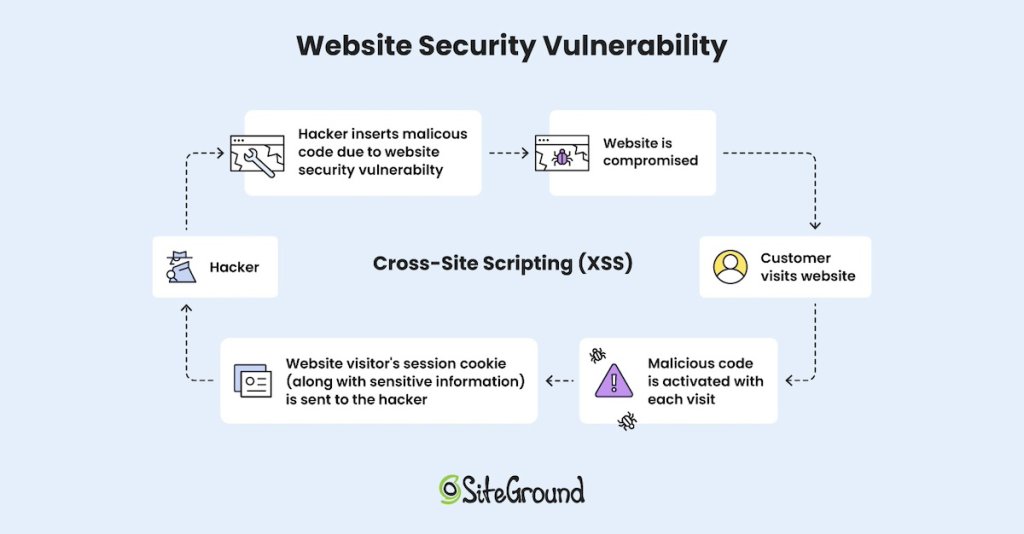
2. Cross-Site Scripting (XSS)
Cross-site scripting (XSS) is like someone slipping a harmful note into your website that your visitors accidentally read. These harmful notes (scripts, or malicious codes, as they are called) are a threat to site security, as they can steal personal information, mess up how your site looks, or send users to dangerous websites. The worst part? Your visitors might think it’s your fault, even though the hacker is behind it.
3. Broken Access Controls
This happens when your website doesn’t do a good job of keeping certain areas or actions off-limits to unauthorized users. For example, picture someone sneaking into a staff-only area of a store—that’s what broken access controls are like online. Hackers might use this lack of login security to view private information or make changes they shouldn’t be allowed to.
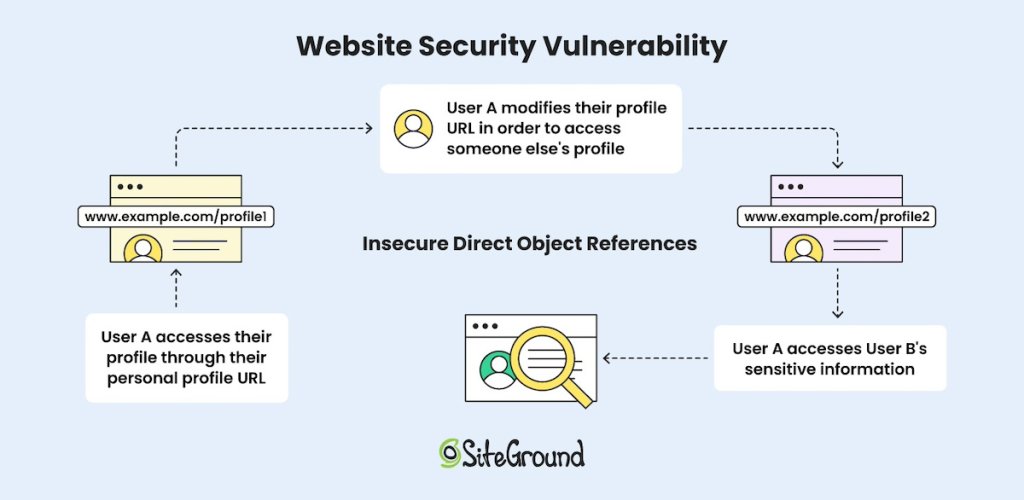
4. Insecure Direct Object References (IDOR)
Would you leave a key under the doormat where anyone could easily and predictably find it? With IDOR you’re doing just that if you give website users direct links to sensitive information (such as “www.example.com/profile1”). That’s because a hacker could guess or change those links (like to “www.example.com/profile2”) to see someone else’s sensitive information. As such, IDOR happens when websites don’t check who’s allowed to see what, and pay close attention to user roles and access and other security measures.
5. Security Misconfiguration
Security misconfiguration occurs when websites are launched with default settings, outdated software, or unnecessary features enabled, leaving the door wide open for hackers. Common examples include using default passwords, failing to apply security patches, or enabling services that aren’t needed. These oversights give attackers more opportunities to exploit vulnerabilities, gain unauthorized access, or steal sensitive information.
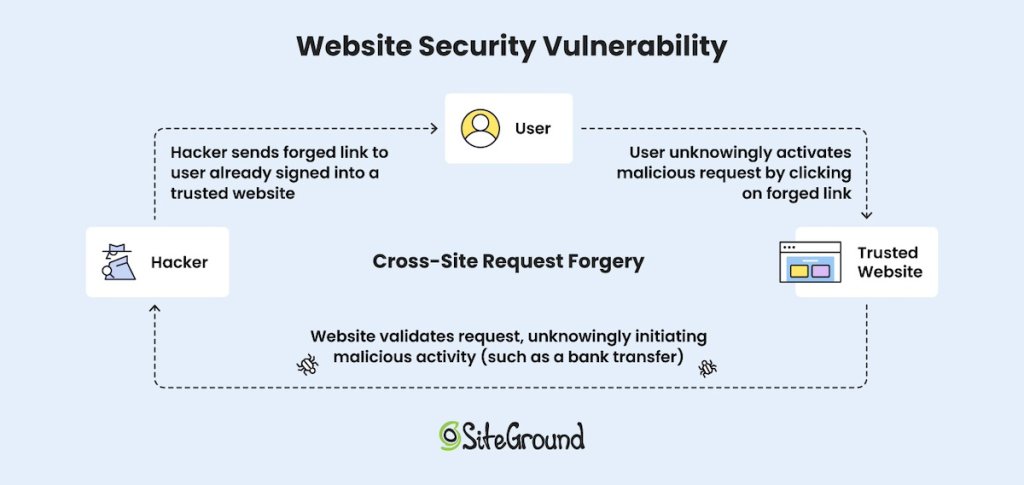
6. Cross-Site Request Forgery (CSRF)
CSRF is when hackers trick you into doing something you didn’t mean to do. For example, you’re already signed into your bank account, then you receive a bogus email with a link or button that’s disguised as something harmless. You innocently click on it, and it ends up transferring money from your account to the hacker, or perhaps it performs some other malicious action on the website where you’re logged in. You’ve essentially just been fooled into signing a virtual blank check.
7. Unvalidated Redirects and Forwards
This issue occurs when a website sends users to another page without checking if the destination is safe. Hackers can use this to redirect your visitors to harmful sites, like phishing pages or ones that install viruses. Think of it as though someone handed you directions to a fake address where bad things happen.
With all of these web vulnerabilities, it might seem a bit intimidating to even think about how to mitigate them. But there’s great news: we’re going to break it down into simple solutions that can quickly and easily improve your website security outlook.
Simple Fixes to Address Website Security Vulnerabilities
Now that you understand the most common website security vulnerabilities, let’s discuss some of the straightforward ways you can address them, as well as other website security tips. The bonus is that these web vulnerability solutions are easy to understand and act on, even if you don’t have a technical background.
1. Choose a Good Hosting Provider
The first and most important step you can make in this process is choosing a solid hosting provider—it’s essentially the online home for your website, and it plays a vital role in protecting your site from the website security vulnerabilities we’ve discussed above. Not only that, but a good hosting provider will offer maximum uptime and optimized website speed, ensuring that your website performance is reliable and top notch.
How to do it:
Look for a hosting provider that provides a free SSL certificate and daily backups, as well as other important security measures, such as daily malware scans, and a server-level WAF (not sure what we’re talking about here? Don’t worry, we’ll cover it all in a minute!). Do your research, and check reviews to make sure the provider you choose has a good reputation, along with superb customer service.
2. Perform Regular Maintenance and Updates
Keeping your website’s software, plugins, and tools up to date is a no-brainer on your list for stronger web security. Developers frequently release updates to fix vulnerabilities and improve performance. By staying on top of these updates, you can protect your site from previously mentioned web vulnerabilities, such as SQL injection, cross-site scripting (XSS), and insecure direct object references.
How to do it:
Create a schedule to check your CMS (such as WordPress), plugins, themes, and tools weekly, or enable automatic updates if your platform supports them. This is where those free daily backups are essential, though, because before you make any updates, always back up your website to prevent data loss or compatibility issues.
For added safety, test updates in a staging environment to ensure everything works smoothly before applying them to your live site.
To make web management easier and less stressful, consider using a managed WordPress hosting with free backups that handles updates, (free!) backups, and maintenance for you, helping keep your site secure without all the extra effort on your part.
[80]
3. Implement Input Validation
Input validation verifies that any data users enter into forms or search bars is checked and cleaned to fit the expected format, thus blocking harmful code. This security measure helps prevent hackers from injecting malicious commands, protecting your website from SQL injection and cross-site scripting (XSS) attacks that could compromise data or functionality.
How to do it:
Use easy-to-install tools or plugins that automatically clean up and check the information users enter on your site.
Focus on areas like forms, search bars, and comment sections.
For extra protection, set up these checks both on the user’s side (their browser) and on your website’s server, so you catch anything suspicious before it can cause harm.
4. Strengthen Access Control
Access control means deciding who can do what on your website. This includes using strong passwords, setting up roles like “admin” or “user,” and limiting what each role can access or change. These steps help keep hackers out of sensitive areas and protect your website from common vulnerabilities like unauthorized access or data leaks.
How to do it:
Assign user roles carefully, making sure each person only has the permissions they need.
Also be sure to implement strong, unique passwords for all accounts and enable two-factor authentication (2FA) for an extra layer of security.
It’s also helpful to install a plugin that keeps an activity log of your website, tracking events like login attempts, user activity, and bot visits, so you can quickly spot and address suspicious behavior.
5. Use Monitoring Tools and Scanners
Monitoring tools and scanners act as security guards for your website by watching for unusual activity or hidden threats. They can alert you to suspicious or malicious behavior, such as injected code, compromised files, or web vulnerabilities that could be exploited by attackers. This helps you catch problems early before they cause serious harm.
How to do it:
Look for a malware scanner tool that offers automated file scans and malware cleanups. A good tool will offer detailed reports and recommendations for resolving issues, making it easier to maintain a secure website. This can also help prevent future attacks by identifying weak points in your website’s security configuration.
6. Secure Your Connections
A secure connection encrypts data sent between your website and its users, often using HTTPS (look for the padlock symbol in the browser). The distinction between HTTPS versus HTTP is an important one: it signals this secure connection—and thus trust and confidence—to your website users. It also keeps hackers from intercepting sensitive information, adding extra protection against data theft.
How to do it:
Make sure your site uses HTTPS by installing an SSL certificate. Certain hosting providers, including SiteGround, will provide you with a free SSL certificate that can easily be implemented on your website, making HTTPS implementation as easy as the flip of a switch.
7. Improve Redirection Security
A redirect is when a user is automatically taken from one URL to another. So redirection security involves checking these links or forwards from your website to make sure they lead to safe destinations. This stops hackers from tricking your site into redirecting visitors to malicious websites.
How to do it:
Limit the use of redirections and always verify that any destination URLs are trustworthy before implementing them. Regularly review your redirects to ensure they haven’t been altered or exploited, and consider using tools to monitor and secure your redirection paths.
8. Employ a Web Application Firewall (WAF)
A Web Application Firewall (WAF) is specifically designed to protect your website from security vulnerabilities, such as SQL injection, XSS, and CSRF, by safeguarding features like user forms, search fields, and API endpoints. It works by stopping harmful requests before they can cause damage, ensuring your site remains secure.
How to do it:
Many hosting providers offer built-in WAF options, as it’s an essential security feature. While there are numerous WAF options available, including WordPress plugins and third-party services, having a server-level WAF is imperative. This type of WAF operates with large-scale data and provides real-time protection, ensuring a higher level of security.
At SiteGround, our security team keeps a close eye on security bulletins to identify potential exploits and web vulnerabilities. In doing so, they promptly develop custom security rules and integrate them into an advanced, in-house managed WAF. This robust protection is automatically applied to all websites hosted on our platform.
A CDN, or Content Delivery Network—as it’s called—helps protect your website by spreading traffic across multiple servers around the world.It not only improves your site’s speed but also provides an essential layer of protection against web server vulnerabilities. By distributing traffic and blocking harmful bots, a CDN prevents malicious traffic from overwhelming your server, keeps data safe with encryption, and stops potential attacks before they reach your site.
How to do it:
Quite simply, select a hosting provider that leverages a CDN. SiteGround’s CDN, for example, helps safeguard your website by mitigating web server vulnerabilities, blocking harmful traffic, and encrypting data. Additionally, with the Always Online feature, even if your server goes down, the CDN enables a cached version of your site that remains accessible and secure.
10. Install a Reliable Security Plugin
There are many plugins out there to help address the web security vulnerabilities mentioned above. And if you’re using WordPress, the SiteGround Optimizer Plugin is particularly ideal, as it allows you to prevent many of the aforementioned web vulnerabilities but with just one plugin – easily and for free.
The SiteGround Security Optimizer Plugin provides a combination of enhanced login security, firewall settings, and activity tracking, with an all-in-one solution that fortifies your site. It safeguards key system directories, enables protection against XSS, prevents unauthorized access, hardens login security, and continuously monitors for any unusual activity. In the event of a breach, the comprehensive activity logs allow you to swiftly identify what occurred and take the necessary steps to resolve it. It’s basically a one-stop shop for securing your WordPress site.
Final Word on Website Security Vulnerabilities
In the end, website security doesn’t have to be a daunting task. By applying simple fixes to these common website security vulnerabilities, you not only protect your site but also build trust with your visitors. Take action today to lock down your site and keep those Wild Western cyber bandits at bay—after all, a little effort now can save you a lot of headaches down the road.
Meanwhile, you can make addressing website security extra worry-free by taking advantage of SiteGround Hosting. We put our all into security measures that go above and beyond so that you can rest easy. Plus, we offer unparalleled speed and service.
From celebrating our 20th anniversary to unveiling new features and bringing our service to a new high, 2024 was a year of growth and transformation. But more importantly, it was a year of staying true to our mission—empowering businesses to succeed online.
Every milestone we reached was driven by you—your needs and your success. Because when you grow, we grow. And we build it all, together.
20 Years Of SiteGround: Building A Legacy Together
In 2004, we started with a simple goal: to make web hosting easy and reliable. Twenty years later, we’ve grown into a global leader, trusted by millions of websites.
The numbers tell part of the story: over 3 million domains hosted, 500+ employees worldwide, and countless innovations that changed the hosting landscape. But those numbers don’t tell the whole story. The real milestone? The trust you’ve placed in us—trust that your site will perform seamlessly and that every decision we make is designed to help you succeed.
True to our commitment, this year, we kept building and adding tools and solutions empowering your online presence and growth. Here’s a snapshot of some of the things we did–inspired by you and for you in 2024.
2024 Highlights 🎉
Business-Critical Services, Built For You
We launched and integrated new business-critical services like our Premium Backup, Premium Site Scanner, Google Workspace, and Expert Care, and you were quick to see their value and make them part of your toolkit.
Premium Backup: Your Favorite New Feature 🛡️
Instantly loved by our users, our new Premium Backup service added hourly backups, on-demand slots, and multiple restore and download options to keep your data secure and conveniently quick to access. In just a few months, we have generated over 45TB of premium backups and completed over 3,000 downloads. For our clients this meant confidence that their work is always secure and the convenience of quick recovery in the face of unexpected challenges.
Expert Care: A New Level Of Service For Your Website 🧑💻
While our hosting support continues to define industry standards, we recognize that our clients often face challenges that extend beyond hosting itself. That’s why 2024 marked the launch of Expert Care—a specialized service providing professional help for all your website needs. Our clients loved it instantly and its adoption rate is constantly growing, showing how valuable this service is to our community, helping countless webmasters enhance their websites and save time with our expertise.
Upgrades That Add Value, At No Extra Cost
We’ve enhanced key existing services this year to offer you more functionality, all without adding to your costs.
The New And Improved Site Scanner 🕵️♂️
Our Site Scanner tool has been a long-time favorite among our clients. This year, the service advanced into a comprehensive security solution with weekly file scans in the Basic plan and unlimited 1-click malware cleanups in the Premium plan. Now, the scanner safeguards your site against threats from every angle. From FTP uploads to software updates, the Site Scanner proactively detects issues and helps you resolve them in real time—giving you peace of mind with no extra effort.
Email Marketing Packed With New Features 📣
This year, we supercharged our Еmail Мarketing service to help you create impactful campaigns, better engage your audience, and measure success – all in all, empowering your business to grow with less effort. We added automations, detailed performance stats, integrations with popular WordPress lead-generation plugins, and many more small but mighty features. As a result, our email marketing clients sent more than 12 million emails through our service!
Proactive Security – Keeping Your Business Safe
Threats don’t stop. Neither do we. This year, we continued advancing our security systems to deliver even stronger protection to your websites. And the numbers speak for themselves:
Our new DDoS mitigation system blocked 411 major attacks – including a massive 6.2Mpps surge at 340MB/s running for over 4 months – the biggest we’ve ever seen (and handled!).
Our brute force defence blocked an average of 1.4 billion malicious requests every single day.
We upgraded our Web Application Firewall (WAF) for faster, sharper security preventing even more threats before becoming an issue for you.
With 3,400+ new malware rules, our Site Scanner caught threats before they could reach your website.
Taking Care Оf Maintenance, So You Don’t Have To
Deciding when to upgrade a website’s PHP version or MySQL database is typically a webmaster’s responsibility—often complex, risky, and time-consuming work. At SiteGround, we take this hurdle off your hands because we believe every website deserves to benefit from the latest technologies for improved speed and security. We upgraded millions of websites to PHP 8.2 and MySQL 8—writing custom scripts, running extensive tests, and addressing any issues—all seamlessly and without disrupting your workflow.
We do all of this for you because we care about making your websites faster, safer, and easier to manage.
Support That Feels Human—Because It Is 🤝
Тhis year our AI chatbot has successfully resolved thousands of issues for many clients. But when things go wrong, nothing compares to reliable, knowledgeable support from a real person. At SiteGround, we’re committed to providing exceptional support by continuously enhancing our team’s skills and knowledge. In the past year alone, our support team completed over 400 training and feedback sessions to ensure you always receive the most knowledgeable and friendly assistance – аvailable 24/7 and as reliable as ever.
But don’t just take our word for it.
Constantly Innovating for Your Success 🏆
In 2024, SiteGround was honored with the prestigious Google Cloud DORA Award, recognizing our excellence in development, operations, and reliability. This award reflects the cutting-edge technologies and practices we’ve implemented to deliver high performance and platform scalability. This formal recognition of excellence only adds to the praise and love we hear from the people we value most – our clients.
Thank You For The High Ratings – 98% Satisfaction! ♥️
The most important achievement for us remains your recognition of our work. All year round we have steadily held the highest Trustpilot score in our hosting segment – 4.8 out of 5 stars. But what is more, in our annual survey 98% of you said you were happy with our service. We’re proud and humbled by this number and will continue raising the bar for ourselves even higher in 2025.
Here’s to another year of growth, innovation, and collaboration—thank you for being part of the SiteGround story. Let’s keep building together. 🎉
The holiday season is a whirlwind of joy and hustle, with Santa leading the charge. But what if he had SiteGround by his side? This year, we launched new tools and features to lighten the workload for every website owner – even Santa himself! Here’s how:
For 20 years, SiteGround has delivered ultrafast hosting magic, ensuring your website can handle even the busiest holiday rush. Our powerful platform, featuring built-in multi-level caching, free one-click CDN, and custom setups, ensures your site runs smoothly and efficiently all year-round – but especially during high-traffic seasons!
Grinch-Proof Security ⛔
Just as every snowflake is unique, so is your website. With our new Premium Backup feature you can keep your data safe and ready for instant recovery. Say goodbye to the naughty Grinch with our robust security, allowing you to rest easy while we keep watch around the clock.
Unwrap New Tools for a Stress-free Holiday Season 🎁
🤹🏼 Workshop Wonders
Unite your team with the magic of Google Workspace and transform your operations into a seamless gift-wrapping machine. Organize, collaborate, and respond swiftly, ensuring smooth and efficient teamwork during the busy holiday season.
📨 AutoMagical Email Marketing Tool
With the automated magic of our Email Marketing tool, your messages reach everyone – children and grown-ups alike – just in time for the holidays. Ensure your communications are timely and effective, spreading cheer far and wide.
🧝🏼 Expert Elves on Duty 24/7
When tasks get overwhelming, our Expert Care elves are ready to lend a hand, keeping everything merry and bright.
Explore these features and more to ensure your website shines bright this holiday season. Visit our page to discover how SiteGround can transform your holiday experience and take advantage of our special offers!
The idea behind the circuit board in unicorn shape
At SiteGround, we believe in nurturing the curiosity and creativity of future generations through engaging, hands-on experiences. One of the most fulfilling aspects of our community involvement is our collaboration with Uni for Kids: scientists, inventors, engineers, educators and entrepreneurs, inspiring young people to discover and develop their talents in science, art and the arts. With their help we inspire young learners across the country to ignite their passion for technology and innovation.
Our friends from Uni for Kids designed circuit boards shaped like the SiteGround unicorn and it has inspired more than 300 kids (so far) across the country for STEM.
This kid’s workshop was so successful, we decided to challenge the grown-ups as well! We started with our own team during our amazing 2024 SiteGround Team Festival! From there the idea grew into turning them into Christmas tree decoration – and some of our lucky partners got one hand-made especially for them from SiteGround for Holidays 2024!
Supporting Sofia Science Festival
Continuing our mission to spark an early interest in STEM, we proudly supported an Electronics Workshop at the Sofia Science Festival on May 11 and 12 at Sofia Tech Park. This workshop was part of the “Engineers in Action” event and offered kids from 1st to 12th grade a chance to build their own circuit boards shaped like the SiteGround unicorn. It was an incredible opportunity for young minds to dive into the world of electronics in a playful, interactive way.
Regional Technology Forum “Engineers in Action” in Varna & Plovdiv
Our involvement with Uni for Kids extends to supporting events like the Varna & Plovdiv Regional Technology Forum “Engineers in Action”. This forum allows hundreds of kids a day filled with:
Robotics and 3D modeling competitions for students, featuring challenges such as line-following and track navigation.
A youth tech expo showcasing scientific and technological projects by students.
Hands-on workshops in electronics, 3D modeling, and automation.
A career fair with presentations by partner companies, offering students insight into real-world tech career paths.
One of the standout attractions was of course our Electronics Workshop, where kids can once again build their own SiteGround unicorn circuit boards—a fun challenge that taps into their creativity and problem-solving skills.
Hosting Teach for Bulgaria: A Special Visit to Our Office
On June 4, we had the pleasure of welcoming 15 third-grade students from the local school in Dinkata Village, Pazardzhik, for a unique SiteGround Day. This event, hosted in partnership with Teach for Bulgaria, was designed to inspire these bright 9-year-olds with a blend of fun and educational activities.
The highlight of the day was our Unicorn Workshop, where the children built their very own unicorn circuit boards. This hands-on activity not only introduced them to basic electronics but also gave them the joy of creating something tangible. The excitement in the room was palpable, punctuated by bursts of laughter as the children brought their creations to life.
Adding to the experience, SiteGround team members Yasen Kiprov and Sophia Lasheva shared inspiring stories about how childhood dreams, combined with dedication and hard work, can become reality. Their talks sparked conversations and encouraged the students to envision a future where they could pursue their passions fearlessly.
Looking Ahead
At SiteGround, we are more than just a tech company; we are active participants in shaping the future by fostering a love for learning and innovation in young minds. These initiatives with Uni for Kids are just one way we contribute to our community, empowering the next generation of tech enthusiasts to dream big and achieve more.
Join us in supporting and celebrating the future tech leaders. Let’s continue to inspire and be inspired!
At SiteGround, we are beyond proud to share that our founding member, Ivo Tzenov, has been honored as the first-ever winner into the “Bulgarian Entrepreneurs Hall of Fame.”
This recognition came during a glamorous gala at the National Theatre, where leading figures in the business world gathered to celebrate excellence and vision. This event, organized by The Bulgarian Entrepreneurial Association (BESCO), marks the start of a tradition aimed at acknowledging entrepreneurs who not only build successful ventures but uphold values that inspire future generations.
For us at SiteGround, this award symbolizes the hard work, resilience, and commitment that Ivo has shown since the very foundation of our team. From our roots as a small startup, over 20 years ago, to becoming a global leader in web hosting technologies, his passion for innovation and people-first philosophy has defined who we are.
A Journey Built on Empowering Others
In an emotional speech to over 600 attendees, Ivo Tzenov reminded us all what truly matters in business: “The most valuable thing we can do is inspire and empower people to create. We started by fostering this freedom within SiteGround, and later expanded our impact through our foundation. Today, I’m grateful to BESCO for supporting not just us but all entrepreneurs in Bulgaria.” He spoke with the conviction that building opportunities for others is a responsibility that drives progress, not just within a company but throughout the community.
An Event Honoring Bulgaria’s Pioneers
Ivo’s recognition was part of an evening that celebrated leaders across multiple industries. Over 100 nominations were considered for the award, with only five people reaching the final vote of a jury cоmprized by BESCO’s main partners over the years: more than 80 prominent personalities from the Bulgarian entrepreneurial ecosystem, including experienced investors and successful entrepreneurs.
The five honorees included:
Hristo Hristov, CEO of Darik Radio, who transformed the media landscape with innovative news platforms.
Mihail Stoychev and Georgi Petrov, whose work with SMS Bump and NitroPack has reshaped digital marketing, achieving significant milestones in just a few short years.
Svilen and Konstantin Rangelovi, the creative minds behind Dronamics, developers of the world’s first cargo drone, “Black Swan,” showcasing Bulgaria’s potential for world-class technological achievements.
Raycho Raychev, founder of EnduroSat, who has pushed the boundaries of space technology, collaborating with giants like SpaceX.
The Power of Community and Shared Values
BESCO’s CEO, Dobromir Ivanov, spoke to the essence of entrepreneurship in Bulgaria: “Entrepreneurs are united by their values. For them, success isn’t just what they achieve for themselves but what they give back to others.” This sentiment echoes our own culture at SiteGround, where teamwork, mentorship, and a commitment to fostering talent are woven into our fabric. We believe, like Ivanov, in the principle of “give back & pay forward.”
More Than an Award
Ivo Tzenov’s induction into the Hall of Fame is a testament to the journey of not just one entrepreneur but to SiteGround’s collective commitment to creating opportunities and breaking boundaries, that we have upheld for over 20 years. The Hall of Fame award is more than recognition; it’s a reminder that success can and should include uplifting others and setting a positive example. As SiteGround continues to grow and contribute to the global tech landscape, we remain committed to our roots and to the values that made this recognition possible.
We hope that this honor inspires the next generation of innovators to see that greatness can be achieved, nurtured, and shared right here in Bulgaria.
The latest update to our Email Marketing platform brings you Email Automations — a powerful new feature that lets you set up a series of emails that automatically get sent, based on subscriber actions, like signing up for your newsletter or downloading a resource. Thanks to it, you can now send welcome sequences, deliver freebies, and keep your audience engaged with simple, effective email flows.
Create the Automations Your Business Needs
SiteGround Email Marketing empowers you to set up a range of automations that are very effective and help you boost lead conversion and client retention. For example, you can create:
Welcome Series: Welcome every new subscriber with a tailored series that introduces them to your brand, keeping them engaged from day one.
Nurture Flows: For potential customers, automated nurture emails build rapport and guide them toward conversion naturally.
Freebie Deliveries & Mini-Courses: Automatically deliver content—like downloadable resources or educational emails—to keep subscribers engaged and coming back for more.
Automations scale with you as your list grows, ensuring each subscriber has the same quality experience, no matter when they join.
Tailored For A Seamless Setup
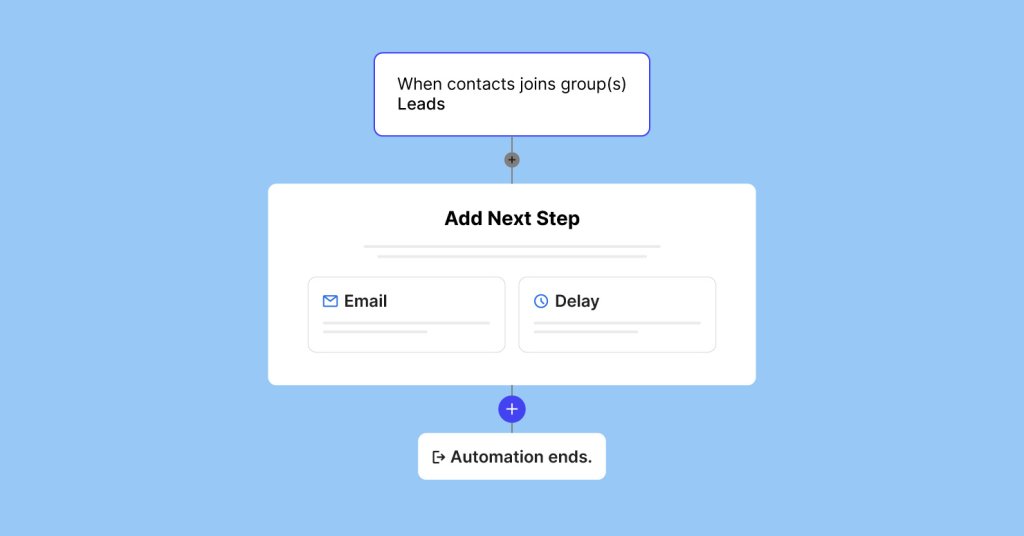
You can easily create Automations with our platform. Our Automations work with these three simple building blocks—Triggers, Emails, and Delays:
Triggers: The trigger starts your automation when a subscriber takes action, such as joining a group via a sign up form on your website.
Emails: Map out each email in your sequence to ensure every message supports your goals, from engagement to loyalty to conversion.
Delays: Space out emails in a way that keeps subscribers interested without overwhelming them. Choose intervals that fit your sequence, from immediate follow-ups to spaced-out sequences.
Not sure what email automations are exactly? In our in-depth guide on email automations, you’ll discover the what, why, and how of automated emails, with practical examples of email sequences that drive subscribers’ engagement and real business growth on autopilot.
Get Started with Email Automations Today
With Automations, you’re setting up your business for consistent growth without the added workload. Log in to your SiteGround Email Marketing account now to set up your first automation and experience how email marketing can drive growth for your business.
And if you’re not yet a customer, take advantage of our exclusive 80% discount and discover how easy it is to nurture, engage, and grow your audience with SiteGround Email Marketing.
With SiteGround Email Marketing, automations take your email engagement to the next level by working 24/7 to build relationships, save you time, and deliver real results. Setting up a sequence once means you reach every subscriber at the right moment with relevant, impactful messages—strengthening loyalty, driving conversions, and giving you back hours to focus on growth. It’s the consistency, scale, and efficiency you simply can’t achieve manually.
We’re thrilled to announce that SiteGround has been honored with the Google Cloud DORA Award for Nurturing Team Culture of Performanceand Innovation. This recognition places us alongside global leaders like GitLab, Uber, Vodafone, Virgin Media O2, and more, acknowledged by the awards for their industry excellence throughout the years. The SiteGroundGoogle Cloud DORA Award is a testament to the hard work and dedication of our team, highlighting our efforts to continuously improve our operations, work processes, technology, and infrastructure for the benefit of our clients.
Innovating DevOps for Performance and Growth
The Google Cloud DORA award recognizes organizations at the forefront of advancing DevOps through DORA research. Our award demonstrates how we implement effective DevOps processes that lead to a more productive work environment, better teamwork and efficiency, and deliver top-notch performance while ensuring our clients have the best possible experience.
What Does DORA Measure?
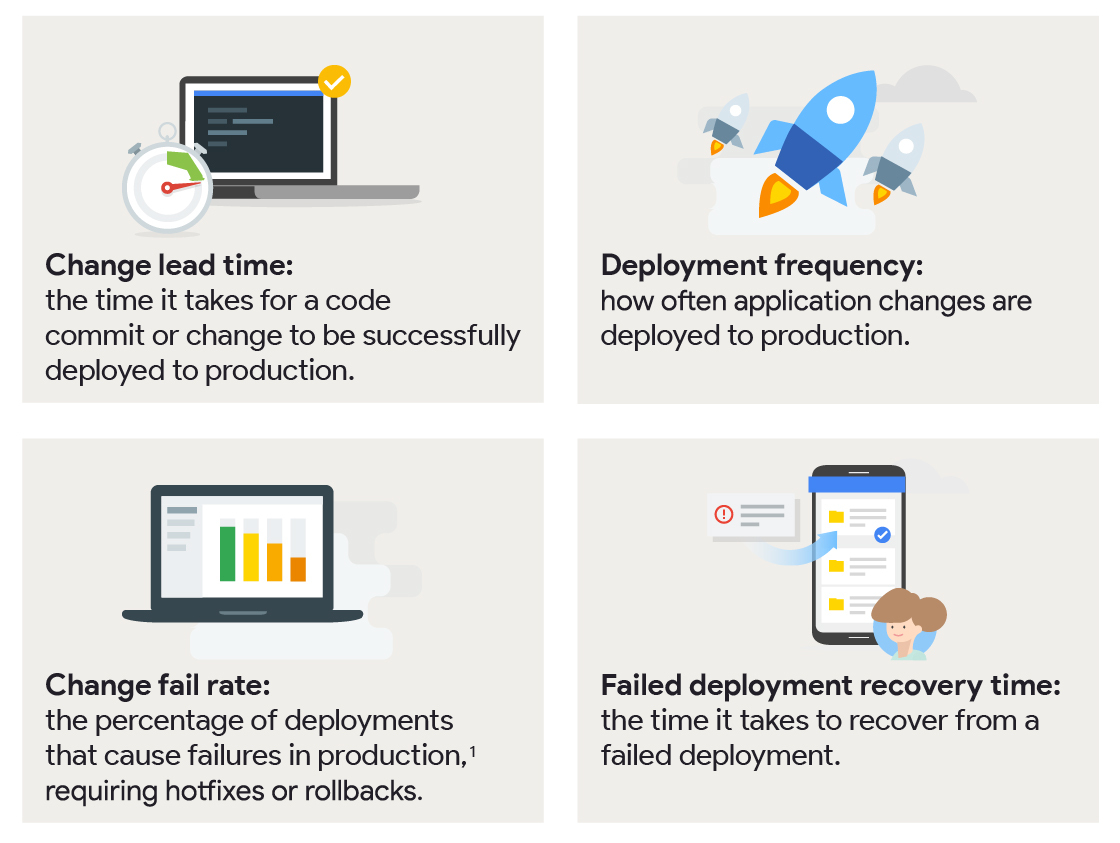
The DevOps Research and Assessment (DORA) team developed the Four Keys project, which helps organizations like ours track important aspects of our software development. This allows us to see how well we’re doing and find ways to make our software delivery and teamwork even better, ultimately enhancing our clients’ experience with our services.
For over a decade, DORA has validated these software delivery metrics as an effective way of measuring the outcomes of the software delivery process. Each year the DORA research team publishes a comprehensive Accelerate State of DevOps Report, collecting data through an annual, worldwide survey of professionals working in technical and adjacent roles.
This year nearly 3,000 working professionals from a variety of industries around the world participated in the survey to help form a better understanding of the factors that drive high-performing, technology-driven organizations. The DORA awards outline companies with exceptional results in the field, and SiteGround is proud to be recognized among the top-performing organizations with a DORA award!
SiteGround’s Performance on Key DevOps Metrics
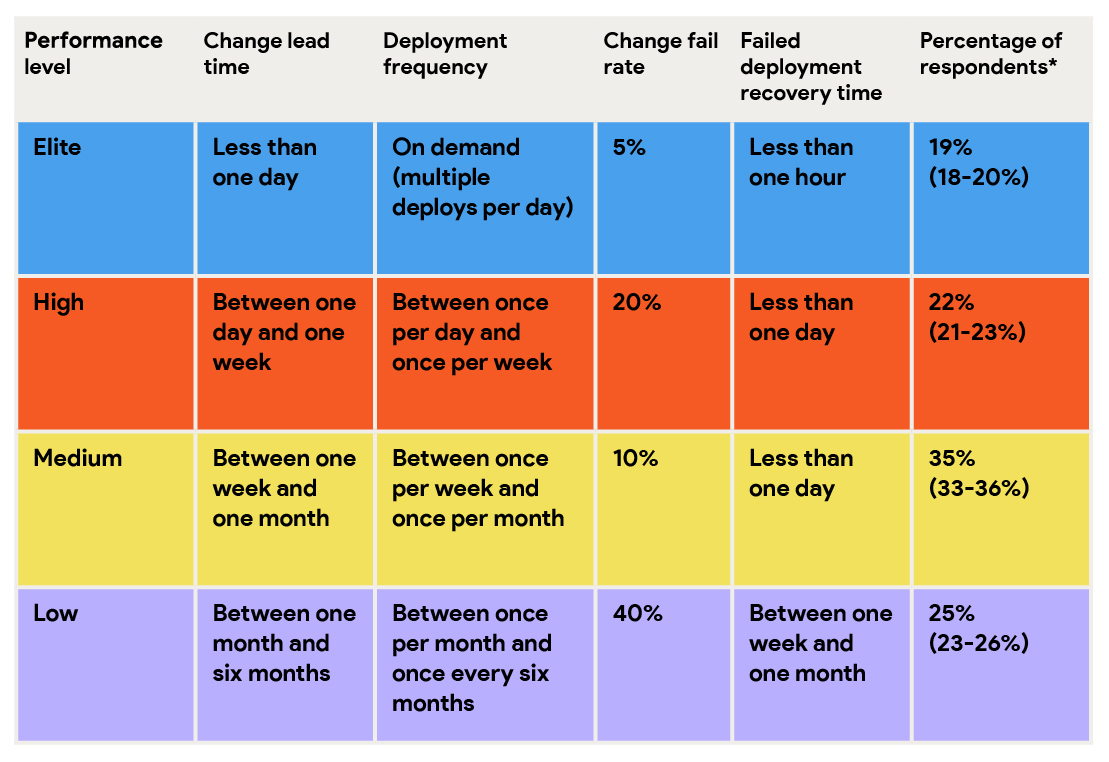
According to DORA’s analysis of the state of DevOps across all 3,000 respondents in 2024, four clusters of companies emerged, based on their software-delivery performance: Elite, High, Medium, and Low.
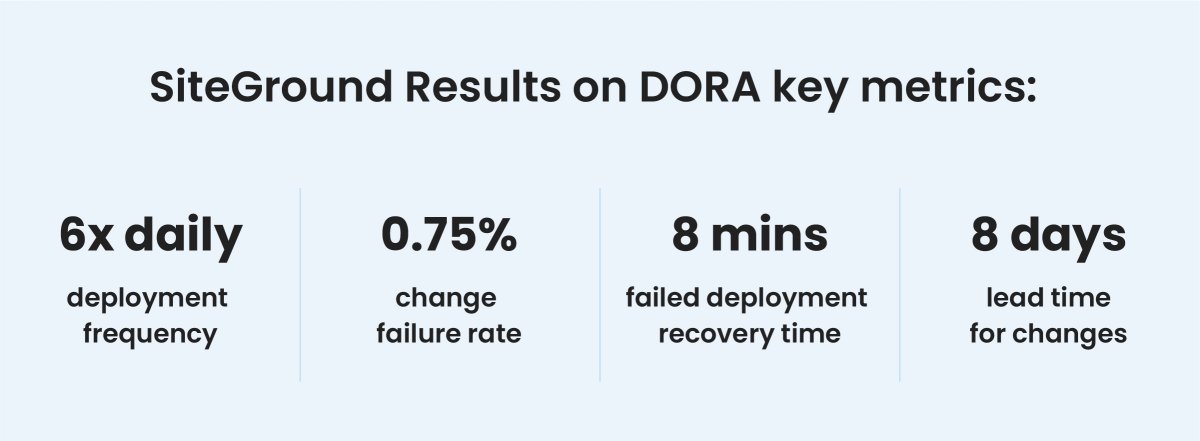
Here is how SiteGround stacks up in each metric of our software delivery process today:
Deployment Frequency
This measures how often we update our software with new features or fixes. Frequent updates mean you’re always getting the latest improvements, product features, and fixes.
Our current deployment rate of 6 times per day places SiteGround in the Elite group of companies – under 19% of all surveyed respondents with multiple deployments per day according to the DORA report for 2024.
Change Failure Rate
This measures the percentage of updates that cause problems and need fixing. A lower rate means our updates are more reliable, giving you a smoother experience. Our change failure percentage of just 0.75% ranks us at the forefront in this category, with a 5% considered Elite performance.
Failed Deployment Recovery Time
If something goes wrong after a release or a change in production, this metric shows how quickly we can fix it and get everything back to normal. At SiteGround our failed deployment time is exceptional – only 8 minutes, with less than an hour considered Elite performance.
Lead Time for Changes
This shows how quickly we can take a new idea or fix it and make it live for you to use. Faster times mean we’re responding quickly to your needs. According to the DORA report for 2024, our lead time of 8 days places us on the verge of the High performers group with up to one week lead time for a change.
Modernizing our DevOps to Empower Millions of Websites to Succeed
Our results and recognition in the Nurturing Culture of Performance and Innovation category are rooted in the synergy of our team-empowering work ethic, effective solution-building, and proactive approach to technology, which was unleashed to its full potential after we switched our bare metal to Google Cloud infrastructure. That transition opened up the resources to improve our software development cycle, our cross-team work efficiency and quality, and more effectively track and measure the results from this targeted effort.
Winning the Google Cloud DORA Award is not just an honor for us, but a commitment to our clients. Here’s how our focus on the DORA principles benefits SiteGround’s clients:
Leading the Way of Innovation
At SiteGround, we pride ourselves on being at the forefront of technological advancements in web hosting and digital solutions. Our commitment to frequent deployments means we’re constantly integrating the latest technologies and features into our platform. Our proactive approach ensures that your website is equipped with cutting-edge tools to stay competitive in a rapidly evolving digital world.
Quick Response and Agility
Our reduced lead time for changes means we can swiftly implement your feedback and adapt to new market demands. Whether it’s a new feature you’ve been waiting for or a critical fix, our agile development processes ensure that your needs are met promptly, keeping your operations running smoothly and efficiently.
Reliability You Can Count On
We understand that downtime can significantly impact your website. That’s why our focus on minimizing the time to restore services ensures that any disruptions are addressed quickly, with minimal impact on your operations. Our robust systems and processes are designed to provide you with a reliable service you can depend on.
Quality and Consistency
Our low change failure rate reflects our commitment to delivering high-quality updates. You can trust that our improvements and new features will enhance your experience without causing disruptions. This reliability allows you to focus on your online presence, knowing that your digital infrastructure is in safe hands.
Empowering Client Goals and Team Innovation
At SiteGround, it’s the expertise and dedication of our technology-driven team paired with our focus to always drive our services and products forward that positions us as industry leaders. Your success is our success, and we’re committed to providing the best tools and services to help you achieve your goals. Winning the Google Cloud DORA Award underscores our technical excellence and our commitment to nurturing a company culture of performance and innovation for the benefit of our clients and our industry as a whole.
Back in May, we shared the news that PHP 8.2 is becoming the default version for all new sites hosted on our servers. Now, as of this month, we’re thrilled to announce that PHP 8.2 is fully rolled out across our entire infrastructure for existing sites as well. This significant upgrade provides SiteGround clients with enhanced security improvements and superior performance, ensuring you get the best out of PHP 8.2 right from the start.
Implementing this change on such a large scale was a complex and extensive process, but we carefully planned and executed it. Our unique approach was guided by our commitment to providing clients with seamless, high-quality service and ensuring each of their websites is faster, safer, and better equipped for the future. Here’s more about the journey behind this upgrade.
PHP 8.4: Stay Updated! 🚀 Check out our latest blog post to explore the newest features and enhancements in PHP 8.4.
Smooth Transition and Optimized PHP Experience for Faster and Safer Hosting
The scale of this project was immense, involving hundreds of hours of planning, testing, and implementation by our DevOps team. All this to ensure a smooth, free-of-charge transition to PHP 8.2 for customers who have switched on their Managed PHP service. Here’s a snapshot of the results:
✅ Our team spent 88 days on preparation and gradual upgrades across shared and cloud servers.
📊 Millions of websites with managed PHP underwent comprehensive compatibility checks.
🎉 A massive 92.92% of sites passed the PHP 8.2 check with no issues and were classified as low-risk and directly upgraded to PHP 8.2.
⏰ Only about 7% of sites were identified as high-risk and were granted additional time to use PHP 7.4 to ensure stability and client peace of mind.
Why the PHP 8.2 Upgrade is Complex – and Necessary
PHP 8.2 brings powerful improvements to our customers’ websites in terms of speed, security, and efficiency. It is designed to handle PHP requests faster, which improves performance across all types of websites. PHP 8.2 is considered a mature release and is the primary version actively supported by PHP core developers, ensuring it remains well-patched.
It includes new functionalities such as read-only properties and deprecation of dynamic properties, allowing developers to produce safer code and leading to a more secure website overall. Plus, it is completely compatible with other software hosted on our platform, and all major apps, like WordPress and Joomla, already support PHP 8.2.
With all this in mind, this was the right time for SiteGround to make PHP 8.2 the default and ensure our clients get the best from their hosting environment. However, moving to a major PHP version like this one is challenging because it affects almost every application and domain hosted on our servers.
Moreover, some website elements, like old plugins or custom code, may have compatibility issues when moving to a new PHP version. This is why the transition to PHP 8.2 was both important and complex. While new websites on our servers have been using PHP 8.2 by default since May 2024, updating all sites using our Managed PHP service required a meticulous approach.
Initial Testing, Compatibility Checks, and Risk Management
In July, we began a phased upgrade process for clients using our Managed PHP service. We started with the first shared server test and performed detailed checks with sites to verify if they would load correctly with PHP 8.2. These tests were performed in isolation, ensuring that live client sites were unaffected during the assessment process.
This test allowed us to understand whether the sites were ready for PHP 8.2. Our comprehensive compatibility checks helped us categorize websites into low-risk and high-risk groups to better manage the rollout and reduce potential risks for clients.
Low-risk: websites that our tests detect as properly loading on PHP 8.2
High-risk: websites that we have detected as having some compatibility issues
To all sites that loaded without a problem, we sent a notification a week before the actual upgrade, ensuring complete transparency and zero surprises for our clients. For sites that did not pass the compatibility check, we kept them on PHP 7.4. This allowed clients to update their site’s code for compatibility while remaining fully functional.
We also contacted such clients with a recommendation to switch back to managed PHP after they resolve the compatibility issues so that we could continue updating their sites automatically and save them time and effort.
Gradual Upgrade of Clients’ Sites with Managed PHP
To ensure stability and minimize risks, our PHP 8.2 upgrade process was gradual and carefully controlled. After the initial server test, we performed a phased upgrade, starting with a five-server batch, then scaling up to 50, 250, and finally 500 shared servers per week. This gradual approach ensured that we could quickly catch and resolve any issues that arose.
By mid-September, the PHP 8.2 upgrade was complete for all our shared hosting servers. At the end of August, we started the upgrade process to our cloud servers which was on track and successfully completed by the end of October.
For Those Still On PHP 7.4, We Strongly Recommend Moving to PHP 8.2 For clients who manage their own PHP version and are still using PHP 7.4, we encourage you to upgrade to PHP 8.2 soon, as this version is more secure, faster, and fully supported. Versions below 8.2 are no longer supported by the core PHP developers and will become more and more vulnerable as time passes. Note that PHP 7.3 will be removed from SiteGround servers in 2025, as it reaches the end of its lifecycle. For your convenience, we provide a PHP compatibility check,performed by our technical experts as part of the Expert Care service.
We’re happy to have achieved the huge upgrade to PHP 8.2 successfully, maintaining our commitment to a secure and up-to-date hosting environment. As always, our team is here to help with any questions and guidance you may need to ensure you get the most out of PHP and beyond!