
How to build 15 websites in 5 months with no team and win an award for best SMB design agency

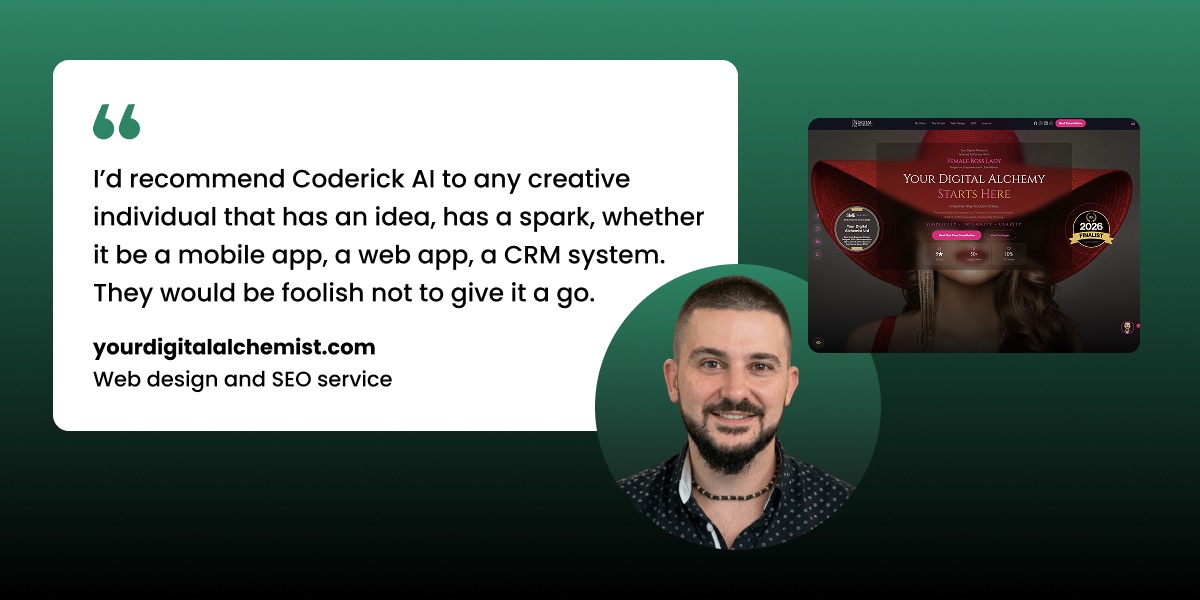
Quote from Marc Jukes of yourdigitalalchemist.com: "I'd recommend Coderick AI to any creative individual that has an idea, has a spark, whether it be a mobile app, a web app, a CRM system. They would be foolish not to give it a go." Shown alongside a screenshot of his web design work.

If you’ve ever looked at web design and thought “I’d need a developer for that”, Marc Jukes used to think the same thing, until he started using the right tool: SiteGround’s Coderick AI.

Marc runs Your Digital Alchemist, a fully managed web design and SEO service for small businesses in the UK beauty and aesthetics sector. Only, he works alone, from home, and he builds every website with Coderick AI.

From December 2025 to May 2026, he built 15 websites, won a regional award for best small business website design agency, and received four enterprise award nominations. 

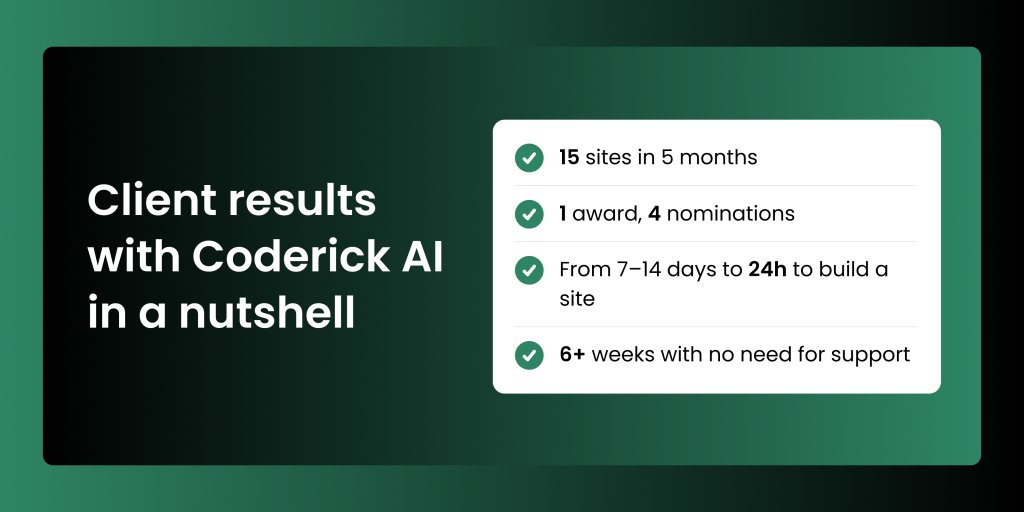
Infographic summarizing client results with Coderick AI: 15 sites built in 5 months, 1 award and 4 nominations, site build time reduced from 7–14 days to 24 hours, and 6+ weeks with no need for support.

The tools that were supposed to work

Before Coderick AI, Marc tried the platforms most freelancers and small agencies reach for first: the popular drag-and-drop builders. He paid for more than one, and found all of them clunky, painful, and slow: 20, 30, sometimes 40 hours per website, and still not the result he had in mind.

The time cost alone makes those tools hard to justify when you work solo. And when the output doesn’t match what you promised a client, it makes the work harder to sell, and harder to repeat. That’s not a skill problem. It’s a tool problem.

The workflow that changed everything

When SiteGround launched Coderick AI, Marc was among the first to use it. There were early rough edges, especially having in mind the dynamic world of AI and LLM development. But within a few weeks, something had clearly shifted.

“SiteGround’s team is listening and improvements are happening every day.”

His approach is methodical. Before he opens Coderick AI, the prep work is done: 

  • Content collected from the client
  • Competition researched
  • Images resized and named
  • Logo ready

Foundation first. Then he feeds everything in and lets the tool build, refining from there by talking through sizing, layout, nav menus, padding, margins, mobile responsiveness. When he’s not sure what to tackle next, he just asks. Coderick AI walks him through the rest of the process until the site is done.

He builds a landing page prototype before a client has committed to anything, showing them exactly what’s possible using Coderick AI’s free trial credits.

“You’re not only showing your client your expertise, you’re showing them what the platform can do. And you’re saying: you could do this yourself, but I’m the expert. I will save you time.”

Show your clients the prototype before they’ve signed anything, and the conversation tends to take care of itself.

Price fairly. Earn loyalty.

When your pricing is fair and your clients know exactly what they’re paying for, word of mouth does the heavy lifting. Marc charges a fraction of what agencies typically ask for the same result — and doesn’t hide which platform he uses to deliver it.

“Too many people are getting charged thousands and thousands of pounds for something you can actually build with Coderick AI very cost-effectively. It’s all about fairness and transparency.”

Transparency about what you use and what you charge tends to come back around. For Marc, it’s why most of his new business comes through word of mouth. Website clients become SEO clients, recurring revenue builds, and two to three new websites a month adds up fast.

Practice what you preach

If you’re going to sell web design services, your own site should be the first proof of what you can do. That’s exactly how Marc approaches it: his website is built with Coderick AI, and it’s all the more proof of what the platform is capable of.

He updates it regularly, pushing the tool further each time: testing animations, custom JavaScript effects, layouts he hadn’t tried before. 

The first website he built with Coderick AI looks nothing like the ones he’s building now. When building and iterating takes hours instead of months, keeping your own site current stops feeling like a luxury.

One person. Real results.

Not everyone starting a business has the perfect setup: a dedicated office, a full schedule, or a technical background. Most people are figuring it out within whatever constraints they have.

Marc got registered disabled a few years ago. Working from home isn’t a preference; it’s his reality. He built this business within those constraints, and Coderick AI is a significant part of why it works.

“It’s something that can help many like me — people that have got a creative skill, that can’t leave the home, that have a disability. If they want to learn, they could actually set up their own small agency doing what I do.”

Since December, he’s built 15 websites, won a regional award, earned four enterprise nominations, and has two active referral partners signed up through a portal he built himself, also using Coderick AI. What made all of this possible?

“Time. Coderick AI saves you a lot of time, a lot of heartache, and money.”

Who Coderick AI is actually for

The answer is broader than you might expect. 

“I’d recommend Coderick AI to any creative individual that has an idea, has a spark, whether it be a mobile app, a web app, a CRM system. They would be foolish not to give it a go.”

The 50,000 free credits are enough to see what’s possible before committing to anything. And once you’re in it, the tool rewards patience — talking to it clearly, breaking down what you want, asking what comes next. The more you put in, the more it gives back.

The gap between “I’d need a developer for this” and “I can build this myself” is smaller than most people think. It’s all about how big your imagination and your motivation is. Marc has both of these in plenty. He just needed an ally — and we’re proud that he found one in the face of SiteGround and Coderik AI. 

And so can you.

[96]

200+ client websites managed. Zero support calls in a year.

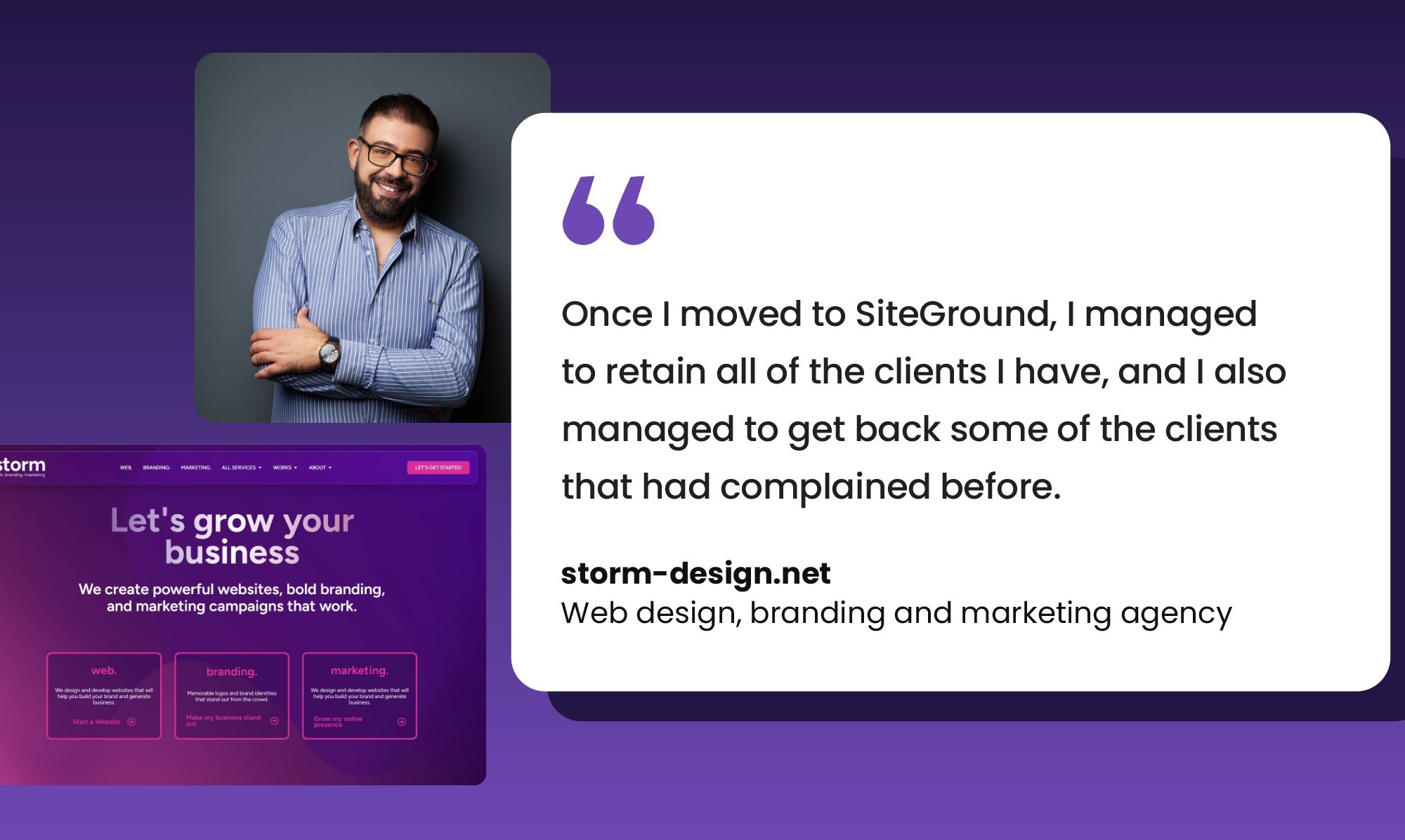
Storm Design founder smiling with arms crossed next to a quote about retaining and winning back clients after switching to SiteGround

Most web agency owners don’t think about hosting until something goes wrong. Jesmond Darmanin thought about it for two weeks straight: during a “holiday” in Greece, on his phone, with 85 client websites to move.

Jesmond Darmanin has been running the web design and branding agency Storm Design since he was 17. Twenty-five years later, it’s one of Malta’s most established digital agencies. For years, he managed his own servers through cloud providers. It worked, until it didn’t.

That was enough. He moved everything to SiteGround, and the hosting emergencies that used to be a regular part of his life simply stopped. But it wasn’t always that way.

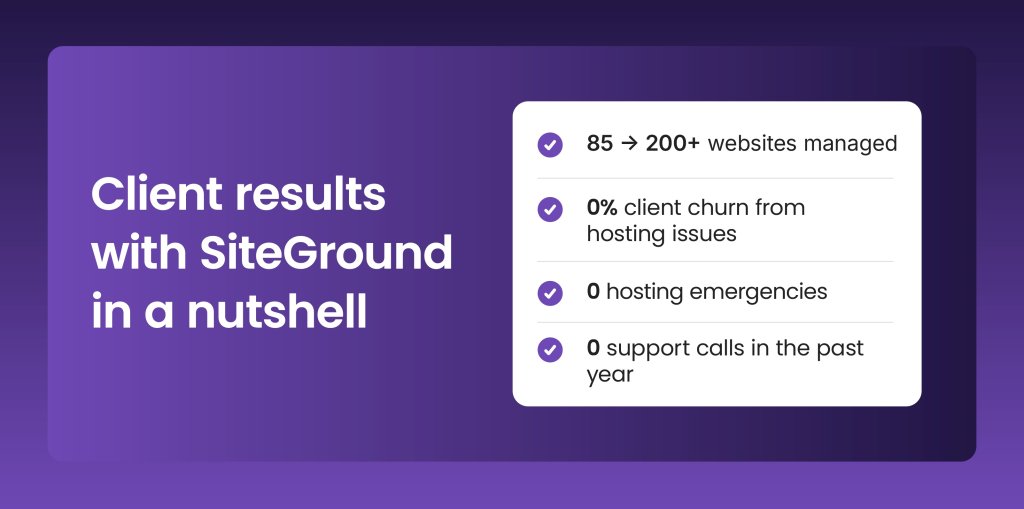
Infographic showing Storm Design's results with SiteGround: portfolio grew from 85 to 200+ websites, with zero client churn, zero hosting emergencies, and zero support calls in the past year

What self-managed hosting really costs you

For a technically capable team, managing your own cloud server seems like the smart, cost-effective choice. Full control, low monthly bill. But what it comes down to is that every security gap is yours to catch, including the ones introduced by a routine software update.

The hack that took 85 sites offline

A dreaded update had opened a vulnerability. One hour before his flight to Greece, Jesmond got the notification: his server had been compromised. Eighty-five client websites were down or barely loading.

  • Emergency remote cleanup by an external company: €1,000
  • Server back online for only two days
  • Then compromised again, through a backdoor the cleanup had missed

The maintenance problem

The emergencies were just part of it. Every software update required a server restart, and every restart meant downtime. With clients in different time zones, there was no safe window to take things offline. Complaints accumulated.

“I did lose clients because of the downtime. They told me we’re going to have to switch hosts.”

The client cost

Hosting issues were costing Storm Design somewhere between 5–10% of its client base every year. When other businesses depend on you to keep their websites running, that’s not just lost revenue. It’s trust you don’t get back easily.

The checklist that led to SiteGround

With 85 sites needing an immediate new home, Jesmond wasn’t shopping casually. He needed something specific: 

  • Security handled at the hosting level, not by his team
  • Reliable, automated backups
  • One back-end for managing all client sites
  • A migration process that didn’t require moving databases by hand

SiteGround wasn’t a completely unfamiliar name. He’d worked inside a client’s account before and had seen the tools. When he cross-referenced it against other well-known providers, the reputation held up, and he decided to give it a go.

What followed was not the relaxing Greek holiday he’d planned. He completed most of the migration from his phone, on buses and trains, while the trip carried on around him. 

The tools that cut hours from the weekly workload

The improvements Jesmond noticed after switching went beyond traffic and rankings. They showed up in the day-to-day work of managing a growing portfolio of client websites.

Tools that previously required third-party plugins or manual setup were now built into SiteGround’s backend:

One-click WordPress login, no individual site logins needed

“The option to simply go into the account and click WordPress login and not have to manually log into the websites: that was a huge time-saving.”

Team access got simpler too. He could set up accounts for colleagues and limit each person to only the sites they were working on: a small thing that makes a big difference when you’re managing multiple clients across a shared environment.

Security handled at the platform level

On the security side, the difference became very real when a client’s site was recently compromised due to a weak password. SiteGround Site Scanner caught the malicious files and blocked them before any damage was done, and Jesmond got an immediate notification.

“Getting a notification about malicious files right away — that’s not something I would have been able to do myself.”

For anyone managing sites on behalf of clients (especially ecommerce) that kind of automated catch is the difference between a minor incident and a very bad phone call.

Coderick AI: Jesmond’s new favourite tool

Beyond the day-to-day tools, Jesmond found an unexpected favorite in SiteGround’s Coderick AI. He’d been looking for a task management tool that could handle client requests and integrate project costing: something he couldn’t find off the shelf. So he built it himself.

“I described what I needed, and let’s say we’re 80% there. It’s already open on my second screen. It became one of my favorite tools very quickly.”

The tool he built lets clients submit change requests directly, which then feed into his to-do list. He can add costs, send approval links to clients, and once approved, tasks move automatically into an in-progress table. He’s now waiting on his next round of credits to keep building.

“I got into the idea of always looking: how can I build something new? It’s a fun tool to work with.”

A year with zero support calls

When a hosting platform is working the way it should, you stop noticing it. No alerts, no emergency calls from clients, no late-night troubleshooting. For Jesmond, that’s exactly what happened: he hasn’t needed to contact support in over a year.

The client retention picture changed just as completely. The downtime complaints that had been a regular part of the job stopped. Some of the clients who had walked away came back.

“Once I moved to SiteGround, I managed to retain all of the clients I have, and I also managed to get back some of the clients that had complained before.”

Of course, some businesses closed down along the way (that’s the reality of working with startups), but hosting hasn’t been the reason anyone walked away.

Storm Design now manages over 200 websites. Jesmond travels without a knot in his stomach about what might break while he’s offline: something that anyone who’s ever managed a client portfolio remotely will recognise as no small thing.

“I don’t want to deal with this anymore. That peace of mind was a very, very big one. Compromising on hosting is not a mistake I want to make again.”

Reliable hosting = clients retained

The lesson Jesmond carries from the Greece incident isn’t just about hosting. It’s about what happens when other people’s businesses depend on your infrastructure choices.

“You cannot live a type of life where you’re constantly thinking: is the server okay? Am I getting hacked? That kind of stress, especially once your client base starts to grow, is something no business owner should underestimate.”

The monthly invoice might look cheaper with a self-managed setup. But when hosting issues start costing you clients year after year, the math stops working in your favour. SiteGround ends up paying for itself. Not in traffic spikes or overnight transformations, but in the clients you keep and the emergencies that never happen.

[86]

Why MarketingDirecto.com hasn’t switched hosts in 8 years

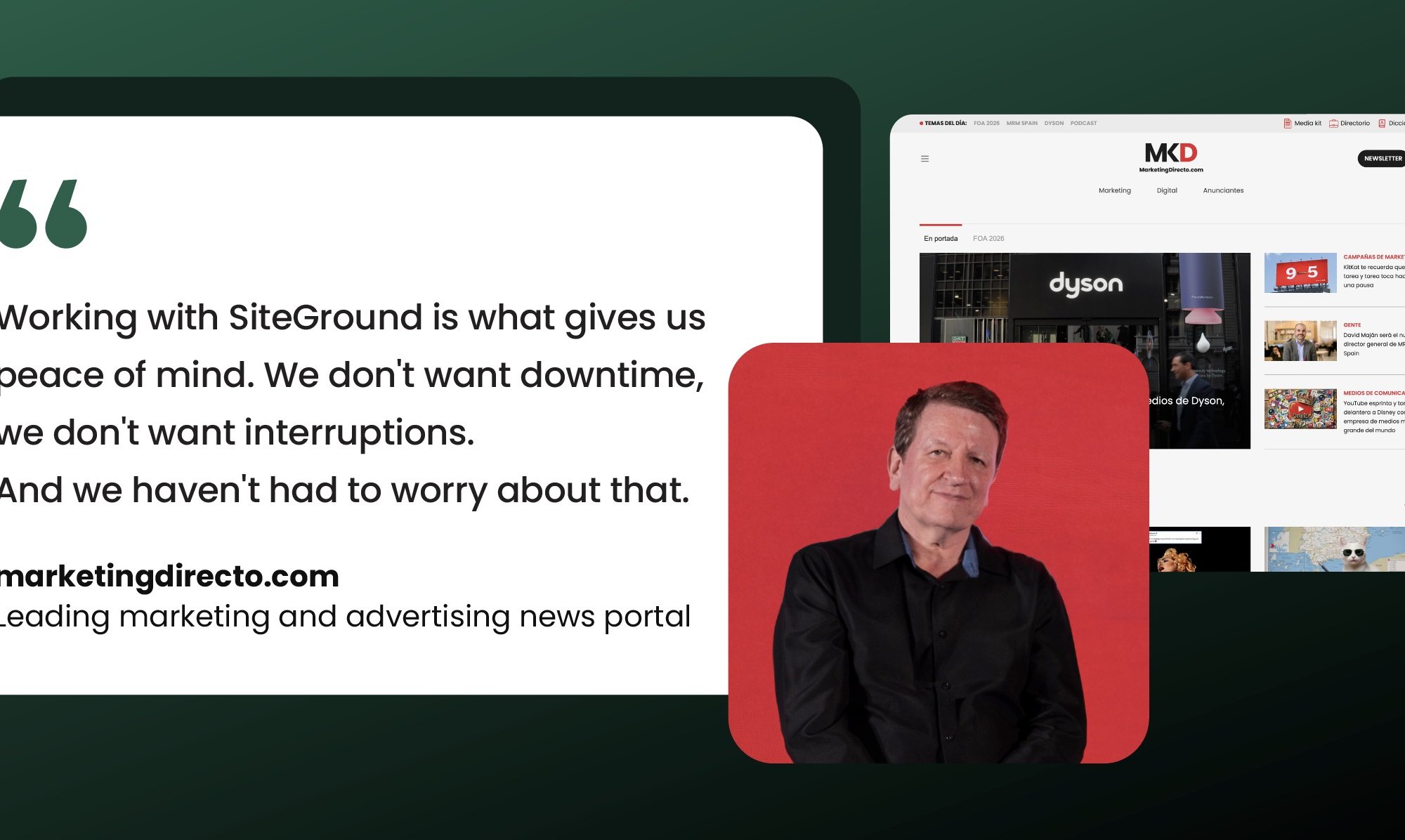
Quote card featuring Javier Piedrahita, founder of MarketingDirecto.com, saying "Working with SiteGround is what gives us peace of mind. We don't want downtime, we don't want interruptions. And we haven't had to worry about that." alongside a screenshot of the MarketingDirecto.com homepage.

When your website is your business, downtime isn’t an inconvenience. It’s lost revenue, lost trust, and lost visibility in search. Whether you’re running an online store, a service business, or a content-driven site, your audience expects it to just work.

MarketingDirecto.com’s CEO & Founder Javier Piedrahita knows that pressure better than most. As one of the longest-running marketing and advertising news portals in the Spanish-speaking world, they’ve been publishing daily since 1999: a quarter century of content that professionals still search for, reference, and share.

But keeping a site like that online: fast, stable, and accessible, turned out to be harder than it should have been.

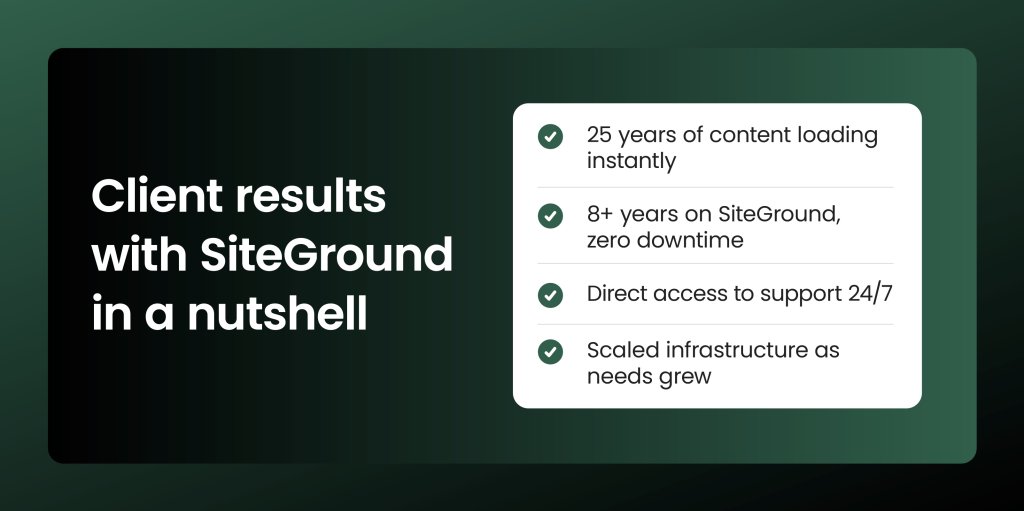
Summary card of MarketingDirecto.com's results with SiteGround: 25 years of content loading instantly, 8+ years on SiteGround with zero downtime, direct access to 24/7 support, and scaled infrastructure as needs grew.

The problems that kept piling up

Before SiteGround, MarketingDirecto.com was dealing with constant downtime, growing technical concerns, and a hosting provider that couldn’t keep up.

Constant downtime with no explanation

Imagine it’s Friday evening, you’re trying to step away from work, and a thought creeps in: is the site still up? For MarketingDirecto.com, that wasn’t occasional paranoia. It was a pattern.

“I remember the stability issues. It scared me a lot. The weekend would arrive, and I’d wonder: what’s happening with the website? Why is the site down? What’s going on?”

But the outages were only part of it. On top of that, they were dealing with:

  • CMS issues with no clear fix
  • Security concerns with no dedicated team to handle them
  • A hosting provider with no real answers

“All of this gave us worries and headaches. When you suffer from the downtime, you suffer in Google, you suffer in positioning, long faces all around.”

When your site depends on Google traffic, that last part hits hard. When your site goes down, you don’t just lose visitors right then. You can also slip in search results, and climbing back up takes a lot longer than going down.

A site that outgrew its hosting

The more content you publish, the heavier your site gets. Blog posts, images, landing pages, product listings: it all adds up. And at some point, the hosting that worked fine with 50 pages starts buckling under 500. Or 5,000.

MarketingDirecto.com has 25 years of daily content in their archive: thousands of articles and images that readers still access every day. Their previous hosting simply couldn’t keep up with that volume.

No technical backup when things broke

And through all of this, MarketingDirecto.com didn’t have a dedicated technical team to lean on. Most small and mid-sized businesses don’t. You’re relying on your hosting provider to catch problems, explain what went wrong, and fix things quickly.

When that provider can’t deliver, when you’re left guessing why your site went down and when it might happen again, you spend time on server issues instead of the work that actually moves things forward.

“There wasn’t a technical service team on top of things. Security was always a concern and that’s something we’d dealt with at some point.”

What changed with SiteGround

MarketingDirecto.com moved to SiteGround in 2017, and just like that, the “weekend anxiety” was gone.

“Since 2017 we’ve been working with you, and I’m very happy because I know this is what gives us peace of mind. We don’t want downtime, we don’t want interruptions, we don’t want problems. And with you, this has been working very well.”

For MarketingDirecto.com, it came down to three things: 

  1. A site that finally stayed fast and stable
  2. Support they could actually reach
  3. Infrastructure that scaled with them instead of holding them back

Speed and stability that hold up under pressure

The site just stayed up. No more unexplained crashes. The 25-year archive of content loaded quickly and consistently, even as the team kept publishing new articles daily.

For a site carrying that much content, performance isn’t just about visitor experience; it’s about protecting the search visibility they’d spent decades building. 

Stable hosting meant stable rankings.

Support that actually picks up the phone

But speed and uptime only tell part of the story. What stands out for MarketingDirecto.com is the ability to talk to real people who understand their setup and to report something the moment it looks off, without waiting in a ticket queue.

Their developer, Luis, works directly with SiteGround’s team when the site needs to scale: adding server capacity, expanding resources, adjusting configurations. And that process has always been straightforward.

Scaling without the headaches

As MarketingDirecto.com’s needs grew, SiteGround’s infrastructure grew with them. No drawn-out migrations. No “you’ve outgrown your plan, good luck” moments. Just a team that already understood the site’s architecture and could expand capacity when needed.

What eight years with SiteGround looks like

Nobody switches hosting providers for fun. You switch because something broke, because support couldn’t help, or because you’ve outgrown what they can offer. MarketingDirecto.com went through all of that before landing with SiteGround and haven’t had a reason to look elsewhere since.

“That’s what brands want: stable, long, trusting relationships. And that’s what I have with SiteGround.”

A hosting team that already knows your site inside out makes a difference. No re-explaining your setup every time you need something. No starting from scratch. Just people who get it and can act on it.

Pick a hosting provider you’ll actually want to stick with

When asked what advice he’d give to other companies choosing a hosting provider, Javier kept it practical:

“Look around. Read reviews, check forums. Look at which clients they work with: ‘Oh look, they work with brands that I even know.’ That’s extremely important. That’s what I’ve done myself.”

Solid advice. The clients a hosting provider serves tell you a lot about whether they can handle what you need, especially if your site carries years of content, faces real security threats, and can’t afford to go dark on a Friday night.

Running a growing business or any project that people depend on? Your hosting should be the thing you think about least. That’s what MarketingDirecto.com found with SiteGround, and it’s why they’re still with the same hosting eight years later.

[86]

150+ Sites, zero hosting chaos

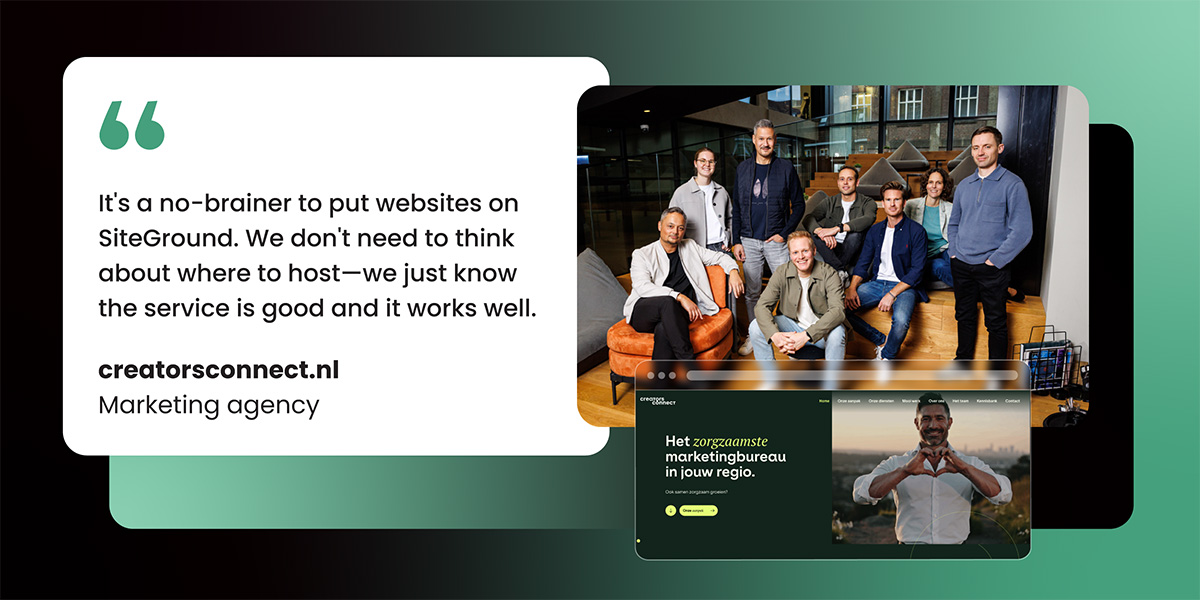
Quote card from creatorsconnect.nl reading "It's a no-brainer to put websites on SiteGround. We don't need to think about where to host—we just know the service is good and it works well," alongside a team photo and a screenshot of their website.

Agencies don’t lose sleep because of strategy. They lose sleep because of instability.

Jeroen Hardenberg, Founder, and Mathijn Vermeer, Partner & Co-Owner of marketing agency Creators Connect, know this firsthand. They experienced what many agencies recognize: new provider, new dashboard, same recurring issues. Not dramatic failures; just a constant low hum of things that shouldn’t need fixing.

As the agency grew (in clients, team members, and responsibility) that approach no longer fit. The standard shifted from “good enough” to “structurally reliable.”

Eventually, after enough testing and enough letdowns, they moved everything to SiteGround.

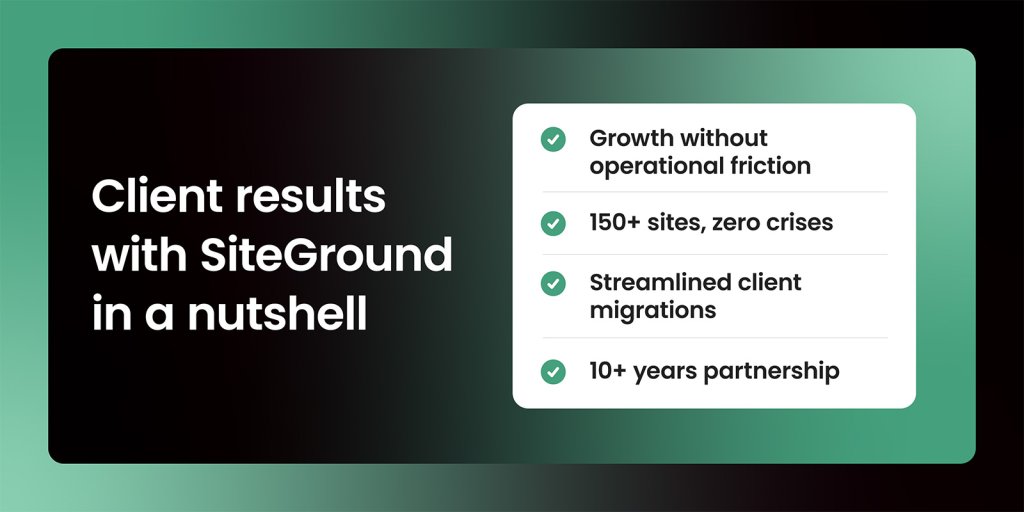
Summary graphic showing Creators Connect's results with SiteGround: 10x revenue, 150+ sites managed with zero crises, streamlined client migrations, and 10+ years of partnership.

The testing phase that wouldn’t end

The move to SiteGround wasn’t a single decision. It happened in stages.

Jeroen signed up for his first SiteGround package in late 2016, after comparing providers and prioritizing European data centers. The service worked, but trust takes time. He kept other options running, still hedging his bets.

His business partner Mathijn was running his own parallel testing cycle, bouncing between providers until he made the switch to SiteGround around 2020.

By 2021–2022, both had seen enough. Everything migrated to SiteGround.

What changed

Five things changed, and each one removed a different source of friction.

Hosting finally stayed in the background

“With other hosting providers, every time there’s another thing that’s broken, you get the headache again. I haven’t had that since working with SiteGround. For me it’s like a no-brainer.”

The infrastructure did what infrastructure should do: it worked, then faded into the background.

A dashboard anyone on the team could use

Creators Connect runs on a network of freelance specialists: photographers, designers, marketers, developers, each with different technical backgrounds. After years of control panels where every small task felt like a detour, SiteGround’s Site Tools were immediately different.

“SiteGround’s Site Tools user interface is so easy to use yet comprehensive that I can easily do anything. It feels more like just a really easy to scan dashboard.”

Streamlined client website migrations

Before, transferring over a client’s website meant figuring it out as you went: a different process every time, with different results, depending on the host. Taking on a new client now follows a repeatable process: assess, migrate automatically with the SiteGround WordPress Migrator, validate, launch. No data loss, no hassle, no variables, the same way every time.

Support that showed up when things went wrong

Despite all of the above, mistakes still happen. And when they do, usually it happens at scale: misconfigured settings, unexpected update breaks. What matters is whether support helps anyway.

“Even if there’s trouble which is caused by us, you guys are still really helpful. There hasn’t been any moment that we haven’t been helped.”

When some hosting plans hit their limits while others had room to spare, SiteGround’s team helped redistribute sites across plans — not to fix a crisis, but to prevent one.

Scaling without multiplying complexity

Since 2016, Creators Connect have been able to grow without hosting holding them back. The team expanded from one freelancer to 25 people. The portfolio grew to 150 managed websites.

That kind of growth usually means more operational risk. Instead, with SiteGround, hosting got simpler.

For new projects under full agency control, the hosting decision is straightforward. SiteGround is the default environment.

Not because alternatives don’t exist, but because consistency reduces operational noise.

The pattern every agency eventually sees

The co-founders keep watching the same story unfold with new clients: businesses trying to save money on hosting, then paying for it elsewhere.

“We have so many clients that move to us and they all use small hosting parties. There’s always trouble, there’s always something that is changing which makes their website go offline.”

Backups not running when disaster struck. Support that vanished when problems hit. One client had to rebuild their entire site from scratch after a provider error wiped everything.

Every hour troubleshooting hosting is an hour you can’t bill. Every site that goes down hurts your reputation, not the provider’s.

After a decade and 150+ sites with SiteGround, the hosting shuffle ended, because the problems did.

Ready for hosting decisions to become no-brainers? Join the agencies who’ve made SiteGround their last hosting switch. Not because they can’t leave, but because they don’t want to.

[86]

How SiteGround gave Japonismo room to grow

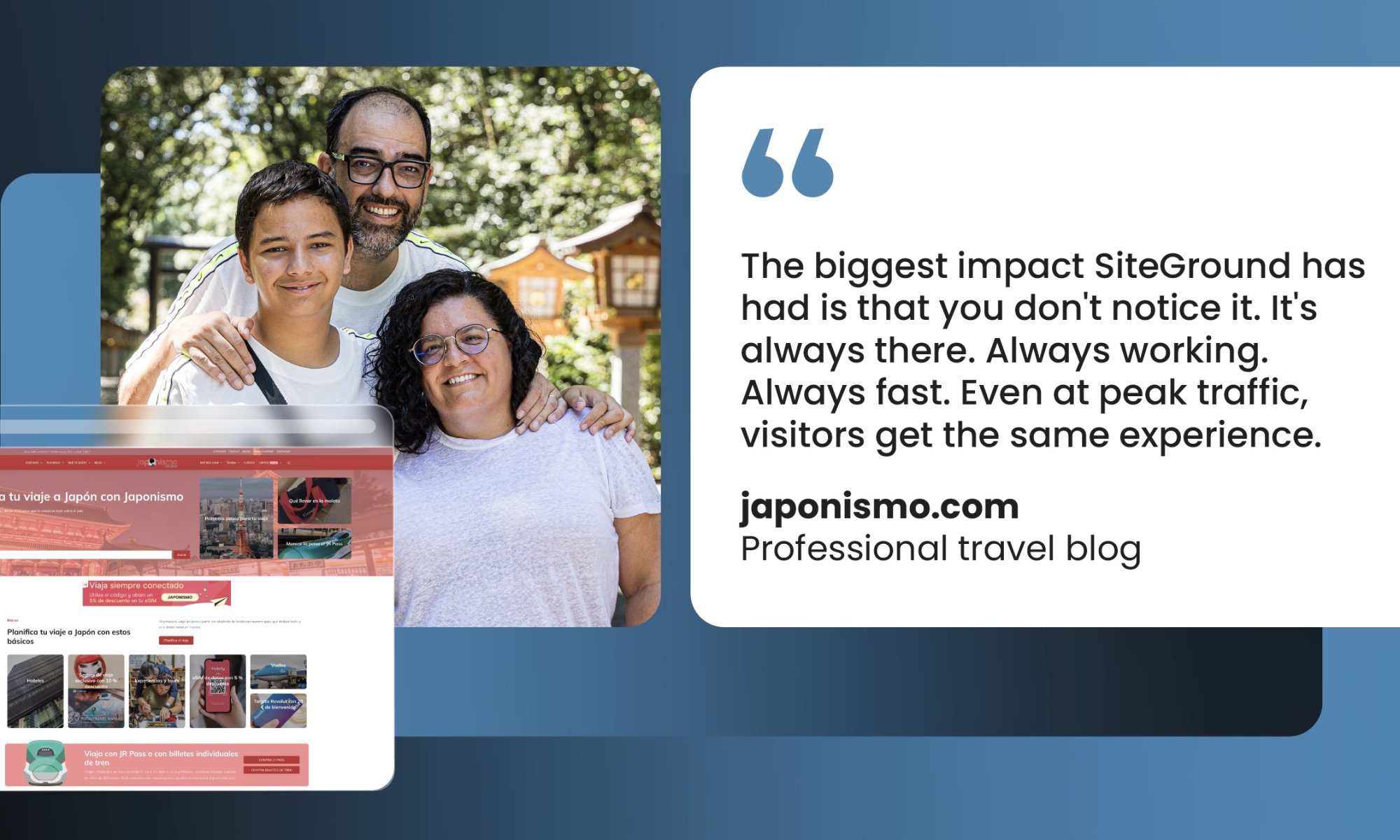
Family of three smiling outdoors next to laptop displaying japonismo.com travel blog website with Spanish content about Japan. Quote reads: 'The biggest impact SiteGround has had is that you don't notice it. It's always there. Always working. Always fast. Even at peak traffic, visitors get the same experience.' - japonismo.com, Professional travel blog

You know that moment when your side project stops being just a side project? When the thing you started for fun—sharing what you know, building something you care about—suddenly has an audience that depends on you?

For Luis Rodríguez and his wife who run their professional travel blog Japonismo, that realization came with a phone call he’ll never forget. His hosting provider was shutting down his site—not temporarily, just off—right when his traffic was finally taking off. Everything he’d built since 2006, all those readers planning their Japan trips based on his advice, suddenly couldn’t reach him.

And his hosting provider couldn’t tell him why or how to fix it. 

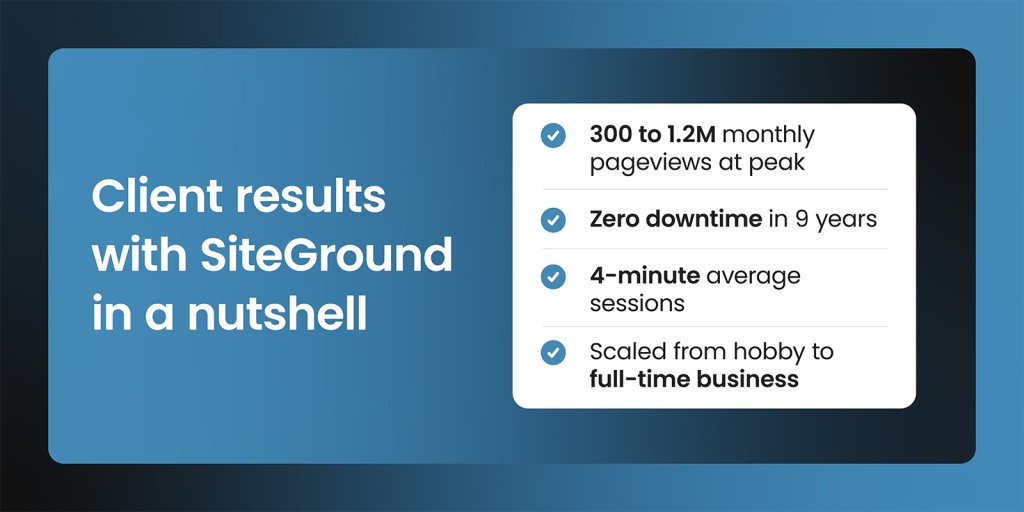
Client results summary showing japonismo.com growth metrics: 300 to 1.2M monthly pageviews at peak, zero downtime in 9 years, 4-minute average sessions, and scaled from hobby to full-time business

The breaking point: months without access

Here’s a scenario most site owners dread: You’re building something that matters. Your audience is growing. People are starting to trust you. And then your hosting provider calls to tell you they’re shutting down access to your site.

Not temporarily. Not for maintenance. Just… off. That’s exactly what happened to Luis with his previous hosting provider.

“They called me while I was in New York and said they were removing access to index.php—basically making Japonismo unavailable to everyone who wanted to visit. And they couldn’t tell me why or how to fix it.”

But that phone call was just the breaking point. The real problem had been building for months.

“We had hosting that left us without access to the website for several months—right when the site was starting to grow and gain audience trust. Just imagine what that meant for us at that critical time.”

If you’ve ever built something while working another job, you know that sinking feeling. You’re already stretched thin. Now you’re troubleshooting server issues at midnight because your hosting provider has no answers.

The problems Luis faced aren’t unusual—they’re the same frustrations many site owners hit when their hosting can’t keep up:

  • Constant crashes that knock your site offline
  • Slow loading times that send visitors straight to your competitors
  • Images that won’t optimize, killing page speed—especially painful if your content is visual
  • Support that can’t actually help when things break

“I didn’t want to spend my time on hosting technicalities that weren’t adding value to the project. I just wanted to write about Japan, share photos, and help people plan their trips. Instead, I was constantly dealing with hosting problems I didn’t understand and couldn’t solve.”

If that sounds familiar, you’re not alone.

Finding a partner, not just a provider

When a friend told Luis about SiteGround in 2016, his expectations were modest. He needed a hosting company that actually understood WordPress. One that wouldn’t leave him stranded.

“My friend told me, ‘SiteGround will save you. They’re serious people who know WordPress inside and out. Migration will be easy and everything will just work. At that point, I had nothing to lose.”

The migration was straightforward—none of the drama he’d come to expect. But more importantly, once Japonismo was on SiteGround, Luis could finally stop firefighting and start building.

Finally, room to build the site you’re envisioning

Everything that had been a daily struggle suddenly just… worked. The site was stable. Images loaded quickly. And Luis could access tools he’d never had before:

  • Staging environments to test new page designs and layouts without breaking the live site
  • Built-in image optimization that handled compression automatically—no technical expertise required
  • Early access to new technology like HTTP/2 for faster loading
  • HTTPS security certificates when they were still relatively new, making Japonismo one of the first Spanish-language travel sites with that level of security

“I remember being among the first sites with HTTPS. SiteGround was always ahead technically, allowing your site to be faster, more accessible, and reducing your technical worries—which I sincerely appreciate.”

For a site built around visual storytelling—articles with 8,000 to 10,000 words, 20 to 25 high-resolution images showing temples, food, landscapes—that technical foundation made all the difference.

Handling peak season: the real test of hosting

But having reliable hosting doesn’t just matter during normal traffic days. For a travel site focused on Japan, the real test came during peak season.

Japan tourism has intense peaks and valleys. Summer months bring massive traffic. Winter slows down. August alone can hit 1.2 million pageviews for Japonismo.

“When traffic is low, any hosting can seem fine. But when August arrives and everyone’s planning their Japan trips, you need infrastructure that doesn’t buckle. Your site can’t slow down when it matters most.”

With his old hosting, those peak months meant crashes and lost visitors. With SiteGround, they became his strongest months.

With all those high-resolution images and long-form content, Japonismo could easily be a slow site. Instead, visitors stay an average of four minutes—far above the typical 30-60 seconds for most pages—reading, scrolling through photos, absorbing the depth of information Luis provides.

That doesn’t happen by accident. It happens when your hosting can handle the load and optimize the delivery.

Support that actually responds

“I’ve never waited more than two minutes to reach someone on chat. And it’s not just fast—it’s actually helpful. They look at logs, identify the issue, and fix it. Sometimes problems that could take hours are resolved in five or ten minutes.”

For someone running a business largely solo, that responsiveness matters. Luis doesn’t need to become a server expert. He needs answers when something breaks—and ideally, he needs things to rarely break in the first place.

“Even when issues aren’t technically SiteGround’s responsibility, they investigate and help anyway. That’s what partnership looks like.”

And that partnership has lasted.

Nine years on SiteGround and counting

Japonismo has been with SiteGround since 2016. Luis has moved from shared hosting to cloud hosting as traffic grew. The site has evolved from a hobby project to a full-time business—and eventually into a specialized media outlet focused on Japan, with the website remaining the core of everything they do. And through all those changes, the hosting hasn’t been something he’s had to think about.

“The biggest impact SiteGround has had is that you don’t notice it. It’s always there. Always working. Always fast. Even at peak traffic, visitors get the same experience—which means I can focus on what I actually do: helping people connect with Japan.”

That’s the real lesson here.

What actually matters when you’re building something

When you’re starting a digital project—whether it’s about travel, food, business advice, or anything else—there’s a temptation to cut costs where you can. Hosting seems like an easy place to save money.

Luis learned otherwise.

“Cheap becomes expensive when your site goes down during your peak season. Or when loading times drive visitors away. Or when you spend hours dealing with technical problems instead of creating content. Finding a hosting partner who knows what they’re doing—that’s not an expense. That’s what makes growth possible.”

For anyone building something online, the lesson is straightforward: Your hosting provider should remove obstacles, not create them.

That’s what partnership actually means.

Ready to stop wrestling with server issues and get back to what you actually do? Thousands of creators and business owners made the switch to SiteGround for the same reason Luis did—they wanted hosting that works so they could focus on building something that matters.

[86]

Multiple client sites, one platform: the SiteGround choice

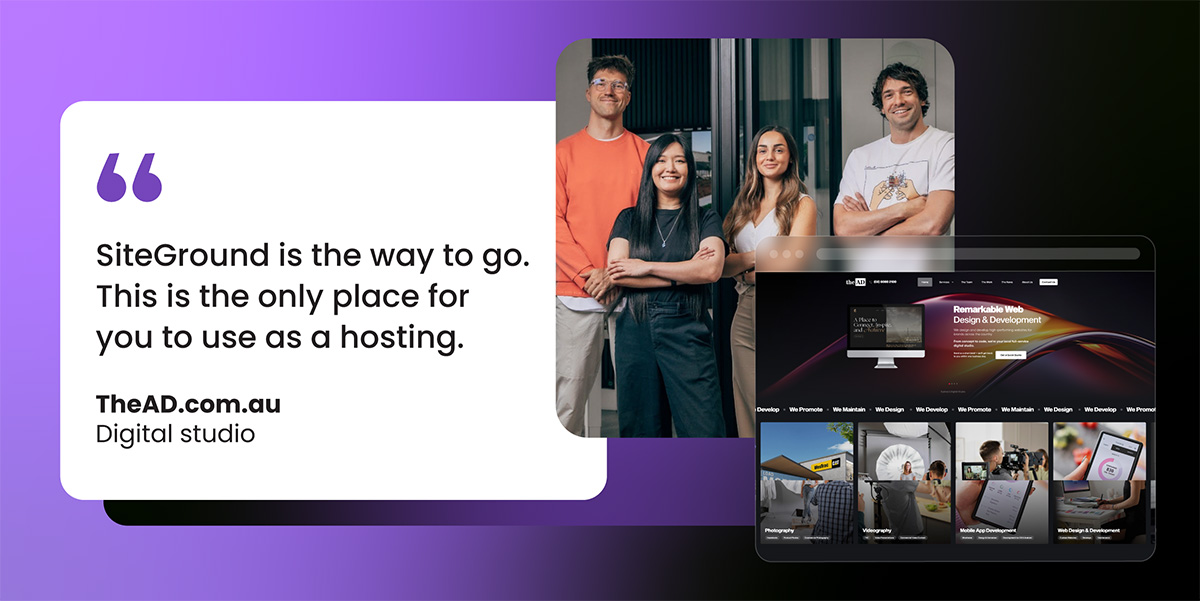
Team photo of TheAD.com.au digital studio alongside their portfolio website, with testimonial quote: 'SiteGround is the way to go. This is the only place for you to use as a hosting.'

If you’re running a service business and managing client websites across multiple projects, your choice of hosting partner becomes crucial, as it can make or break your process. Different dashboards for every task. Inconsistent site speed. Slow support responses. Every client update takes twice as long as it should.

That’s where Max Narelik found himself in 2019 with TheAD, his digital marketing agency in Sydney. Then he switched to SiteGround—and stopped fighting his hosting setup.

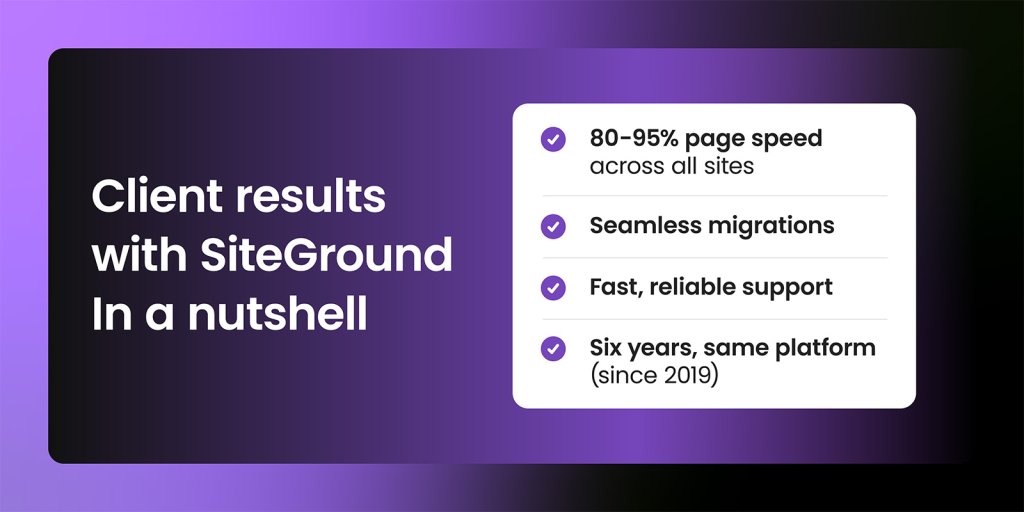
Graphic showing client results with SiteGround: 80-95% page speed across all sites, seamless migrations, fast reliable support, and six years on the same platform since 2019

The small team doing everything

Max has spent more than 20 years in digital advertising and marketing. His agency serves businesses across Australia: from bakeries to major construction companies and everyone in between. Companies that need marketing expertise but can’t justify a full-time department.

“We’re going to provide on-demand marketing services for the companies who do not have a budget or ability to have the full marketing department within their company,” 

Sound familiar? If you’re running a similar operation, you know the drill. TheAD handles everything in-house with a small team. 

  1. It starts with positioning and branding—logo design and brand identity. 
  2. Then websites and social media creatives. Traditional advertising like cinema, radio, billboards, and bus stops. Photo and video production—all done in-house. 
  3. Then the active stage: SEO and Google Ads. YouTube ads, social media management, ongoing technical support.

“We’ve got everything under one roof. We can deliver relatively seamlessly, consistent with the idea from brand identity to the idea of creative, idea of advertising, to delivery to photography, videography, then to manage the actual campaign itself.”

The tricky part: every client is different.

“You have to research the competitors, you have to research the target audience, you have to research the point of difference. None of them is the same as the other.”

With this many moving parts across different industries, you need tools that save time, not waste it.

The switch to SiteGround

Max had tried other hosting services before. The problem? When you’re running SEO campaigns for clients, slow site speed kills your results. And logging into different dashboards just to update client sites adds up fast.

In 2019, Max needed three specific things: 

  1. Managing multiple sites from one place 
  2. Speed that actually helps rankings 
  3. Pricing that makes sense for an agency

 And SiteGround delivered them.

“With SiteGround, it was easy to manage the multiple sites, speed, and the price as well,” Max recalls. “It was way easier to manage our client sites, to be honest.”

The migration? Simple.

“For us, it’s super easy, and it’s getting easier”

The features that matter

When you’re choosing hosting for client work, some features sound good on paper but don’t move the needle. Here’s what actually makes a difference day-to-day.

Speed that affects rankings

When you’re optimizing client sites, you’re probably targeting similar benchmarks.

“We’re doing SEO, so site speed is important for us.”

If you’re running SEO campaigns, you know this matters. That’s often the difference between ranking on page one versus page two for clients.

Usability that saves time

“The ease of use is crucial, because there’s a lot of requests. We have to go and change a lot of things. Usability is important.”

When clients need quick updates—and they always do—you need a system that doesn’t fight you. TheAD uses managed hosting for WordPress on SiteGround as their standard. No complicated builders, just a clean, fast system.

When something does go wrong?

“SiteGround support is quite good. We got a nice confident reply within a timely manner. That’s all we need.”

The real reason agencies stick with SiteGround

You’ve probably been there: a client calls with a site issue, and you’re scrambling through unfamiliar documentation or waiting on support.

After six years with SiteGround for WordPress sites, Max has eliminated that problem.

“SiteGround is the way to go. This is the only place for you to use as a hosting,” 

Deep platform knowledge means faster fixes. When clients have issues, his team already knows the solution—no hunting through forums or waiting on callbacks.

“We’re super familiar with SiteGround’s system. And if customers have an issue, they’re going to come back to us. When the customer comes back to us, we know how to suggest to them what to do.”

The math is simple: faster troubleshooting means lower client costs and more time for billable work. Platform familiarity isn’t just convenient—it’s profitable.

Growing through good work

Max’s hosting choice wasn’t just about technical features—it supports his entire business philosophy. If you’ve ever felt pressure to lock clients into long-term contracts, his approach might resonate with you.

Here’s his philosophy: no lock-in contracts. No hard selling. Just build great websites that do the talking for you. When potential clients land on a site, they should get their questions answered and start building trust before they ever pick up the phone.

Sound idealistic? Maybe. But it works—especially in a tight-knit market like Sydney where your reputation travels fast. Do good work, and people remember. Mess up, and they remember that too.

Most of Max’s new business comes through referrals and word-of-mouth. The SEO work delivers steady growth across different client industries. Some grow faster than others, but the trajectory stays consistent.

When your business model depends on your work speaking for itself, your hosting can’t be the thing that lets clients down.

Less time on hosting, more time on clients with SiteGround

When you can hit 90%+ speed scores, manage all your client sites from one place, and get support that responds when you need it—you spend less time troubleshooting and more time on billable work.If your current hosting creates more problems than it solves, you’re not alone. Agencies managing multiple client sites need hosting that scales without adding complexity.

[82]

How a tour photographer transformed her online portfolio with SiteGround

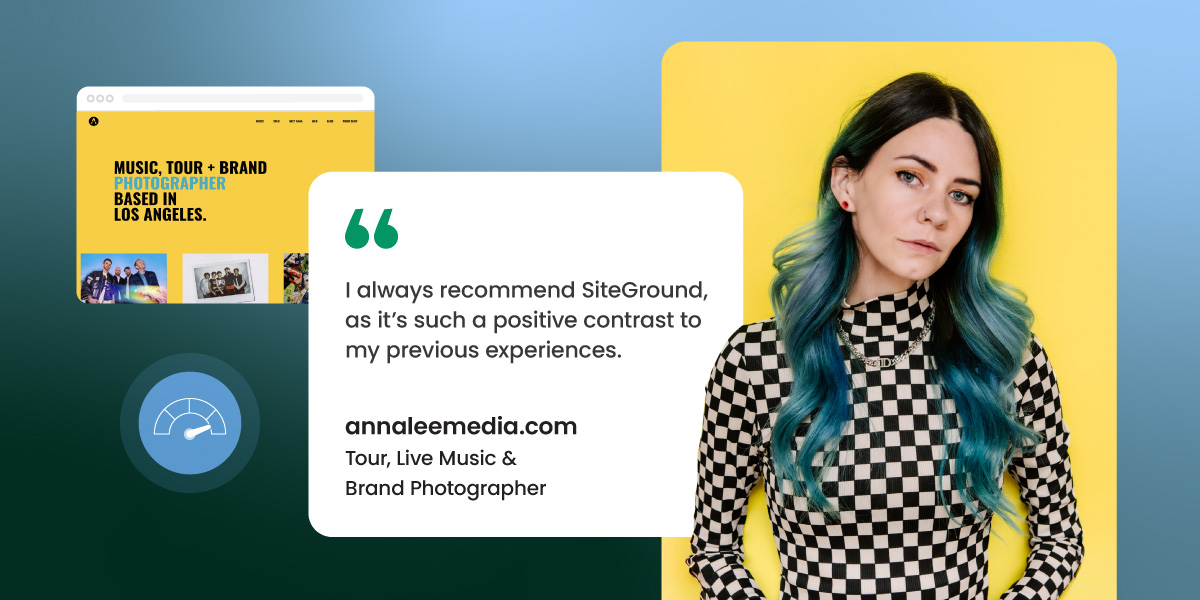
Tour and brand photographer Anna Lee with teal hair wearing a checkered top, shown alongside her testimonial quote "I always recommend SiteGround, as it's such a positive contrast to my previous experiences" and a preview of her website annaleemedia.com featuring yellow branding and improved site performance metrics

For photographers, designers, artists, and creative entrepreneurs, a portfolio website isn’t just nice to have — it’s pivotal for your career. It’s where potential clients discover your work, where you showcase your best projects, and where first impressions either open doors or close them.

As a Los Angeles-based tour, live music, and portrait photographer working with major artists like Coldplay, Anna Lee needed a website that matched the caliber of her work. Instead, she spent over a decade fighting with hosting that held her back at every turn.

The shift to SiteGround didn’t just solve technical problems. It removed barriers that were quietly hindering growth, productivity, and professional confidence.

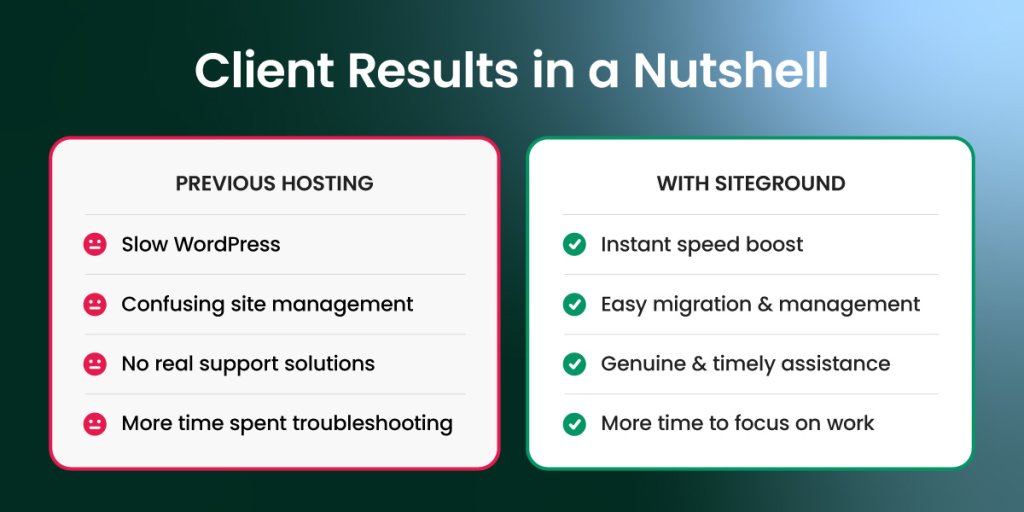
Comparison graphic titled "Client Results in a Nutshell" showing previous hosting problems versus SiteGround solutions. Left side lists issues with red icons: slow WordPress, confusing site management, no real support solutions, and more time spent troubleshooting. Right side shows improvements with green checkmarks: instant speed boost, easy migration and management, genuine and timely assistance, and more time to focus on work.

The problem with “just any hosting would do” 

By 2020, when Anna planned a complete website redesign, the limitations became impossible to ignore. 

“The process of improving my website was always frustrating. I would call their customer service with an issue, then leave without any real solution, while always being talked into buying more products and services.”

  • Slow performance undermining professional credibility
  • Unresponsive WordPress backend that made every task tedious
  • Confusing interface that required exceptional technical knowledge
  • Unhelpful support that prioritized upselling over problem-solving

“I knew that I wanted to overhaul the infrastructure at the hosting level. I knew I needed a better option that was more WordPress-friendly.”

The vision for her new portfolio required a foundation that could actually support it — specifically, hosting optimized for WordPress and built with creative professionals in mind.

The SiteGround switch: removing barriers to growth

Anna’s decision to switch came through a recommendation from a website building coach specializing in helping creative professionals establish their online presence. SiteGround was her consistent recommendation for WordPress sites — backed by research showing it as the preferred choice for users prioritizing performance without complexity.

Stress-free migration

Website migration can feel like a daunting process to most people, especially after a decade with the same provider. However, it doesn’t have to be.

For Anna, clear documentation replaced guesswork and timely, reliable support eliminated the anxiety of going through the process alone, without a high level of technical expertise. 

“Migrating is always intimidating, but it went so much more smoothly than I expected. SiteGround’s articles were very helpful resources to walk me through the process and what to expect.”

Moving at the right speed

The speed difference was undeniable from day one. Not just faster page loads for visitors, but instant responsiveness throughout the WordPress backend.

“The main difference I noticed was speed. I could tell right away. Especially with back-end WordPress loading.”

This allowed Anna to seamlessly organize her work, manage workshop information, and set up a functioning contact form that connects her with the right people — ultimately turning her website into a central hub of information about her business.

Intuitive site management

SiteGround’s Site Tools transformed Anna’s hosting experience making navigation intuitive and processes — easy to go through and complete.

“The hosting level navigation is very clear and easy.”

For creative professionals without technical backgrounds, this clarity matters the most. You can manage your portfolio confidently, make updates independently, and solve basic issues without requiring support intervention. The interface becomes a tool that serves you, rather than a puzzle to solve.

Support that actually solves problems

The contrast in customer service revealed what genuine support looks like.

After switching to SiteGround, Anna’s conversations with customer service representatives focused on solving problems, not selling add-ons. The support team provided real help during migration and beyond, without aggressive upselling tactics. 

“The support team is helpful, and I don’t end up spending more money on ‘solutions’ after communicating with them.”

Daily peace of mind

Knowing the website functions properly, loads quickly, and stays secure eliminates a constant source of background stress. For someone traveling for work and managing multiple projects at once, this peace of mind frees mental energy for what actually matters — creating exceptional work and growing the business.

“Having a functional website that I’m proud of allows me to share my work professionally, and this, no doubt, leads to more opportunities as a result of a beautiful portfolio.”

The right hosting choice for creative professionals 

After over a decade with underperforming hosting providers, and the transformation that followed the switch to SiteGround, Anna’s perspective is clear:

“When it comes to website hosting, I always recommend SiteGround, as it’s such a positive contrast to my previous experiences. “

Better hosting is the foundation that allows you to spend less time fighting technology and more time doing meaningful work.

SiteGround has become that foundation for many entrepreneurs and creative professionals — because it understands what they actually need and delivers it without complexity or compromise. 

If you need help on choosing the right hosting provider for your website or project, this is a helpful guide on how to choose the right hosting partner

[82]

From Weekly Hacking Attacks to 8 Years Without a Security Breach

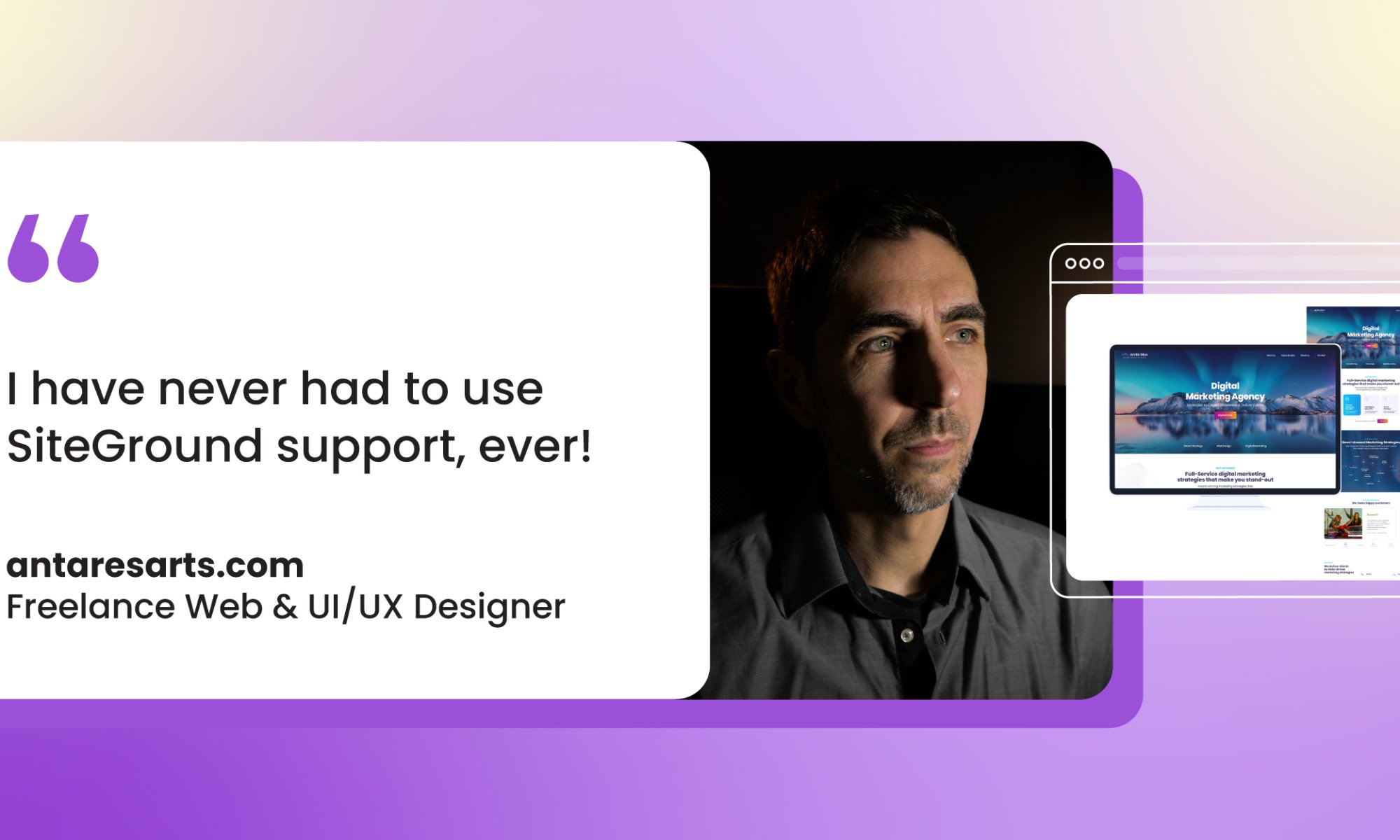
Freelance web designer Gellert Geszvein next to his quote "I have never had to use SiteGround support, ever!" with his website antaresarts.com displayed showing a digital marketing agency portfolio

You know that sinking feeling when a client messages you on a Saturday night saying their website is down? Or when you log in Monday morning to find three client sites have been hacked over the weekend?

That was life for a freelance web and UI/UX designer and illustrator Gellert Geszvein who runs AntaresArts.com – until switching to SiteGround changed everything.

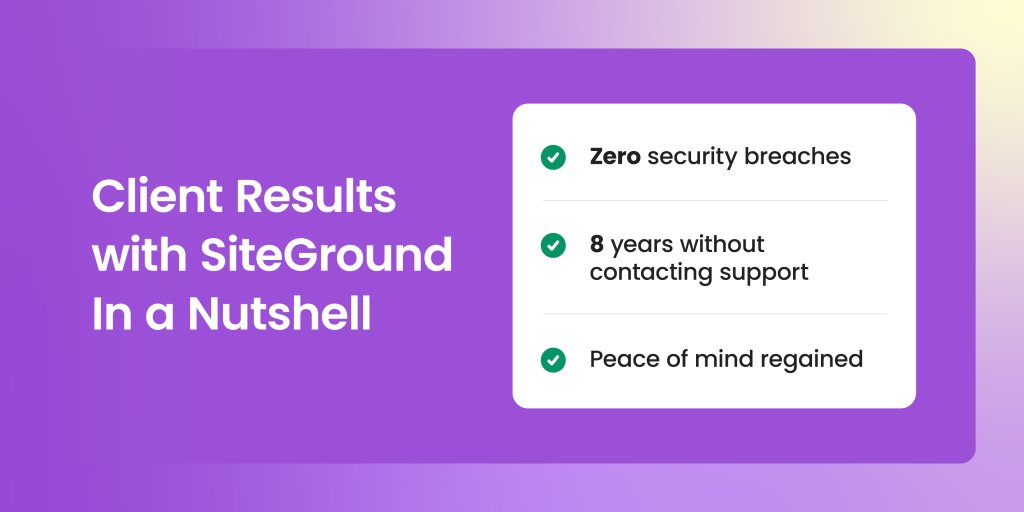
Purple graphic showing client results with SiteGround including zero security breaches, 8 years without contacting support, and peace of mind regained

The Moment Hosting Problems Outgrew the Business

Most freelancers follow the same path. You start with a few projects, teach yourself as you go, take on clients when they come. For years, it’s manageable – maybe a handful of sites to maintain, occasional updates, nothing too complicated.

Then things shift. The client list grows. Each new project means another website to maintain, another domain to manage, another hosting account to worry about. When you’re the one responsible for keeping everything running, every server issue becomes your problem to solve.

For Gellert, the turning point came when he and his family launched Sunnyhelps.com – an ecommerce site selling visual schedules and learning tools for toddlers and neurodivergent children. Suddenly he wasn’t just building sites for clients anymore. He was running his own online business, dealing with orders and customers and inventory, while still managing his client work.

“There are so many things we have to micromanage: orders, customer messages, new products, marketing activities. The server things shouldn’t be one of them.”

But server problems were exactly what he spent his time managing. And every hour fixing hosting issues was an hour not spent on actual client work or growing the business.

The Endless Hosting Shuffle

You know what nobody puts on their portfolio? The hosting shuffle. You start with one provider, things break, so you switch to another one your client swears by. Then that one has issues. So you try another.

“I have worked with almost every major hosting provider in the past and numerous smaller ones from Europe and North America. The experience was never flawless and I never felt like I had arrived and could forget about the servers. I spent years searching and trying.”

The problems never really changed:

  • Support was nearly impossible to reach. Getting through could take an hour. Sometimes multiple attempts just to reach someone. Then you’d explain the issue, wait, explain it again to someone else, wait more. Meanwhile, your client’s business was offline.
  • Sites broke without warning. An update would push through, and suddenly a site wouldn’t load. Or a backup restore would fail. Or a domain connection would drop. Never at convenient times.

Every incident cost billable hours. Time Gellert couldn’t bill for, time his clients lost, time that should have gone into actual design work or growing his business.

“It was very difficult to contact support, took a long time to get through, and in many cases it took several attempts. This meant a lot of inconvenience and wasted time for me and for my customers.”

When you’re building a reputation as someone clients can rely on, unreliable hosting becomes your problem. Customers don’t distinguish between a hosting failure and your failure – it all reflects on you.

Website Security – the Hosting Issue You Can’t Ignore

The hosting shuffle might have continued indefinitely – annoying but manageable – except for one thing: security breaches.

If you’ve ever had a client site get hacked, you know the panic. The emergency calls, the scramble to restore backups, the explanations to angry clients. Now imagine that happening repeatedly across multiple sites, despite every protection plugin and security solution you can find.

For clients running actual businesses – ecommerce sites processing transactions, service companies managing customer data, agencies with reputations on the line – these attacks aren’t just technical inconveniences. They threaten revenue, destroy customer trust, and can shut down operations entirely.

That’s when one of Gellert’s clients mentioned SiteGround Web Hosting. After researching the platform, Gellert decided to move the most vulnerable sites to more secure infrastructure. At that point, he’d tried everything else.

The expectation was straightforward: fix the security problem. Nothing more.

What happened went beyond that.

The SiteGround Difference

Migrating the website to SiteGround did solve the hacking problem. But it also fixed issues Gellert had spent years accepting as “just how hosting works.”

The Attacks Stopped. Completely.

Not “reduced” or “mostly prevented.” Zero successful hacking incidents since transferring to SiteGround. The security crisis that had driven the switch simply stopped being an issue. SiteGround’s security system handled threats automatically in the background – without Gellert needing to manage any of it.

Site Management Finally Made Sense

This part was unexpected. After years of wrestling with clunky control panels and unclear interfaces, Site Tools – SiteGround’s website management interface – actually made sense.

“The Site Tools user interface is so easy to use yet comprehensive that I can easily do anything. Somehow all the features are right where I would look for them and as easy to use as can be.”

Coming from someone who designs UI/UX professionally, that’s not a casual observation. Site Tools demonstrated how website management should work – intuitive enough for beginners, comprehensive enough for professionals.

PHP updates happened instantly. New site setups ran smoothly. Domain configurations worked on the first try. The technical tasks that used to require support tickets or hours of troubleshooting just worked.

Support Stopped Being Necessary

Here’s the most unexpected part: 

“I have never had to use SiteGround support, ever!”

Over eight years, Gellert has done full website resets, complex database work, site migrations between servers, and multiple domain changes. Never once needed to contact support.

When he did need guidance on specific technical configurations, SiteGround’s documentation (the knowledge base and tutorials) had clear, current instructions. The articles were actually useful – written by people who understood the technical problems he needed to solve.

The value of a support system, it turns out, isn’t just about having someone available when things break. It’s about building a platform that rarely breaks in the first place.

The Invisible Business Win

There’s a business impact here that’s hard to put in a spreadsheet but impossible to ignore.For any client site hosted on SiteGround, server management disappeared from Gellert’s mental task list. Setting up domains, configuring email accounts, managing SSL certificates – all of it became fast and forgettable in the best possible way. These things worked, then faded into the background where infrastructure belongs.

“SiteGround saves a lot of time and effort whether I’m looking at it from my clients’ side or as a service provider.”

The constant low-grade anxiety – “what’s going to break this week?” – was gone. That mental bandwidth freed up actually mattered. More focus on design work. More capacity for new client projects. More energy for growing both AntaresArts and Sunnyhelps without worrying about adding technical liability with every new site.

That’s the transformation that doesn’t show up in feature comparison charts.

What This Means for Freelancers and Business Owners

Eight years in, Gellert hasn’t looked back. No emergency switches when something breaks. No reason to look elsewhere.

He recommends SiteGround Web Hosting to every new client now – not because he’s selling it, but because he’s tested nearly every alternative and knows what they cost in time, stress, and lost weekends.

  • For freelancers managing multiple client sites like Gellert does, reliable hosting means spending time on billable work instead of emergency fixes. 
  • For business owners running their own sites while juggling client work, it means reclaiming the hours that used to disappear into troubleshooting. 

Nobody starts a business thinking “I can’t wait to spend my evenings troubleshooting server issues.” But somehow that’s where a lot of us end up.

Unless your hosting just works. Then you get to do what you actually signed up for: building, creating, growing. Join millions of businesses doing just that with SiteGround.

SiteGround's AI-powered Site Builder interface showing a flower shop website template for "Dahlia" with tone of voice options and AI prompt feature, alongside text promoting easy website creation with hosting and built-in tools

Scaling Nexus Lean Agency to 20x Clients with SiteGround

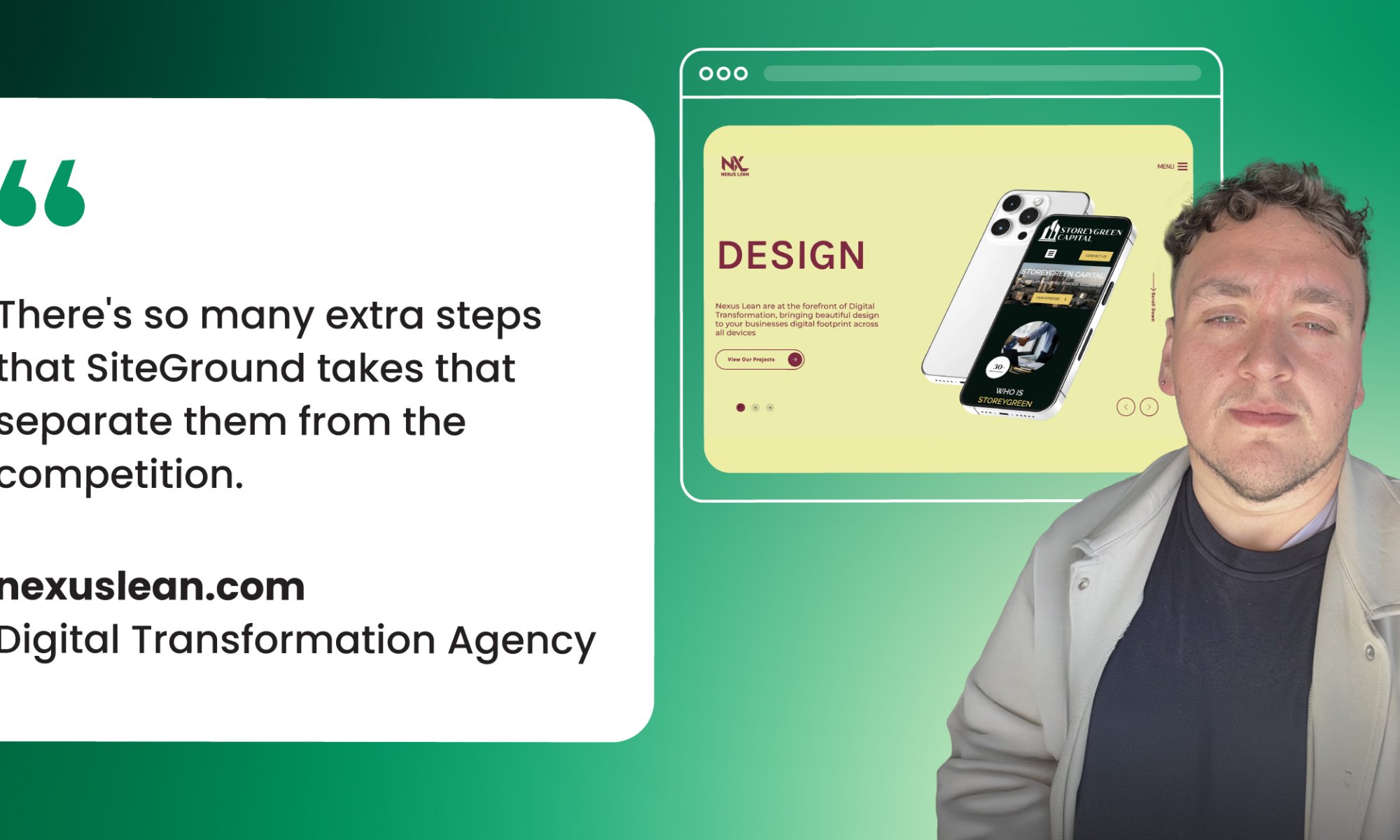
Quote from Nexus Lean Digital Transformation Agency stating "There's so many extra steps that SiteGround takes that separate them from the competition" alongside a browser mockup display

Running a web agency on referrals alone sounds perfect, right? No ad spend eating into your business margins. Clients who trust you and who you actually know. Growth that feels organic and sustainable.

But here is the thing: referral-based growth is fragile. One site goes down during a client’s critical moment, and suddenly your reputation takes the hit. Your setup that worked fine for five clients suddenly struggles with fifteen. Two or three failures, and the referrals stop coming. 

For Tyler Voase and his consultancy Nexus Lean, these stakes carried extra weight. His clients weren’t typical agency customers—they were people from disadvantaged backgrounds rebuilding their lives through entrepreneurship. When a website goes down for them, it’s not just lost revenue. It’s a setback that can derail everything they’re working towards.

The Hosting Decision That Makes or Breaks Referrals

Tyler’s portfolio grew entirely through word-of-mouth. Zero paid advertising. Every new client came because an existing client’s business actually worked.

“I’ve never run any paid ads. It’s all been organic. I love to engage and build—that’s the fun part for me.”

That model only scales when your hosting partner can keep up with your growth. 

SiteGround’s reliability made it possible for Tyler to take on clients who need education and hands-on support—the kind of work that requires trust—without worrying that technical failures would undermine everything.

“A good host could be the difference between somebody paying you money and not paying you money.”

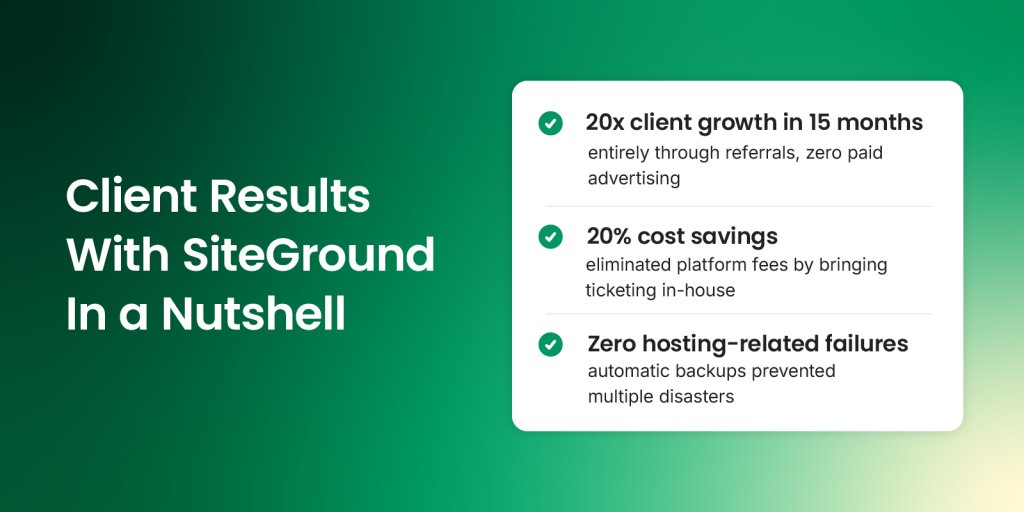
In 15 months, Tyler scaled from only 2 clients to 39 active websites—every single one through word-of-mouth. That kind of growth only works when your technical foundation holds. This is how reliable WordPress hosting became the difference between managing chaos and confidently scaling a mission that matters.

Three key results displayed with checkmarks: 20x client growth in 15 months through referrals without paid advertising, 20% cost savings from eliminating platform fees by bringing ticketing in-house, and zero hosting-related failures due to automatic backups preventing multiple disasters

From Personal Experience to Purpose

Tyler’s background wasn’t typical for an agency owner. Growing up in a challenging household gave him a different perspective on what people need when they’re trying to rebuild.

Sales became his strength. Before working for himself, Tyler spent years in sales roles, developing skills that would later drive his consulting work. When he finally started his agency, he didn’t have much—but he knew he wanted to build something that mattered.

His focus on helping disadvantaged communities happened organically. The early days were lean. Working with clients who couldn’t afford mistakes, learning web development as he went, running a business on tight margins—one hosting failure could mean someone giving up on their fresh start entirely.

“When I first started, I had this idea of an agency. I’ll find clients who are going to pay me thousands and thousands. But that doesn’t scratch the itch I have. I fell into a niche of people who needed the help rather than wanted the help.”

The Roadblocks That Stop Most Agencies Cold

If you’re running an agency—especially if you’re learning as you go—these challenges might sound familiar:

  • You’re not a developer, but you’re expected to solve technical problems. Tyler wasn’t a coder. He was a business guy who learned websites out of necessity. Managing 30+ client sites without a technical background? That requires tools that actually make sense, not ones that demand a computer science degree.
  • Support that wastes your time is support you can’t afford. When you’re juggling multiple client sites, waiting hours for help isn’t just frustrating—it’s losing you money.

“With other hosting companies, if you need help with something, they make it so difficult to just get something quick.” 

Recognize that frustration?

  • Every decision feels high-stakes when you’re running lean. When Tyler’s hosting renewal with his previous provider came up, he was at a crossroads many agency owners face: Do you cut corners to save money, or do you invest in reliability your clients depend on? For Tyler, cutting corners on hosting meant cutting corners on his clients’ success.
  • Your clients can’t afford your technical failures. Whether you’re working with startups, small businesses, or people rebuilding their lives, downtime isn’t just inconvenient—it’s revenue lost and trust broken.

SiteGround: The Safety Net That Never Failed

When you’re managing multiple client sites, your hosting needs to work as hard as you do. Tyler found that in SiteGround.

Tools That Don’t Require a Manual

If you’ve ever struggled with cPanel, you’ll appreciate what Tyler discovered in Site Tools. For someone managing 30+ websites without a technical background, the difference was immediate.

“It’s really nice being able to look at analytics all within the Site Tools section. Even if you’ve got 30 websites, you can go between them really easily and just go through the traffic. The built-in metrics and analytics—that’s super helpful.”

The best part? His clients could navigate it too. No more hand-holding through basic tasks.

Backups That Save Entire Projects

Here’s a scenario every agency owner dreads: You update a plugin, and suddenly half the site’s functionality disappears. Now what?

For Tyler, this wasn’t hypothetical.

“I’ve made a change to plugins, and suddenly half the functionality is completely gone. I hadn’t made any backups. But then I realized—SiteGround has regular backups made automatically.”

This automatic daily backup service has saved Tyler from recreating entire projects multiple times. When you’re learning on the job with clients who can’t afford mistakes, that’s not just convenient—it’s business-saving.

“There’s been times where you guys have completely saved me having to recreate like seven pages of a website because of my own mistake. Little things like that—the security features, the Optimizer that SiteGround puts on all their websites, the WebP converter for images. There’s so many extra steps that SiteGround takes that separate them from the competition.”

Support That Actually Supports

You know what’s better than support that solves your problem? Support that shows you how to solve it yourself next time.

When Tyler hit an SSL issue he couldn’t figure out, SiteGround’s approach surprised him:

“The guy was just like, ‘Yeah, give me two minutes.’ Not only did he fix it for me, he also taught me how to fix it in the future. That’s when someone goes above and beyond.”

This approach mattered enormously to Tyler and it wasn’t just about hosting.

“There isn’t another service provider that I pay for—there isn’t a better company than SiteGround that I’ve used.”

When Your Hosting Matches Your Ambition

When your hosting infrastructure works, you stop firefighting and start building. Tyler’s journey shows what you can achieve when technical failures stop holding you back. 

His client results tell the story: One clinic increased revenue by 268%, collected over 133 five-star reviews in months, and now appears in ChatGPT search results—not just Google—attracting higher-value clients who find them through AI-powered search. Another eliminated nearly £5,000 in platform fees by bringing ticketing in-house, sold 1,600+ tickets generating £45,000 in revenue, and landed a partnership with Nike.

“That Nike partnership—that’s probably the biggest work I’ve done. We built the booking system, the email capture, everything in-house.”

These aren’t outliers. They’re what happens when an agency can focus on client success instead of technical problems.

3 Lessons From Tyler’s Journey

Tyler shares what he’s learned building a business that matters:

1. Admit What You Don’t Know

Early on, Tyler did what a lot of new business owners do—he pretended he had all the answers. Clients would call asking if he could deliver something, and he’d immediately say yes without knowing if it was possible. The result? He’d end up looking foolish when he couldn’t deliver.

“Don’t be embarrassed to admit you don’t know things. At the very start, clients would ask, ‘Can we do this?’ And I’d just say, ‘Yeah, of course I can’—without actually knowing if I could.”

His advice now: abandon the notion that you know everything. Start from scratch. If you have questions, ask.

2. Care About What You’re Doing

Tyler’s definition of success isn’t measured in revenue alone. He believes that if you only chase money and fall short of your financial goals, you’ll always feel unsuccessful. But if you genuinely want to help people—whether that’s through creative work, business growth, or transformation—helping even one person means you’ve done well.

“Be violently committed to what you’re doing. Care about what you’re doing. If you care, you will do well.”

That commitment shows. It’s what turns clients into advocates and builds the kind of reputation that brings referrals without advertising.

3. Choose Partners Who Support Your Mission

Tyler knows that choosing the wrong partners can sink a mission. You need people who understand what’s at stake—where quality isn’t negotiable and reliability matters more than a low price tag.

“SiteGround is the perfect middle ground. You’re not super expensive in the grand scheme of things, but the service, delivery, and quality are exceptional.”

Whether you’re serving clients rebuilding their lives, creative agencies launching campaigns, or startups racing to market—technical failures aren’t just inconveniences. They’re reputation risks that can stop referrals cold. That’s why choosing partners who understand the stakes matters. Tyler chose SiteGround—the partner who gets it.

When Your Agency Needs Infrastructure That Keeps Up

Tyler’s growth shows what becomes possible when you can stop worrying about whether your hosting will hold up and focus on the work that actually matters—whether that’s serving disadvantaged communities, scaling your creative agency, or building something that makes a difference.

The technical stuff should be the easy part. Your hosting should work so well you forget it’s there.

Ready to build something that matters? Join the businesses who’ve chosen SiteGround WordPress Hosting to handle the tech while they focus on changing lives—because when your hosting just works, you get to focus on what drives you.

A promotional image for SiteGround featuring three people working around a table, with text highlighting the benefits of saving time and scaling a WordPress agency. The text reads, "Ready to Save Hours of Work and Scale Your WordPress Agency? Trust SiteGround to deliver the solid foundation your agency deserves. Elevate your web management processes with a hosting service that ensures peace of mind for both you and your clients." A "GET STARTED" button and a 98% satisfaction rating bar graph are also included.

From 30K to 2.5 Million Monthly Sessions: The Forked Spoon’s Growth Story with SiteGround

SiteGround customer testimonial featuring The Forked Spoon food blogger, showing family photo with horse and dog alongside food blog website screenshot displaying recipe content, with quote praising reliable uptime and support

It’s similar to every small business story. You start out doing something you love. Maybe you’re selling products, offering services, or simply sharing your craft or expertise online or offline. But somewhere along the way, you ask yourself, “Could this be a real business? And if so, what more can I do to help it grow and thrive?”

That’s exactly where Jessica and Aaron Randhawa found themselves in 2016 with their food blog, The Forked Spoon.

The Turning Point Every Business Owner Faces

Jessica started her blog on the free Blogger platform back in 2011 as a simple way to share family travels. Her space gradually transformed into a collection of personal stories mixed with food recipes. She moved to Squarespace, and for years, it stayed that way – a hobby, something she did out of passion. She earned a bit from brand sponsorships, but nothing significant.

Then one day, a fellow blogger shared their monthly income figures. The numbers stunned Jessica. She turned to her husband Aaron and asked a question you might be asking yourself right now: “What would it take to turn this into a real business?”

Summary of client achievements with SiteGround showing growth from 30,000 to 2.5 million monthly sessions in 18 months, sustained 40% month-over-month growth for 18 consecutive months, immediate ad revenue monetization through premium networks, and zero downtime across 8 years

The Squarespace Bottleneck

In 2017, following that eye-opening conversation about successful blogging, Jessica and Aaron began to seriously evaluate their setup. Squarespace was holding them back in ways they hadn’t fully recognized.

“We decided to switch everything over to WordPress to focus more on SEO since Squarespace at the time wasn’t able to do much for SEO.” – Aaron Ranhawa

The problems were significant and multifaceted:

  • SEO capabilities were virtually nonexistent
  • Oversized images were killing performance
  • Limited monetization potential
  • Technical limitations prevented the kind of optimization they needed for serious traffic growth

“The site was slow. It was a hot mess. Our images were way too big and heavy, which Squarespace didn’t care about.” Aaron recalls.

Sound familiar?

The SiteGround Difference

In mid-2017, The Forked Spoon made the leap from Squarespace to WordPress hosting with SiteGround. By 2018, they were focusing heavily on SEO, optimizing existing content, improving site speed, and publishing consistently.

The results came faster than they expected.

“In 2018, after focusing on SEO and everything being on SiteGround and WordPress, we started seeing month-over-month growth of 40% starting from 30,000 visitors.” 

Within just one month, they qualified for Mediavine, an advertising network that required a minimum of 50,000 sessions at the time. They’d increased their traffic by nearly 70% in 30 days.

But that was just the beginning. By November 2019 – roughly two years after the migration – The Forked Spoon was attracting 2.5 million sessions per month. That’s an 80x increase from their starting point.

“I was like, why didn’t we do this sooner!? Imagine where we would be now!” Jessica says.

The results were in:

  • Within 30 days: 70% increase in traffic, qualifying for premium ad networks
  • Within 18 months: 2.5 million sessions per month
  • Growth rate: 40% month-over-month for 18 consecutive months
  • Overall result: An 80x traffic increase from their starting point
Google Analytics dashboard showing website traffic growth from 2019 to 2023 after switching to SiteGround hosting, displaying 43.7 million users, 44.4 million new users, 57 million sessions, and 43.94% bounce rate with upward trending visitor graph

A Migration That’s Worth It

Infrastructure That Grows With You

No business owner should have to worry about whether their website hosting can handle their success. 

The Forked Spoon started on a basic SiteGround hosting plan and scaled to cloud hosting as their traffic exploded. Simply because SiteGround’s infrastructure is built to grow with you.

“We love having you guys utilize Google’s cloud as a backbone, it just never goes down,” Aaron explains.

The Uptime Factor

Just like for any online presence, so in the food blogging world, downtime is a constant concern. Community forums regularly fill with complaints about outages, power failures, and networking issues. During those crises, The Forked Spoon stayed live.That’s not just convenience—that’s revenue you’re capturing while others are losing it.

“We’re in a lot of communities online for food bloggers, and we always hear, ‘Is anybody else down? Is this company down?’ And with SiteGround, we’ve never heard any excuses. You guys are always up,” Aaron shares.

Jessica and Aaron admit they deliberately kept quiet about their hosting provider for years, treating it as a competitive advantage in an industry where uptime directly impacts revenue during peak traffic moments.

“Uptime is a huge thing in food blogging, and we’ve just kind of kept you guys in our pocket, been quiet about it to keep it as a competitive advantage.” – Aaron Randhawa

Website Management Tools That Actually Work 

Managing the technical side of a high-traffic blog requires tools that make your work easier, not more complicated. This was SiteGround’s thought behind Site Tools – their custom-built website control panel replacing traditional cPanel. 

And Aaron found it did streamline his daily workflow.

“Site Tools is way better than cPanel. So much more intuitive. It’s got everything we’ve ever needed. I love the simplicity, and it’s easy to get to.” 

You need to be able to manage your site quickly, especially in critical situations, so you can get back to running your business. When something goes wrong—a plugin breaks, an update causes issues—you can restore from SiteGround’s automated daily backups in minutes, not hours.

“Having everything automatically backed up on your servers… I’ve had to roll back plugin updates or all of a sudden, something’s wrong with WordPress, and had to roll back a WordPress update–it’s really easy to do that with SiteGround’s Site Tools.”

Support That Doesn’t Make You Wait

For Jessica and Aaron, who manage everything from recipe development to website maintenance, knowing help is available around the clock just gives them this extra layer of peace of mind. When you’re running a business by yourself or with a small team, you can’t afford to wait hours for technical support.

“Another thing we really like is the 24/7 support. It doesn’t matter what time of the day it is, I’m always going to be able to talk to somebody. I don’t think I’ve ever had to wait more than two minutes to get a hold of somebody on chat.”- Aaron Randhawa

The Investment That Actually Pays Off

When they first considered making the switch to WordPress hosting with SiteGround, the investment in changing platforms and the cost of managed hosting services gave them pause. When you’re evaluating hosting costs, it’s easy to focus on the monthly price. But here’s the real question: What’s the cost of staying where you are?

For The Forked Spoon, the leap they took in 2017 wasn’t just about changing hosting providers. It was about removing the technical barriers standing between them and their business goals.

And the return became clear quickly. Within weeks, they qualified for premium ad networks. Within months, their traffic had multiplied. Within two years, they were running a highly profitable digital business.

Eight Years And Counting

Since 2017, The Forked Spoon has remained with SiteGround. In an industry where business owners constantly chase better deals or performance promises, that loyalty tells you something.

“We’ve had no issues or reason to switch,” Jessica says simply.

That’s eight years without a single reason to look elsewhere. No downtime during crucial traffic spikes. No scrambling to find support during emergencies. No wondering if their infrastructure could handle their next growth phase.

Your Next Chapter Starts With a Decision

From a personal blog documenting travels to a food publication with 2.5 million monthly sessions, The Forked Spoon’s story shows what’s possible when technical limitations are removed. When you can stop worrying about whether your site will stay up and focus on what you do best.

Ready to remove the technical barriers holding your business back? Join thousands of entrepreneurs who’ve chosen SiteGround to power their growth—from your early days, to your days of glory, we grow with you.

Call-to-action banner with headline "Ready to transform your digital presence?" encouraging entrepreneurs to join SiteGround, featuring photo of smiling woman in beanie working on laptop with growth chart visible on screen, and purple "Get Started" button