

For the past months, multiple teams across SiteGround — engineers, designers, product managers, QA specialists — have been tirelessly working toward a shared goal: the launch of our Ecommerce Platform. It started with a complete redesign of our Website Builder with a grid-based drag-and-drop editor that gives users full creative control over their site, and on top of it, they layered a full set of tools for online store building and management. Why? To let anyone go from zero to a working online store without plugins, third-party tools, or weeks of setup. On March 17, both went live.
True to our mission to help anyone, anywhere, manage a complete online presence with ease, we built both platforms entirely in-house, from scratch. But how did we make it happen? We asked the two main leads behind the development: Hristo Pandjarov, Product Innovation Director, and George Penkov, Engineering Director.
What was the single biggest bet we made with the Website Builder & Ecommerce Platform, the one decision that shaped everything else?

Hristo: Honestly, it was our decision not to compromise on quality and excellence, regardless of how much development that required.
In the early stages of planning and development, we explored using existing solutions, but we quickly realized that nothing available would meet our needs or deliver the architectural quality we required. So we started from scratch and built on the knowledge we’ve gathered over two decades of hosting websites at the scale and quality we’re known for.
What does ‘from zero to launching an online store in hours, not weeks’ actually require on the engineering side?

George: Having been in web development for 20+ years, it still amazes me how many setup steps are now engineered away: like getting an SSL certificate, setting up DNS records, installing a CMS, and many more. And that’s before you even think about content. Nowadays, even choosing a domain name is simplified with the power of AI. A couple of clicks and you have a fully set-up website. But on the engineering side, all the steps users used to do manually still need to happen.
To build this seamless experience, we built our Ecommerce Platform on top of SiteGround’s already optimized hosting infrastructure— the same one powering over 3 million domains worldwide.
So, we had the infrastructure in place, then it was all about the content. Underneath our simple Ecommerce Builder, where you choose a ready-made template and customize every element to your liking, sits a robust page-editing and rendering engine. We designed its persistence model to prioritize a mature desktop application feel with keyboard handling, undo/redo stacks, zero latency, and generative AI support. Imagine editing a Google Doc, but for your entire website – everything feels instant, you can undo any mistake, and AI is right there to help.
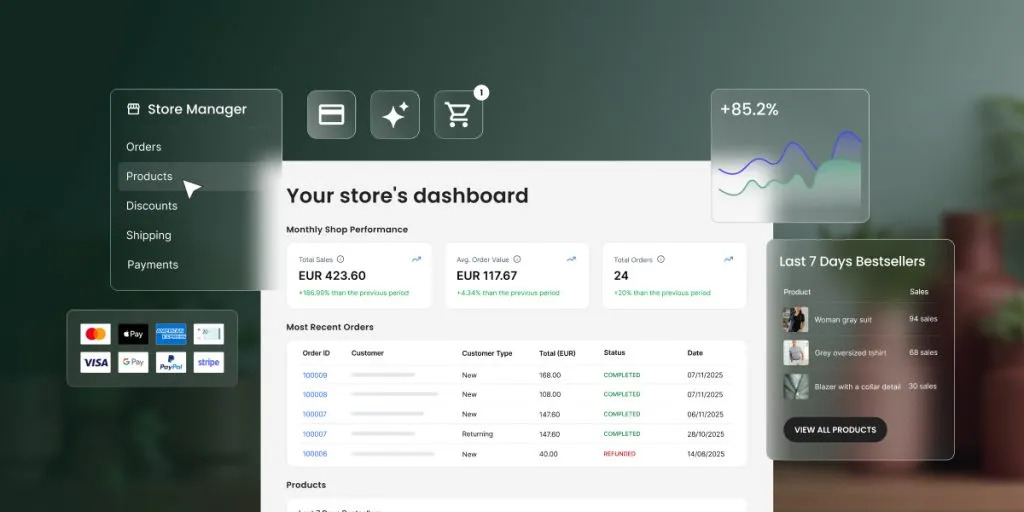
And finally, on top of all that, comes the e-commerce set of tools, including product management, order management, customer profiles, analytics, marketing, shipping, payments, taxes, and more. Implementing all of those features is a monumental engineering effort, and at the same time, the UX is just as critical — because if a user can’t navigate their dashboard, every store update becomes a headache. We are tackling this challenge with several layers of systems to help. Most of the focus is on the initial steps: a templating feature to give you a complete website in a click, a guided tour through your first steps, and we will soon add a very helpful AI assistant that can handle most tasks across the entire vertical with just a prompt.
What’s the hardest problem your team solved that users will never even notice?
Hristo: Our biggest challenge was to strike a balance between maintaining the platform’s simplicity and adding all the necessary functionalities. That’s something a lot of other platforms neglect as they ship countless features, and, in the end, website owners are stuck with an overly complicated interface.

George: The fluidity of actually using the Website Builder and E-commerce Platform. Users see a desktop app-like experience — instant previews when dragging the color picker, responsive undo and redo, and complex tasks like dragging, resizing, and arranging elements that feel as smooth as using a graphic design tool. That fluidity was essential, and it took serious engineering effort to achieve. We didn’t just need to make it work — we needed to make it feel effortless, so there’s zero frustration when building a site.
We have more features coming soon that will streamline online store management even further with a helpful AI assistant that can handle most tasks across the entire workflow with just a prompt.
With all the platforms for online store building, why did you decide to build one as well?
Hristo: For the past 20+ years, we’ve been striving to empower small businesses and entrepreneurs to succeed online. We saw that in the landscape of tools, many focus on a rich set of functionalities that overwhelm users, and instead of simplifying processes, they create more bottlenecks. So we focused our efforts on simplifying and streamlining each of the e-commerce business pillars: product management, payments, deliveries, and taxes. This way, we strive to make it easy for anyone without a technical background to build a fully functional website on their own. Our main goal was to support businesses by letting them focus on generating revenue rather than managing their websites.
Our mission is the success of our clients
This launch isn’t just about a new platform. It’s about enabling people all around the world to achieve more without dealing with the technical complexity. Because there are no bad business ideas — just ones that never make it past the idea stage.
If you want to be part of a team where every decision enables millions of users around the globe to create their successful online business, apply to our open positions.