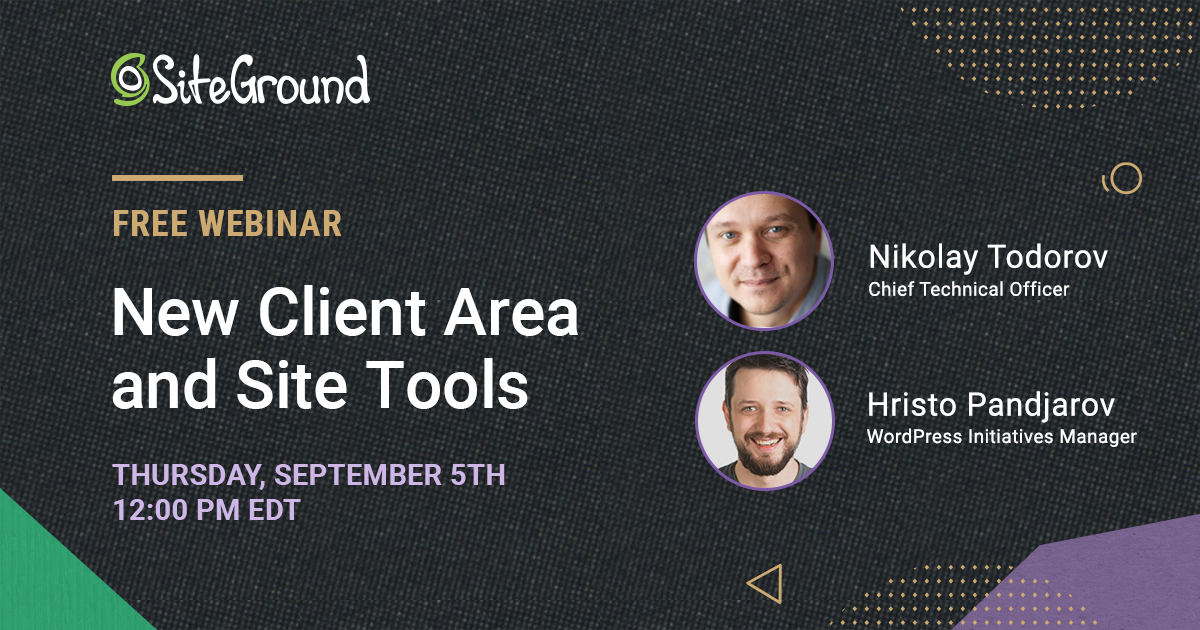
Last week we featured our new Client area and Site Tools in a webinar. We share the recording in this post together with the answers of all questions to which we could not reply during the live show.
A lot of users’ questions were answered by Nikolay and I during the live webinar. However, there were some that we couldn’t get to and we’ve added them below along with the answers.
Questions about addon domains:
Q: [Bruce Gandy:] What about existing Addon Domains?
A: Existing add-on domains will become separate independent sites in the new User Area. Each site will have its own sets of Site Tools. Once you log in to Site Tools with your username and password, you will be able to change between your sites from the Site dropdown in the header.
Q: How do I manage addon domains?
A: Existing add-on domains will become separate independent sites in the new User Area and each will have its own sets of Site Tools. You will not be able to create new addons, instead, you can easily create new sites in your hosting plan (Websites > New site).
Q: I have MANY ‘Addon Domain’.s. what will happen to them?
A: All your addons will be converted to sites. The advantage of having them independent from each other is the enhanced security and isolation.
Questions regarding the File Manager:
Q: [Sune:] Can we copy files from one website to another website as in old filemanager root?
A: As each site has its own set of Site Tools, including separate File Managers, copying files from one site to another within the File Manager is not possible at this point. You can use SSH or FTP client if you need to transfer files between sites.
Q: [Terri Z:] Also, will I still be able to see all account (multiple sites) files in ONE place, as I can in File Manager?
A: As each site is independent from the rest, you can only see the content of the site you’re currently managing in the File Manager.
Q: [Art B.:] Will we still be able to upload plugins using file manager?
A: Sure. You can upload plugins directly in the File Manager by dragging the plugin files and dropping them in the relevant folder of your installation in the File Manager.
Q: [Kieran:] With the new Collaborator/Client tools, will we be able to limit access to certain Site Tools like File Manager or Databases?
A: The default collaborator and client roles do not allow you to define access to specific tools, but we are working on offering the option to create your own custom roles and customize the access you grant. That option will be available together with the tools replacing the WHM.
Q: [Patrick:] Isolation Question: If a client of ours requires admin access and then installs a “File Manager plugin”… While in the past, most File Manager plugins allow full GoGeek account directory access to our “entire GoGeek Account”. Does the new isolation structures provide less concern for other client domain files? Or would some file manager plugins still be able to access the entire specific GoGeek acct?
A: With our new site-centric setup each site has its own set of Site Tools, including a File Manager, completely isolated from the rest of the sites. While you can easily switch between all of the sites you have access to, technically each of these sites is their own entity. If you give access to a particular site to your client, they will only have access to this one site with no risk of accessing files or sites they are not supposed to.
Q: [Loni:] Do we still get access to wordpress toolkit and file manager
A: Yes! You can find the File Manager in section “Site” and the tools currently located in the WordPress toolkit are found in section “WordPress > Install&Manage” (check the action menu next to the installation).
Q: [Random:] I often used File Manager to clean .staging Backup or Removed files so my Node usage would lower sooner than later.. How will I do this now that File Manager only shows public?
A: You can still remove files from the /home folder using SSH. However, note that inside the /home folder are generally saved system files that are needed for your website to operate normally.
Q: [Random:] Hi, you answered my .staging cleaning question… but it sounded like you didn’t understand the reason for needing to do this… It is because my storage often is close to max and I do many staging design tests, when I delete the staging copy the .staging Backup & Removed folder doesn’t clear for days and so I get Node max warnings.. so I manually clear those files.
A: Ok, in that case you have to do it via SSH.
Questions regarding backups:
Q: [Terri Z:] What is Missing? I’m specifically concerned about manual backup that can be downloaded (cPanel backup) and database tools, particularly phpMyAdmin
A: We offer backups (automatic daily backups and the option to create instant ones with a friendly restore tool), but we do not offer the cPanel backup. PhpMyAdmin is available in section Site > MySQL > PhpMyAdmin tab.
Q: [Mark M.:] Is it easy to find and download a backup?
A: You can find your backups in Site Tools > Security > Backups. Restoring a backup is even easier than before. Just select the backup you wish to restore from and select the item you wish to restore from the Action menu next to it. Downloading a backup is not possible at the moment.
Q: [Ingrid B.:] How long is this webinar? I need to know how much time to allow for it as I have potential diary conflicts to sort out! Also, is the backup facility negatively affected by this new development? It’s one of the things I paid for!
A: The webinar took roughly 1.5 hours and you can watch it here at a time when it’s convenient for you. We continue to offer the same backup service – automatic daily backups and option to create instant ones manually. Easy restore tool is also available. You can manage backups and restores from Security > Backups.
Questions regarding our Reseller program:
Q: [Sandra:] How will these changes affect reseller accounts?
A: We are migrating the existing reseller functionality and setups on the new platform with two changes – 1) we remove cPanel and replace it with our own Site Tools; 2) the removal of the credit system – this change is not related to the new interfaces’ business logic, but coincides in timing with the switch. Resellers won’t be able to purchase new credits after they get switched to the new interfaces. Yet, existing resellers will be able to use their outstanding credits same way as until now – for purchases of StartUp plans and renewals of those. Once these credits are over, you will get fixed discounts on purchases and renewals of StartUp plans.
Q: [Vincent P.:] Will this affect the Reseller administration panel from which we could instantly login into cPanel or WHM?
A: Instead of logging into cPanel (and WHM) you will now be logging into our Site Tools via a single login from your Client area. As an added convenience you will be able to switch between your sites from the Site Tools themselves.
Q: [Kyle:] Will the discounted rates for resellers for startup accounts remain discounted at $3.95/month when they renew or will the price increase?
A: Yes, resellers will be able to buy and renew StartUp plans at a discounted price (3.95/mo in USD prepaid annually). The renewal price is the same as the initial price for resellers.
Q: [Emily:] Having just moved a bunch of our client websites to SiteGround and priced according to the credit structure we’re really worried about the price going up. It’s a massive issue for a small business like ours. Would you consider keeping the credit pricing structure?
A: We decided to remove the credit system because we have seen that our “typical” reseller is not managing a large number of accounts and is not really taking advantage of the growing discount in the credit price. That combined with the fact that we have not made changes in the reseller pricing for the last 10 years (unlike what we did for standard clients) made us want to simplify the terms and unify prices as much as possible. The new reseller prices equal the initial (discounted) price for standard clients.
Questions regarding Joomla!:
Q: [Jen:] I use Joomla. Are all the changes mainly for WordPress users?
A: Joomla users will also be switched to the new interfaces. Features like Joomla installation and Joomla auto-updates will be available (you cannot see them in the demo as we were still working on them at the time when we launched the demo). The main change for Joomla users is that we plan on discontinuing the current Joomla staging tool due to low usage, however, we are working on an alternative solution that could accommodate most of the use cases.
Q: [Kathy A.:] Is Joomla still supported? I understand for demo he used WP. But I’m too old and unpaid volunteer to spend another 10 years learning a new OS at this time. Will I get any benefits from this rework on my Joomla sites?
A: Yes, we continue to fully support Joomla. However, we use the switch moment to discontinue tools that are not largely used such as the Joomla staging. We are working on a more generic solution as an alternative to it.
Q: [Becky R.:] Do we have to use Auto-Update tool for Joomla? Can we opt out?
A: Yes, you can opt-out from the autoupdates. Currently, you can do that from the Joomla Autoupdate manager in cPanel.
Q: [Mitch:] where are the Joomla Tools tab? How do we load a Joomla platform without Softaculous?
A: You can install a new Joomla from Site > App manager (select Joomla from the application drop down). Your active Joomla installations will be listed in the same section and you will be able to access the available Joomla tools from the action menu next to the installation.
Q: [Gwallter R.:] Wordpess is upfront – what about Joomla?
A: We continue to fully support Joomla.
Q: [Terri Z:] I’m on a roll lol. Will there be any account/site downtime?
A: We expect roughly 2 minutes of downtime upon switching the interfaces, but there will be no DNS and IP change so it will feel like a glitch. However, we ask you to avoid updating your sites during the migration period in order to facilitate the process.
Q: [Adriel B.:] Will IP addresses change with the migration?
A: No, there will be no IP change or DNS propagation.
Q: [Loni:] When does this go live for us?
A: We start with a small batch of clients shortly, but it will take a few months to switch all of the existing clients. You will get an email with a 7-day notice once any of your accounts get scheduled for a switch.
Q: [Jozef S.:] When do you plan to make a switch to this new interface?
A: New clients are already being activated on the new interfaces. We plan to start switching existing clients in the second half of September slowly.
Q: [John M.:] Are we going to receive a target date for the conversion to the new Client Area & Site Tools?
A: Yes, once any of your accounts get scheduled for the switch, we will send you an email 7 days before the actual change date.
Q: [Jonathan:] The migration starts in September – When do you expect to be finished with all migration?
A: We think it will take us a few months to switch all clients, but we will know how many exactly after we actually start migrating and do a few runs.
Q: [Tim:] Will my cloud account automatically transfer without any downtime to sites or email?
A: We will convert cloud accounts automatically and we do not expect downtime more than 2 minutes. As there will be no DNS and IP change it will feel more like a glitch.
Q: [Carolyn:] what if i sign up as a new customer now to build out a separate site with the new interface while waiting for my existing accounts migrate later this month. can they be merged later?
A: Of course, you can now sign up for a new hosting plan as a new client (you need to use a new email address), which will be created in the new Client area. Just one small detail – your existing accounts may not get scheduled for the switch this month. But, we’ll keep you posted when the switch option becomes available on demand so you can request it upfront if you wish.
Q: [Jackie T.:] Does the migration affect our mail box?
A: We will migrate automatically your emails and keep usernames and passwords, so your mail service should not be affected. The only difference will be that if you have email accounts on addon domains, you will see them listed in the Site Tools > Email section of the addon site, hence not all mail accounts will be listed in the same place as you may be used to.
Miscellaneous questions:
Q: [Irving B.:] Can we now store unlimited number of credit cards (one for each website / client) ?
A: You can store up to 3 credit cards as you like, but you cannot specify which card to be used for which website. Cards are still associated with the user and not with the specific plan or site and in case of automatic renewal of service, the primary card on file will be charged (if valid).
Q: [Jozef S.:] I have some issues with my website. Could it be because of you were making changes and transition to this new interface?
A: The switch to the new interfaces has not yet started so it has no impact on the status of your site. If you’re experiencing issues with your account, please log in to your User Area and contact our Technical Support.
Q: [Marge K.:] I see you have many requests for this webinar to be done again or at a different time. I also would like to attend at a different time as I have an appt. for more than 3 months scheduled at that time. Thank you. Marge
A: You can watch the webinar here or on Youtube at a time convenient for you. We want to make more webinars about the new interfaces, but they will probably be zooming on a smaller set of items and functionalities.
Q: [Mitch:] where did the softaculous function go?
A: We now offer an “App manager”, which is powered by Softaculous Remote and allows you to install new applications easily. You can find it in section Site>App Manager.
Q: [Matt:] Since you are not using cpanel anymore is there going to be a way to transfer (copy the etc & mail folder) clients emails from another cpanel to this new platform and keep users/passwords and all mail?
A: For cPanel accounts hosted on our platform we will automatically switch the emails and keep the users and passwords as set. For accounts migrating from other cPanel hosts – not yet, but we are working on a tool that will allow that.
Q: [Rubin B.:] I was interested to know if when I transfer ownership of a site, the Invoices, Support Tickets etc. linked to that site will be deleted from my account and moved to my client’s account?
A: No, you will still see in your Account the invoices and tickets associated with the website that were generated before the transfer. They will neither be deleted nor transferred to the new owner.
Q: [James:] Will we need separate ssh for each site?
A: Each site is created and managed separately and has its own SSH and FTP credentials.
Q: [Sabina M.:] I haven’t used it yet (was just about to…), but the staging of sites, will that still be available? And as easy to use as it is promised?
A: Creating a staging copy of your WordPress site is a one-click process, and deploying a staging copy to production is just as easy. You can test it yourself in WordPress -> Staging. If you are a Joomla user you will not be seeing the staging tool for now as we are discontinuing the current tool and working on a more generic alternative.
Q: [Terri Z:] About the collaborator role. Love it – 2FA available to both of us when we don’t both need to use the same login to access their account. But am I correct in understanding that I (developer) can only be added as a collaborator by a client who has a GrowBig account? Lots of my clients have only one site (Startup) and are not techie – which is why they have me, and why it makes sense to me that they could also add me as a collaborator.
A: Indeed, collaborators can be added to websites hosted on GrowBig or higher plans. We consider the StartUp plan a service for DIY sites.
Q: [Mika:] Sounds like for new people is there a behind the sites area so we can manage multiple settings like pho versions etc in mass?
A: We aim to offer a bulk management of sites some time next year, although centralized PHP version control for all sites is still debatable. In this first launch phase of the new interfaces we aimed at offering the tools that were already available with some sweet, but basic additions, which will be upgraded to more powerful tools in the upcoming months.
Q: [Susan:] I am a bit new to all of this. My website isn’t showing up in search engines even though I have put tags on pages. Is this something through my website or something through the SiteGround services or something else?
A: Whether your site gets crawled by search engines and gets listed in searches is not related to the host server itself. You may want to submit it manually if you haven’t done that yet.
Q: [Mary:] Do you have instructions for updating content on WordPress? For example, rotating pictures or menu titles. Thanks!
A: We have a tutorial that may be helpful: https://www.siteground.com/tutorials/wordpress/
Q: [Mark:] Can you still clone a website like in Softaculous?
A: It’s work in progress, but we want to make this service available.
Q: [Eric H.:] Will the Move wordpress, move my site from my staging.xxxx site to my xxxx site for me, and take care of everything?
A: The Move functionality will move your WordPress site and will make the appropriate changes in the WordPress configuration, so you don’t have to do anything else yourself. However, if you want to deploy a staging site, we recommend that you use the Staging tool where you can safely create and deploy staging copies. Every time you deploy a Staging copy from the Staging tool, you also have a backup automatically created for you, so you can easily revert to the previous version of your website if something goes wrong.
Q: [Corinne:] how can I install a wordpress on a subdomain?
A: You can go to Site Tools > WordPress > Install & Manage. Select WordPress or WordPress with Woo, and select the domain or subdomain you wish to install WordPress to from the Domain dropdown. There you will find all existing domains and subdomains in your site. If you want to create a new subdomain first, go to Subdomains.
Q: [Tim:] Will traffic be exportable as a PDF? maybe add our own logo too?
A: This feature is not available at the moment.
Q: [Heidi:] Is there a way to download stats and have them on a pdf file or something ?
A: Unfortunately, not at the moment.
Q: [Jon:] when will we have the server details for email accounts?
A: You can find the email configuration details Site Tools > Email > Accounts. You can find it in the create form, as well as in the Actions menu next to each email account. The Autoconfig files are also available in the Actions menu.
Q: [Michael S.:] How do I migrate email account(s) from another host?
A: Here’s some detailed information on how you can transfer your email accounts and content over to us – https://www.siteground.com/kb/transfer-emails-imap-between-servers
/
Q: [Susanna:] If we create a site and then transfer it to a new owner, will we automatically receive the affiliate credit for that new owner’s site?
A: At the moment you need to contact Affiliate support for that, but we are working on automating that.
Q: [Katy:] If my websites is broken will siteground fix it back to the original prior to migration
A: We don’t expect any site issues as a result of the migration. After the switch sites will be verified manually to make sure the scripts have properly converted the data such as addons to sites and related services.
Q: [Sean H.:] How can I move both a website AND all its email accounts with the new interface? Will it be easier than with cPanel?
A: If you mean moving from another host, migration process will be different if you do it yourself. But you can always rely on our support team to do it for you and if you are transferring a WordPress site you can use our Migrator plugin.
Q: [Kieran:] We have a GoGeek account with Add On domains, currently the SiteScanner tool scanned the main domain associated with the GoGeek account. Will the Site Scanner now scan each website under the GoGeek account individually?
A: The Site Scanner will continue to be associated with your main domain and will not scan all sites under the account.
Q: [Steven W:] One of the features I have loved about Siteground is the transfer of cPanel accounts from a client’s existing web host to Siteground, that includes email accounts and email messages. Apparently with the UI that won’t be possible. Is there a plan to provide for moving email accounts and messages from cPanel to the new UI?
A: We are working on scripts that will allow you to migrate cPanel accounts from other hosts easily, but I don’t have a solid ETA for that.
Q: [Jim:] What about Moodle and other plug-ins. We that have an automatic install?
A: You can install new Moodle installations and manage your existing ones from Site Tools > Site > App Manager.
Q: [Don M.:] Will you be able to use program like InfiniteWP to control website from one location
A: Yes, there is no change in this aspect.
Q: [Greg:] As for quarterly billling methods, did you add Paypal and American Express?
A: We do accept American Express for some regions and PayPal payments, but you may need to contact Customer service for assistance if you wish to pay with PayPal.
Q: [Stacey:] Will websites be faster now that cpanel is removed?
A: Replacing cPanel with our Site Tools will definitely make our platform lighter and vacate server resources that will also make it faster, which we also expect to have a positive impact on the speed of our clients sites.
Q: [James S.:] What is this new interface called – cpanel was easy to state … 🙂
A: We don’t really have a name other than ‘Site Tools’ 🙂
Q: [Christophe C.:] On the new interface, I saw when installing Let’s Encrypt SSL certificate, that the free version was for 3 month… Is that a new condition ? For the moment we don’t have any end date for those certificates…
A: Let’s Encrypt certificates have always been issued for 3 months as per the issuer’s protocols and automatically renewed at least a couple of weeks prior to their expiration date to ensure an uninterrupted encryption. This hasn’t changed, we’re just showing more information in the new interface.
Q: [Ben H.:] How is the domain folder isolation done on the backend? Vhosts?
A: Site isolation is done using the chroot technology, where every process runs within an isolated environment.
Q: [Stacey:] Will there ever be a promo/sale where we can upgrade our current hosting plan and extend it another 3 years without paying the higher price?
A: I am not sure to which price you refer, but we have a promotion ending today that might be interesting. Next one will most likely be the Black Friday promo, which we have not planned yet so I cannot say if it will affect upgrades.
Q: [John M.:] Will MySQL user accounts still have very short names?
A: MySQL users and databases are both created with random automatically-generated names, but you can label them any way you like afterwards.
Q: [RJ:] Will the new platform provide an equivalent to Softaculous for installing other applications besides WP/Joomla?
A: You can use the App Manager in Site Tools to install the latest version of the most popular and stable applications.
Q: [James:] separate ssh for each site?
A: Each site is created and managed separately and has its own SSH and FTP credentials.
Q: [Sueli:] What about AFFILIATE programs? I don’t see the SWITCH TO AFFILIATE AREA in the new Client Demo.
A: Affiliates will also take advantage of the new interfaces. There will be a menu item “Affiliates” with subsections for reports, banners, and more. For the sake of simplicity, we did not feature them in the demo.
Q: [Markz:] Any plans for a staging option for Magento?
A: We are working on a concept for a basic CMS-agnostic staging tool, which should cover Magento as well. No ETA for that yet.
Q: [Sune:] Can we have the websites listed as a list with few lines per website? With MANY websites the overview can be difficult…
A: Yes, point taken, we will work on that. Thank you for the feedback 🙂
Q: [Anyilloyd:] Can i install python Django in my Gogeek account? if yes, how do i do it.
A: No, you cannot do that on GoGeek plan.
Q: [Ben H.:] What if we need to send test emails as a client to test things like email security (SPF/DKIM/DMARC)?
A: If you mean if you can test this during the Client Area and Site Tools beta, I am afraid this is not possible. Still the SPF and DKIM setups haven’t undergone any major changes so both work as expected. As to the DMARC, this isn’t supported with our current platform, but it is in the Site Tools roadmap.
Q: [Becky R.:] Can we test a separate version of PHP in a staging area? We used to control this by adjusting the PHP version per folder, which we can’t do anymore.
A: Yes, you can still do this. The difference is that with the new Site Tools you do not choose a folder, but a domain or subdomain. You should choose the subdomain that represents the staging copy you want to change the PHP version for.
Q: [James:] This question may already have been asked but have you got a local client tool that can connect to the the website? Or is everything done in the cloud?
A: We do not have such tooling, yet. Everything you do should be done either via Site Tools or SSH.
Q: [Eric O.:] I’m used to changing PHP settings for my sites in a Plesk control panel, with 25 or so options that I could just enter new specifications like memory and time settings. cPanel forced us to actually enter the PHP command and the new variable. Does the new tool panel address this?
A: I am afraid, currently not, but we will consider the suggestion. The new interface provides you a list and values for all PHP variables and you have to find the one you indent to change. Search functionality is a work in progress.
Q: [Helen B.:] I use Sucuri.net to protect my websites. Because I have several add-on websites I just need one sucuri account to protect all my websites. Now that add-ons are isolated, will they all still be protected by the single sucuri account?
A: I need some more clarifications on this one. How do you setup your sites with Sucuri.net, so that they are monitored by a single Sucuri account?
Q: [Angela B.:] With blocked IPs, I have been confused. Should I wipe out all the past blocked IPs and start over? I’m afraid I’ve blocked people that shouldn’t be blocked from the old system.
A: The blocked IPs that you already have will be preserved after the migration, but won’t be listed the Site Tools interface. The way cPanel use to block IPs is to add “deny from” rules inside the .htaccess file. With Site Tools we do it a bit differently, by adding it to the Nginx configuration directly. You can still use the .htaccess file to block IPs, but you should do it by manually editing it and records added to it won’t be listed on the Blocked IPs page in Site Tools.
Q: [Ben H.:] How will the port of our current sites to isolated directories work?
A: The isolation of the websites is done via the chroot Unix technology. The difference compared to the old platform is that, before your main site + addon site were isolated in the same virtual environment, because they were running under the same linux user, while with the Site Tools – every single website is isolated in its own environment.
Q: [Eric O.:] Is this system different from a virtual private server?
A: Yes, it is different. As you may know, for a long time we have stopped using standard virtual servers with hypervisors. Since then we have been using our own implementation of Linux Containers. Every server that hosts your websites is a linux container. But if you ask for the site itself – every site’s process runs within its own isolated environment, which is powered by a minimal operating system (based on the chroot Unix technology ). This minimal operating system is isolated from the host OS.
Q: [Stacey:] I’m wondering where to find the FTP Sessions in the new control panel? Often I get the error “too many connections” on FTP and have to manually clear the sessions, but this feature I cannot find anywhere.
A: Unfortunately, this is one of the tools with a really low usage that we decided to drop.
Q: [Paul s.:] i joined siteground and cloudflare 2 days ago, is the security good enough that i can do away with wordfence on my wordpress..
A: It’s always good to have another security layer on top of all the things we do. Wordfence has a lot of nice features and tracks a lot of WordPress-specific processes so we believe it’s good to have it. Yet, if you cannot afford to pay for it, the essential server and application security is covered by us so you do not have to worry, as long as you manage carefully your login credentials and the access to your account.
Q: [Susanna:] I don’t see how this can possibly be an improvement for people who manage multiple sites. Is there any way to keep cpanel?
A: We plan on discontinuing the usage of cPanel after we switch all existing clients to the new interfaces. The main source of improvement comes from the added new features that allow better access control to each site in your account. The changes will also allow us to add more conveniences and tools for bulk management faster.
Q: [Sean H.:] How can we move both website AND email between to GoGeek accounts? Will it be easier than with cPanel. I have 2 GoGeeks and would like to move all sites and email into one. Shall I wait until the upgrade?
A: There is no new shortcut for this use case.
[subscribe_cta]